
(949) 954-8181 Free Case Review No recovery, no fee.
(949) 954-8181 Free Case Review No recovery, no fee.

Family leave retaliation is defined as any adverse action an employer takes against an employee specifically because that employee requested or used protected leave under California or federal law. Tustin employees face this violation more often than most realize, and it is fully illegal under the California Family Rights Act (CFRA), the federal Family and Medical Leave Act (FMLA), and the Fair Employment and Housing Act (FEHA). If your employer demoted you, cut your hours, or fired you after you took protected leave, that is textbook retaliation. The California Civil Rights Department (CRD) enforces these protections, and Optimum Employment Lawyers has built its practice around holding employers accountable for exactly this kind of misconduct.
Family leave retaliation in Tustin covers a wider range of employer conduct than most employees expect. The law defines retaliation as any materially adverse action motivated substantially by the fact that you took or requested protected leave. That definition is deliberately broad, and it protects you from punishment in many forms.
The most obvious examples include:
Subtle retaliation is just as illegal, and it is often harder to spot. Retaliation includes schedule changes designed to inconvenience you, exclusion from team meetings you previously attended, increased scrutiny of your work, and hostile treatment from supervisors. These actions deter employees from exercising their rights, which is exactly what the law prohibits.
Consider a realistic Tustin scenario: a warehouse worker takes 10 weeks of CFRA leave to care for a parent with a serious health condition. Upon returning, her manager reassigns her to a less desirable shift, removes her from a project she led, and begins documenting minor errors that were never flagged before. None of those actions involve a formal termination notice. All of them constitute retaliation.

Pro Tip: Save every email, text, and performance review from the 90 days before and after your leave. That paper trail is often the most persuasive evidence in a retaliation case.
Retaliation is legally distinct from interference. Interference occurs when an employer denies or discourages leave before or during the leave period. Retaliation occurs after the leave, as punishment for having used it. Both are illegal, but they require different legal arguments. Understanding which one applies to your situation shapes how your claim is built.
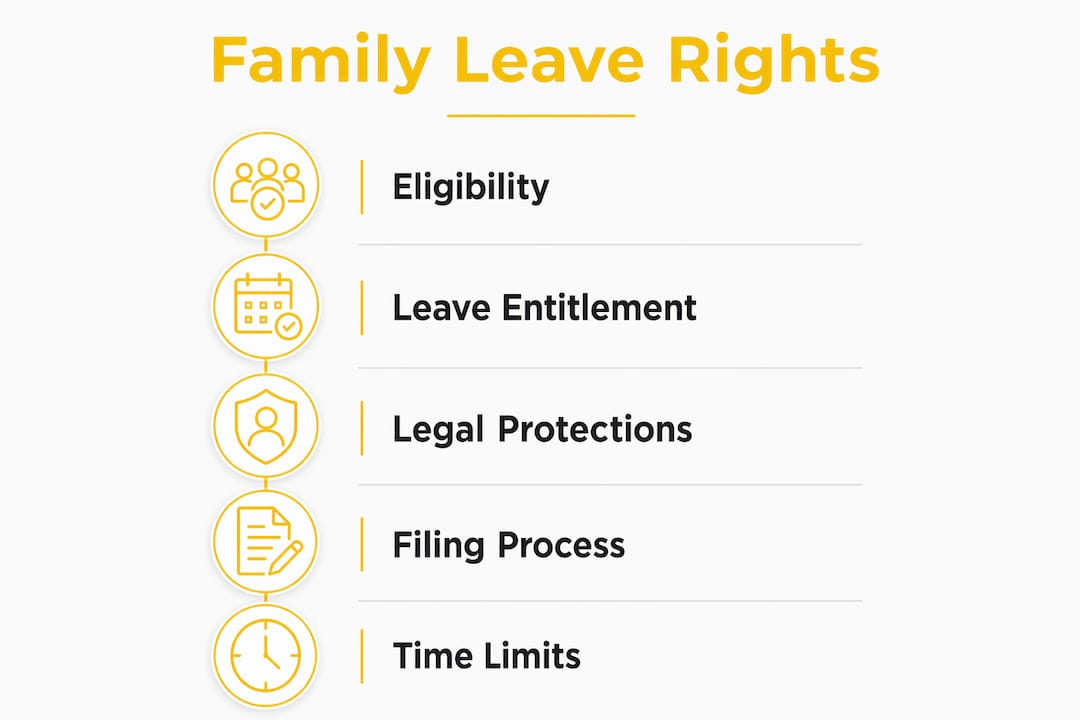
California law provides multiple overlapping protections against protected leave violations, and knowing which law applies to your situation determines your rights and remedies.
| Law | Coverage | Leave Entitlement |
|---|---|---|
| CFRA | Employers with 5+ employees | Up to 12 weeks per year |
| FMLA | Employers with 50+ employees | Up to 12 weeks per year |
| Pregnancy Disability Leave (PDL) | Employers with 5+ employees | Up to 4 months |
| SB 590 (effective January 1, 2026) | Employers with 5+ employees | Leave to care for a designated person |
Under the CFRA, eligible employees working for employers with 5 or more employees are entitled to up to 12 weeks of protected leave per year. That threshold is significantly lower than the federal FMLA threshold of 50 employees, meaning far more Tustin workers qualify under state law. Pregnancy Disability Leave adds up to 4 months of separate, additional leave for pregnancy-related conditions.
SB 590, effective January 1, 2026, expanded California’s paid family leave program to cover care for a “designated person,” a category that previously had no protection. A designated person is someone you identify who has a close relationship with you, even if they are not a biological relative. Interference and retaliation protections apply equally to this new category of leave.
Pro Tip: If your employer has 5 or more employees, California law almost certainly covers you. Do not assume you are unprotected just because your workplace is small.
The CFRA and FMLA run concurrently when both apply, meaning you do not get 24 weeks by combining them. However, PDL runs separately from CFRA, so a pregnant employee in Tustin could be entitled to more than 6 months of total protected leave. Knowing how these laws stack gives you a clearer picture of what your employer is legally required to provide. You can learn more about pregnancy leave protections under California law and how they interact with CFRA rights.
Proving retaliation requires establishing three legal elements. Each one matters, and missing any one of them weakens your claim significantly.
Protected activity. You must show you requested, took, or were in the process of taking leave protected by CFRA, FMLA, PDL, or SB 590. Notifying your employer of a need for leave qualifies, even if the leave was never formally approved.
Adverse employment action. You must show your employer took a negative action against you. Termination is the clearest example, but courts also recognize demotions, pay reductions, schedule changes, and negative performance reviews as qualifying adverse actions.
Causal connection. You must show the adverse action happened because of your leave. Timing and documentation are the most critical evidence here. An employer who fires you two weeks after you return from leave has a difficult time arguing the timing is coincidental.
Once you establish these three elements, the burden shifts to your employer to produce a legitimate, non-retaliatory reason for the adverse action. This is where documentation becomes decisive. Employers who cannot point to pre-leave performance issues, written warnings, or documented misconduct struggle to defend their actions. Lack of pre-leave documentation frequently undermines employer defenses in California courts.
Practical evidence to collect includes:
Proving motive is the hardest part of any retaliation case. The FMLA and CFRA both address common disability and leave issues that arise in these disputes, and courts consistently find that close timing between leave and adverse action is strong circumstantial evidence of retaliation.
Filing a complaint is a concrete, step-by-step process with firm deadlines. Missing those deadlines forfeits your rights, so acting quickly matters.
California employees have 3 years to file a retaliation complaint under FEHA with the California Civil Rights Department. That clock starts from the date of the retaliatory act, not the date your leave ended. Three years sounds like a long time, but evidence fades and witnesses move on. Filing sooner produces better outcomes.
The filing process works as follows:
| Filing Option | Timeline | Outcome |
|---|---|---|
| CRD complaint (FEHA) | Within 3 years of retaliation | Agency investigation or Right-to-Sue |
| Right-to-Sue notice | Request at any time via CCRS | 1 year to file civil lawsuit |
| Civil lawsuit | After Right-to-Sue notice | Court judgment and damages |
Tustin employees can also contact Optimum Employment Lawyers directly for a consultation before filing. An attorney can assess whether your facts support a retaliation claim, identify whether interference claims also apply, and advise on the strongest path forward. You can review your options with a Tustin employment attorney who focuses exclusively on employee-side cases.
Many Tustin employees confuse retaliation with interference, and that confusion can cost them a valid legal claim. Interference is when an employer denies or pressures you not to take leave. Retaliation is adverse action taken because you already used your leave rights. The timing is the clearest dividing line.
Examples that illustrate the difference:
The practical importance of this distinction is significant. Interference and retaliation are separate legal claims with different elements. Both claims may be pursued simultaneously because they address different employer conduct. Filing both when the facts support them maximizes your legal remedies.
SB 590’s 2026 expansion adds another layer. Employers who deny leave for a designated person or retaliate against an employee for taking that leave now face the same legal exposure as they would for traditional family leave violations. If your employer was unaware of this change and acted accordingly, that does not excuse the conduct. California law holds employers to the standard of knowing what the law requires.
Identifying the correct claim also affects which damages you can recover. Retaliation claims under FEHA allow for emotional distress damages, punitive damages in egregious cases, and attorney’s fees. Getting the legal theory right from the start shapes the entire case strategy. You can read more about retaliation rights in California and how overlapping claims are handled.
Family leave retaliation in Tustin is illegal under CFRA, FMLA, and FEHA, and California employees have three years to file a complaint with the California Civil Rights Department.
| Point | Details |
|---|---|
| Retaliation is broadly defined | Adverse actions include termination, demotion, schedule changes, and negative reviews tied to protected leave. |
| Multiple laws apply | CFRA, FMLA, PDL, and SB 590 each provide overlapping protections for Tustin employees. |
| Three-year filing deadline | FEHA gives you three years from the retaliatory act to file with the California Civil Rights Department. |
| Documentation is decisive | Pre-leave and post-leave records, emails, and performance reviews establish the causal link courts require. |
| Retaliation and interference are separate claims | Both can be filed simultaneously when the facts support each, maximizing your legal remedies. |
Optimum Employment Lawyers focuses exclusively on employee-side cases throughout California, including Tustin workers who have been punished for taking protected family or medical leave. The firm has secured significant results for employees, including a $2.2 million settlement in a class action case involving missed meal breaks. That same commitment to aggressive, personalized representation applies to every family leave retaliation case the firm handles. If you were demoted, fired, or treated differently after returning from CFRA or FMLA leave, you have legal options. Contact Optimum Employment Lawyers through the legal consultation page to discuss your situation with an attorney who understands California employment law and the specific challenges Tustin employees face.
Family leave retaliation is any adverse employment action an employer takes because an employee requested or used protected leave under CFRA, FMLA, or related California laws. It includes termination, demotion, pay cuts, and schedule changes tied to the leave.
California employees have three years from the date of the retaliatory act to file a complaint under FEHA with the California Civil Rights Department. Requesting a Right-to-Sue notice through the CCRS portal then gives you one year to file a civil lawsuit.
Yes. SB 590, effective january 1, 2026, expanded protected leave to cover care for a designated person, and it extended full interference and retaliation protections to that new leave category.
Interference occurs when an employer denies or discourages leave before or during the leave period. Retaliation occurs after the leave, as punishment for having used protected leave rights. Both are illegal, and both claims can be filed at the same time.
Yes. Retaliation covers any materially adverse action, including demotions, pay reductions, negative performance reviews, and schedule changes. You do not need to be terminated to have a valid retaliation claim under California law.

© 2026 Optimum Employment Lawyers, PC
Legal Disclaimer | Privacy Policy
 Share
Share
