
(949) 954-8181 Free Case Review No recovery, no fee.
(949) 954-8181 Free Case Review No recovery, no fee.
Wage and hour retaliation is defined as any adverse action an employer takes against an employee for reporting unpaid wages, asserting pay rights, or filing a complaint under California labor laws. In Santa Ana, CA, this conduct is illegal under Labor Code § 98.6, which protects workers from termination, demotion, and other punishments for speaking up about pay violations. The California Department of Industrial Relations (DIR) enforces these protections, and penalties can reach $10,000 per violation per employee. If you work in Santa Ana and believe your employer punished you for reporting a wage dispute, you have real legal options.
Wage and hour retaliation occurs when an employer takes a negative action against you because you exercised a legal right related to your pay. California law defines “protected activity” broadly, and most workers are surprised by how wide that definition actually is.
Protected activities under Labor Code § 98.6 include:
Employers in Santa Ana often retaliate in ways that look routine on the surface. Common tactics include termination, demotion, reduction in hours, sudden negative performance reviews, schedule changes designed to cause hardship, and creating a hostile work environment. Courts recognize that masking retaliation as a performance issue is a standard employer strategy.
Verbal and informal complaints carry the same legal weight as formal filings. Any assertion of Labor Code rights is protected activity, not only written complaints submitted to a government agency. A Santa Ana warehouse worker who tells a floor manager “I was not paid for my overtime this week” has just engaged in a protected activity.

SB 497, effective in 2024, strengthened these protections significantly. Under SB 497, a rebuttable presumption of retaliation applies automatically if your employer takes an adverse action within 90 days of your protected activity. That presumption shifts the burden to your employer to prove the action was unrelated to your complaint.
Pro Tip: Write down the exact date, time, and content of every wage complaint you make, even informal ones. That record becomes your first line of evidence if retaliation follows.
Strong documentation is the foundation of every successful wage retaliation claim. Without it, your case depends on your word against your employer’s, and that is a difficult position to win from.
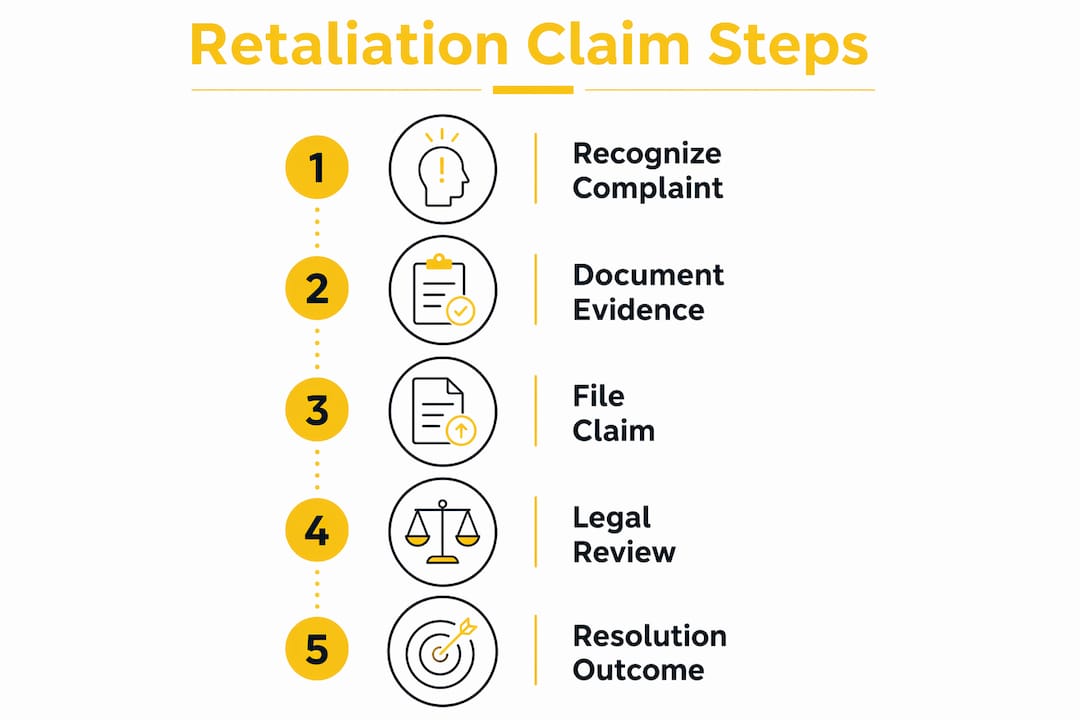
Follow these steps to build a solid record and file your claim:
Gather your pay evidence. Collect all pay stubs, time records, bank deposit records, and any written communication about your wages. Inconsistencies between your time records and your pay stubs are often the clearest proof of wage theft.
Start a contemporaneous log. A daily updated log of hours worked is more persuasive in hearings than vague recollections. Write down your start time, end time, breaks taken, and any supervisor instructions that affected your hours. Do this every single day.
Document the retaliation itself. Record every adverse action with dates, names, and exact words used. Save emails, texts, and voicemails. Note witnesses who were present.
File DLSE Form 1 for unpaid wages. This is the standard wage claim form filed with the Labor Commissioner’s office. You can file it at the Santa Ana DLSE office, which serves Orange County workers. Filing is free.
File a Retaliation Complaint (RCI-1). If you experienced retaliation, submit the RCI-1 form to the Labor Commissioner separately from your wage claim. Both claims can proceed at the same time.
Understand the employer response timeline. Employers have 10 calendar days to respond to a filed wage claim with the Labor Commissioner. If the claim is contested, the Commissioner schedules a hearing where both sides present evidence.
Know your filing deadlines. Civil court retaliation claims must be filed within three years. FEHA-related retaliation claims must be filed with the California Civil Rights Department within three years as well.
Pro Tip: After every verbal pay complaint, send a follow-up email to your supervisor or HR that summarizes what you said. This creates a written record that is very difficult for an employer to dispute later.
California law gives Santa Ana employees real financial remedies when retaliation is proven. The specific remedies depend on whether you file with the DLSE or pursue a civil court lawsuit.
The DLSE process focuses on economic losses. If you win through the Labor Commissioner, you can recover reinstatement to your job, back pay for wages lost due to retaliation, and restoration of lost benefits. The DLSE also awards the civil penalty of up to $10,000 per violation under Labor Code § 98.6, paid directly to you, separate from any other wage recovery.
Civil court expands what you can recover. In a lawsuit, you can pursue emotional distress damages, punitive damages when employer conduct was especially egregious, and attorney fees. Many employees regret filing only with the DLSE because civil court suits allow recovery of damages that the DLSE process cannot award.
| Remedy Type | Legal Basis | Who Receives It |
|---|---|---|
| Reinstatement and back pay | Labor Code § 98.6 | Employee |
| Civil penalty up to $10,000 | Labor Code § 98.6 | Employee |
| Waiting time penalties | Labor Code § 203 | Employee |
| Emotional distress damages | Civil court lawsuit | Employee |
| Punitive damages | Civil court (egregious conduct) | Employee |
| Attorney fees | Civil court lawsuit | Employee’s counsel |
Waiting time penalties under Labor Code § 203 apply when an employer willfully fails to pay all wages owed at termination. These penalties equal one full day of wages for every day payment is delayed, up to 30 days. For a Santa Ana worker earning $25 per hour on an 8-hour shift, that adds up to $6,000 in penalties alone.
Wage retaliation cases also frequently overlap with discrimination claims under the Fair Employment and Housing Act (FEHA). When that happens, damages potential increases significantly because you are pursuing two separate legal theories. Optimum Employment Lawyers has handled exactly these kinds of overlapping cases, including a $2.2 million class action settlement involving missed meal breaks.
For a clear picture of what wage violations cost employers, the penalties stack quickly once retaliation is added to the underlying wage theft claim.
The 90-day rebuttable presumption created by SB 497 is one of the most powerful tools available to Santa Ana employees. It does not guarantee a win, but it changes who has to prove what.
Here is how it works in practice. If your employer fires you, cuts your hours, or demotes you within 90 days of a protected activity, the law presumes that action was retaliatory. Your employer must then produce evidence of a legitimate, non-retaliatory reason for the action. If they cannot, you win on the retaliation claim.
Common pitfalls that weaken retaliation claims include:
Employers frequently argue that the adverse action was based on performance issues that predate your complaint. Courts look at the timing, the consistency of the employer’s story, and whether similar employees who did not complain were treated the same way. Documentation of your complaint date is what makes or breaks this analysis.
Courts also recognize that employers sometimes label wage complaints as insubordination. California law protects you as long as you had a reasonable belief that a wage violation occurred. You do not need to be right about every legal detail.
Pro Tip: If your employer gives you a negative performance review shortly after you complained about wages, request your full personnel file immediately. Comparing reviews from before and after your complaint is powerful evidence of retaliation.
Facing retaliation after reporting a pay violation is stressful. Knowing exactly what to do next protects your rights and strengthens your legal position.
For Santa Ana workers who need to understand the full scope of whistleblower and retaliation protections under California law, those protections extend well beyond wage complaints alone.
California class action cases like the Domino’s hidden fees class action show that when employees organize around shared wage violations, the legal consequences for employers grow substantially. Individual retaliation claims and class actions can both be powerful tools depending on your situation.
Pro Tip: Search for “DLSE Santa Ana” to find the specific Orange County office contact information and confirm current filing hours before you go. Bringing organized copies of all your evidence on your first visit saves significant time.
Employees in Santa Ana who report wage violations are legally protected from retaliation under Labor Code § 98.6, and the 90-day rebuttable presumption created by SB 497 shifts the burden of proof to employers who act within that window.
| Point | Details |
|---|---|
| Retaliation is broadly defined | Termination, demotion, reduced hours, and hostile treatment all qualify as retaliation. |
| Verbal complaints are protected | Any assertion of Labor Code rights is protected, not only formal written filings. |
| SB 497 shifts the burden | Adverse action within 90 days of a complaint triggers a legal presumption of retaliation. |
| Civil court offers more remedies | DLSE caps recovery; civil suits add emotional distress, punitive damages, and attorney fees. |
| Documentation wins cases | Daily logs, follow-up emails, and personnel file comparisons are the strongest evidence. |
Wage retaliation claims in Santa Ana involve tight deadlines, specific forms, and strategic decisions that affect how much you can recover. Optimum Employment Lawyers focuses exclusively on employee-side cases, which means every strategy is built around maximizing your outcome, not splitting attention between employer and employee clients.
The firm has secured significant results for California workers, including a $2.2 million class action settlement for missed meal breaks. If you are facing retaliation after reporting a pay violation, speaking with an attorney early protects your options. Contact Optimum Employment Lawyers for a free consultation and find out exactly what your claim is worth. You can also review the firm’s dedicated wage and hour retaliation practice page for more detail on how these cases are handled.
Wage and hour retaliation is any adverse employer action taken because an employee reported a pay violation or asserted a wage right under Labor Code § 98.6. It includes termination, demotion, reduced hours, and hostile work environment tactics.
Civil court retaliation claims must be filed within three years of the retaliatory act. FEHA-related retaliation claims must also be filed with the California Civil Rights Department within three years.
Yes. Any assertion of Labor Code rights is protected activity, including verbal complaints made to a supervisor. You do not need to file a formal written claim to be protected.
SB 497 creates a legal presumption that an adverse action is retaliatory if it occurs within 90 days of a protected activity. The employer must then prove the action had a legitimate, non-retaliatory reason.
Yes. Civil court lawsuits allow recovery of emotional distress damages, punitive damages, and attorney fees, in addition to back pay and the $10,000 civil penalty available under Labor Code § 98.6.

© 2026 Optimum Employment Lawyers, PC
Legal Disclaimer | Privacy Policy
 Share
Share
