
(949) 954-8181 Free Case Review No recovery, no fee.
(949) 954-8181 Free Case Review No recovery, no fee.


Sexual propositions at work in Rancho Santa Margarita are illegal under California’s Fair Employment and Housing Act (FEHA) and can expose your employer to serious legal liability. The standard legal term for this conduct is sexual harassment, which California law divides into two distinct theories: quid pro quo and hostile work environment. Employees in Rancho Santa Margarita who face unwanted sexual advances, requests for sexual favors, or pressure tied to job benefits have clear legal rights and a three-year window to act. This guide explains what the law covers, how to report it, and what protections apply if your employer retaliates.
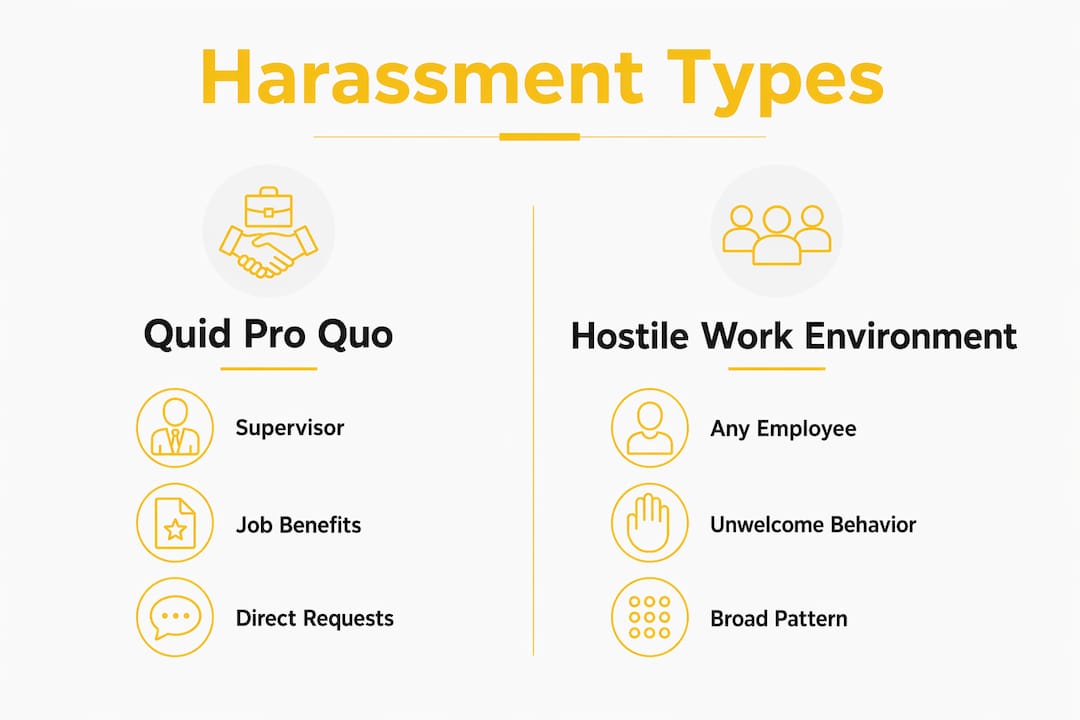
California harassment law draws a sharp line between two types of sexual harassment, and the distinction matters for how you build your case.
Quid pro quo harassment occurs when a supervisor or manager conditions a job benefit on sexual conduct. The job benefit can be a promotion, a raise, a favorable schedule, or continued employment itself. A single incident is enough to establish a quid pro quo claim. Under California law, employers are strictly liable for quid pro quo harassment committed by supervisors, regardless of whether the company has a written harassment policy. That strict liability rule is significant. It means your employer cannot escape responsibility by pointing to an employee handbook.

Hostile work environment harassment covers a broader pattern of conduct. It applies when unwelcome sexual behavior is severe or pervasive enough to create an intimidating or abusive workplace. California courts apply a reasonable person standard to evaluate whether the environment crosses the legal threshold. The harasser does not have to be a supervisor. A coworker, a client, or even a vendor can create a hostile work environment, and your employer can still be liable if it knew or should have known and failed to act.
| Point | Quid Pro Quo | Hostile Work Environment |
|---|---|---|
| Who can be the harasser | Supervisors only | Supervisors, coworkers, third parties |
| Number of incidents required | One incident can suffice | Conduct must be severe or pervasive |
| Employer liability | Strict liability | Liability if employer knew and failed to act |
| Key legal test | Was a job benefit conditioned on sex? | Would a reasonable person find the environment abusive? |
Different legal theories require different fact organization. Victims strengthen cases by tailoring their evidence to whichever theory fits their situation, or both if the facts support it.
Pro Tip: Save every text message, email, voicemail, and written note related to the proposition or harassment. Courts treat contemporaneous records as the most credible evidence in sexual harassment cases.
FEHA is California’s primary statute protecting employees from sexual harassment in the workplace. It applies to employers with five or more employees and covers full-time, part-time, and temporary workers. Employees in Rancho Santa Margarita who work for smaller employers may also have protections under local ordinances or other California statutes.
Under FEHA, you have the right to work free from sexual propositions, unwanted advances, and any conduct that conditions your employment on sexual favors. You also have the right to report harassment without fear of punishment. FEHA protects employees who complain about harassment, file complaints with state agencies, or participate in investigations. These are called protected activities, and any adverse action your employer takes because of them is illegal retaliation.
The filing deadline under California Government Code § 12960 is three years. Complaints must be filed within three years of the unlawful practice with the California Civil Rights Department (CRD). This extended deadline, which took effect on january 1, 2020, replaced the prior one-year limit and gives employees more time to organize their claims and seek legal advice.
Here is what FEHA guarantees you as an employee in Rancho Santa Margarita:
Pro Tip: You do not need to wait for your employer to investigate before contacting the CRD. Filing a complaint with the agency preserves your legal rights and starts the clock on your case.
Supervisor liability under FEHA is an area where many employees miss an important detail. FEHA harassment claims can name supervisors directly to preserve liability theories, which matters when building a case that targets both the individual harasser and the employer. An experienced California employment lawyer can advise you on whether naming your supervisor individually strengthens your claim.
Reporting sexual propositions correctly is as important as recognizing them. A procedural misstep, like missing a deadline or failing to preserve evidence, can weaken an otherwise strong case.
Step 1: Report internally first, if it is safe to do so. Most employers in Rancho Santa Margarita have a written harassment policy that designates an HR contact or a complaint hotline. Report the conduct in writing, keep a copy, and note the date. Internal reporting creates a record and puts your employer on notice. If your employer fails to act after notice, that failure strengthens your legal claim.
Step 2: File a complaint with the California Civil Rights Department. The CRD is the state agency that enforces FEHA. You can file online, by mail, or in person. When you file, you will be asked whether you want the CRD to investigate or whether you want an immediate right-to-sue notice.
Step 3: Choose your right-to-sue option carefully. Selecting the immediate right-to-sue option produces a notice without a CRD investigation, which lets you file a lawsuit faster. Employees often benefit from requesting an immediate right-to-sue to avoid delays from agency investigations and access trial benefits sooner. Once you receive the notice, you have one year to file a lawsuit in California Superior Court. Missing that deadline ends your claim permanently.
Evidence preservation tips:
Common pitfalls to avoid:
Pro Tip: Contact a Rancho Santa Margarita employment attorney before signing any document your employer presents after you report harassment. Severance agreements often contain broad release clauses that eliminate your legal claims.
For detailed information on quid pro quo claims and how California courts evaluate them, Employees-lawyer provides a thorough breakdown of the legal standards that apply to your situation.
Retaliation is the most common fear employees in Rancho Santa Margarita express after experiencing sexual propositions at work. That fear is understandable. Retaliation is also illegal, and California law gives you tools to fight it.
FEHA retaliation protection applies to any employee who opposes unlawful practices, including complaining about harassment or participating in an investigation. The law covers a wide range of employer responses. Retaliation examples recognized by FEHA include:
Any materially adverse action that would discourage a reasonable employee from complaining qualifies as retaliation under FEHA. That standard is broad by design. Courts have found retaliation in cases involving subtle changes like reassignment to a less desirable shift or removal from a high-profile project.
The retaliation claim deadline tracks the same three-year window as the underlying harassment claim. The clock starts from the date of the retaliatory act, not the date of the original harassment. That distinction matters if retaliation happens months after you first reported.
To protect yourself after reporting, document every change in your working conditions. Note the date your manager stopped including you in meetings, the date your hours were cut, or the date a negative review appeared in your file. Courts treat a clear timeline of adverse actions following a complaint as strong circumstantial evidence of retaliation. For a full explanation of your rights, the whistleblower and retaliation protections page at Employees-lawyer covers the specific California statutes that apply.
Employer liability for retaliation is more limited than for quid pro quo harassment, but it is still real. If your employer knew about the retaliation and failed to stop it, or if a supervisor carried it out directly, your employer faces liability. Naming the right parties in your complaint, whether the employer, the supervisor, or both, is a decision best made with legal counsel.
Sexual propositions at work in Rancho Santa Margarita are illegal under FEHA, and employees have three years to file a complaint with the CRD before their rights expire.
| Point | Details |
|---|---|
| Two legal theories apply | Quid pro quo and hostile work environment are distinct claims requiring different evidence. |
| Employer liability is strict for quid pro quo | Supervisors who condition job benefits on sex make employers automatically liable. |
| Three-year filing deadline | California Government Code § 12960 gives employees three years from the unlawful act to file with the CRD. |
| Retaliation is also illegal | Any adverse action after reporting harassment is prohibited and carries its own three-year claim deadline. |
| Right-to-sue notice is the gateway to court | Employees must receive a CRD right-to-sue notice before filing a lawsuit, and then have one year to act. |
Employees-lawyer, operating as Optimum Employment Lawyers, focuses exclusively on employee-side cases throughout California, including Rancho Santa Margarita. The firm has secured significant results for clients, including a $2.2 million settlement in a class action case. Their attorneys understand the emotional weight of sexual harassment cases and provide personalized representation from the first consultation through resolution. If you have faced sexual propositions, unwanted advances, or retaliation after reporting, contact an employment lawyer to review your options at no upfront cost. Employees-lawyer also serves clients across Orange County through its Rancho Santa Margarita employment law practice, giving local employees direct access to experienced representation.
A sexual proposition at work is any request for sexual favors, unwanted sexual advance, or conduct that conditions a job benefit on sexual conduct. California’s FEHA covers both explicit demands and implied pressure tied to employment decisions.
Complaints must be filed within three years of the unlawful act under California Government Code § 12960. After receiving a right-to-sue notice from the CRD, you have one year to file a lawsuit in Superior Court.
No. FEHA prohibits retaliation against employees who report harassment, file complaints, or participate in investigations. Termination, demotion, or any adverse action taken in response to a complaint is illegal.
You do not need a lawyer to file a CRD complaint, but legal counsel significantly improves your outcome. An attorney helps you choose between an immediate right-to-sue notice and a full investigation, and ensures your complaint is framed to support the strongest possible legal theory.
Quid pro quo harassment involves a supervisor conditioning a job benefit on sexual conduct, and employers face strict liability for it. Hostile work environment harassment involves pervasive or severe unwelcome conduct that makes the workplace abusive, evaluated under a reasonable person standard.

© 2026 Optimum Employment Lawyers, PC
Legal Disclaimer | Privacy Policy
 Share
Share
