
(949) 954-8181 Free Case Review No recovery, no fee.
(949) 954-8181 Free Case Review No recovery, no fee.
Meal and rest break violations occur when California employers deny non-exempt employees their legal right to uninterrupted meal and paid rest breaks during work hours. Under California Labor Code 226.7, every missed break triggers a premium pay obligation, meaning your employer owes you one additional hour at your regular rate of pay for each violation. Costa Mesa workers in hospitality, retail, and manufacturing face these violations at higher rates than most industries, yet many employees never file a claim because they do not know what the law actually requires. Understanding your rights under California meal break laws is the first step toward getting the compensation you are owed.
A meal and rest break violation is not just a missed lunch. It is a specific legal failure by your employer to comply with California Labor Code 512 and the applicable Industrial Welfare Commission Wage Orders. California law is significantly stricter than federal law on this point. The Fair Labor Standards Act does not require any meal or rest breaks at all, but California mandates both, with financial penalties attached to every single missed break.
The law applies to non-exempt employees, which covers the majority of hourly workers in Costa Mesa. Employers who interrupt breaks, require employees to remain on call during breaks, or pressure workers to skip breaks entirely are all committing violations. A break that looks scheduled on paper but is routinely cut short or interrupted does not satisfy the legal requirement. Employers who interrupt breaks violate break laws even when those breaks appear on a posted schedule.

California law sets clear, non-negotiable minimums for meal and rest break entitlements. Here is what you are legally entitled to as a non-exempt employee in Costa Mesa:
The distinction between meal and rest breaks matters legally. Meal breaks are unpaid when off-duty, while rest breaks are always paid. Both must be uninterrupted and duty-free.
Pro Tip: If you are classified as a salaried employee, that does not automatically mean you are exempt from break protections. White-collar exempt employees must earn at least $70,304 per year in 2026 and perform primarily discretionary duties to lose break entitlements. If your salary falls below that threshold, you likely qualify for full break protections regardless of your job title.
Costa Mesa’s economy spans hotel and hospitality workers along the 405 corridor, retail employees at South Coast Plaza, and manufacturing workers in the city’s industrial zones. All of these workers are predominantly non-exempt and fully covered by California break time regulations.
Violations rarely look like a manager announcing “no breaks today.” They are usually more subtle, and that subtlety is exactly why so many Costa Mesa employees miss their chance to file a claim. Here are the most common patterns:
Pro Tip: Keep a personal log of every shift, every break taken, and every break that was cut short or skipped. Note the time, the reason, and who was present. This contemporaneous record is your strongest evidence if you file a claim.
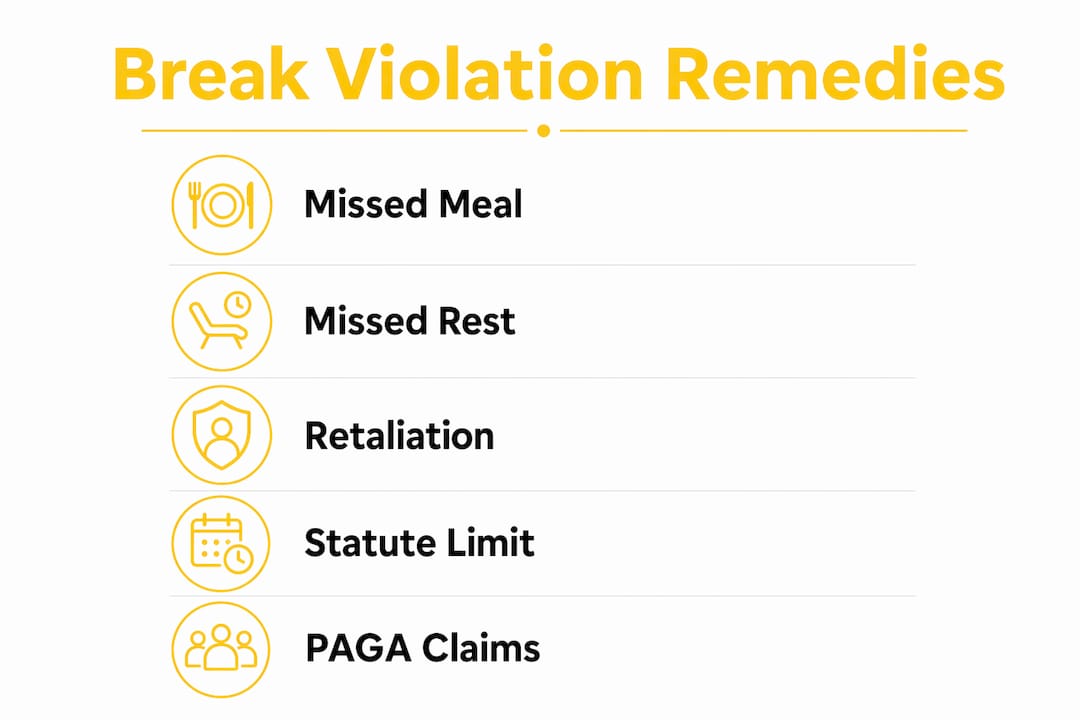
California law gives you concrete financial remedies for every break violation, not just a right to complain. Here is what you can claim:
| Violation type | Remedy available |
|---|---|
| One missed meal break | One additional hour at your regular rate of pay |
| One missed rest break | One additional hour at your regular rate of pay |
| Both missed in one day | Up to two additional hours at your regular rate of pay |
| Pattern of violations | Class action or PAGA claim covering all affected employees |
| Unpaid premium wages | Back pay plus interest and potential penalties |
The statute of limitations for missed break premium claims is three years, and each day with a missed break counts as a separate violation. That means a Costa Mesa employee who missed one meal break and one rest break every workday for two years could be owed hundreds of hours of premium pay.
California’s Private Attorneys General Act, known as PAGA, adds another layer of enforcement. Under PAGA, employees may seek premium pay and additional penalties on behalf of themselves and other affected workers. PAGA claims require formal notice to the California Labor and Workforce Development Agency before filing, but they significantly increase the financial pressure on employers to settle. Optimum Employment Lawyers secured a $2.2 million class action settlement in a case involving missed meal breaks, which illustrates the real financial exposure employers face when these violations are systemic.
Your rights also include protection against retaliation. If you report a break violation or file a claim, your employer cannot legally reduce your hours, demote you, or terminate you in response. Retaliation for asserting employee rights in Costa Mesa is itself a separate legal violation with its own remedies.
To build a strong claim, you should document the following:
Understanding your exempt vs. non-exempt status is also critical before filing. Employees not meeting the salary and duties test for exemption cannot legally be denied break protections, regardless of how their employer has classified them.
Taking action on a break violation claim starts with knowing what you are dealing with. These steps give you the strongest possible position:
The most common reason employees lose valid claims is waiting too long. The three-year statute of limitations sounds generous, but violations compound daily, and evidence becomes harder to gather as time passes.
California Labor Code 226.7 gives Costa Mesa non-exempt employees the right to premium pay for every missed meal or rest break, and three years of violations can add up to significant compensation.
| Point | Details |
|---|---|
| Premium pay per violation | Each missed meal or rest break entitles you to one extra hour at your regular rate of pay. |
| Two breaks, two remedies | Missing both a meal and rest break on the same day can trigger up to two hours of premium pay. |
| Three-year claim window | You can file claims for violations going back three years, with each missed break counting separately. |
| Exemption threshold in 2026 | Salaried employees earning under $70,304 per year are likely non-exempt and fully protected. |
| PAGA expands your options | PAGA claims allow you to pursue penalties beyond premium pay and can cover coworkers facing the same violations. |
If your employer in Costa Mesa has been denying, interrupting, or pressuring you to skip your legally required breaks, you have real legal options. Optimum Employment Lawyers focuses exclusively on employee-side cases throughout California, including wage and hour disputes involving missed meal and rest breaks. The firm has recovered millions for workers in situations exactly like yours, including a $2.2 million class action settlement for missed meal breaks. Their attorneys understand Costa Mesa labor laws and the specific industries where these violations are most common. Contact Optimum Employment Lawyers for a case evaluation to find out what your claim may be worth. If you are in the broader Orange County area, the firm also serves workers through its Orange County employment practice.
A meal break violation occurs when your employer fails to provide a 30-minute uninterrupted, off-duty break before the end of your fifth hour of work. Interrupted breaks, on-call breaks, and breaks cut short by work demands all qualify as violations under California Labor Code 512.
You are entitled to one additional hour at your regular rate of pay for each missed meal break and one additional hour for each missed rest break. If both are missed on the same day, you can recover up to two extra hours of pay for that day.
The statute of limitations for missed break premium claims is three years in California. Each day with a missed break is a separate violation, so the total amount owed can grow significantly over time.
No. California law prohibits retaliation against employees who assert their workplace rest break rights or file wage claims. Retaliation is a separate legal violation and can result in additional remedies including reinstatement and damages.
Salaried employees who earn less than $70,304 per year in 2026 or who do not primarily perform discretionary duties are classified as non-exempt and are entitled to the same break protections as hourly workers. Job title alone does not determine exemption status.

© 2026 Optimum Employment Lawyers, PC
Legal Disclaimer | Privacy Policy
 Share
Share
