
(949) 954-8181 Free Case Review No recovery, no fee.
(949) 954-8181 Free Case Review No recovery, no fee.
Wrongful termination after reporting safety violations is defined as an unlawful firing that occurs because an employee raised workplace hazards, refused dangerous work, or filed a complaint with a regulatory agency. In Newport Beach, this type of retaliation is illegal under California Labor Code §§ 6310, 6311, and 1102.5, as well as federal OSHA Section 11©. These laws give you specific rights, specific deadlines, and specific remedies. If your employer fired you, demoted you, or disciplined you after you reported unsafe conditions, you have legal options worth understanding before those options expire.
California and federal law build overlapping shields around employees who speak up about workplace hazards. Understanding which law applies to your situation determines where you file, how fast you must act, and what you can recover.
California Labor Code § 6311 is the most direct protection for workers who refuse dangerous assignments. Refusing unsafe work is protected when the conditions violate occupational safety or health standards and create a real hazard. Termination after that refusal is actionable as safety retaliation. This matters because many Newport Beach employees in construction, healthcare, and hospitality face pressure to perform tasks they know are dangerous.

California Labor Code § 6310 covers a different but equally important scenario. Filing a Cal/OSHA complaint or participating in a workplace inspection is protected activity under this statute. Your employer cannot legally fire you simply because you contacted Cal/OSHA, even if you never refused to do the work itself.
California Labor Code § 1102.5 is the state’s broadest whistleblower statute. Reporting illegal activity or safety violations to a government agency or even internally to management is protected. Retaliation including termination, demotion, or reassignment is prohibited. This statute covers disclosures to the California Division of Occupational Safety and Health, to supervisors, and to law enforcement.
Federal OSHA Section 11© adds a federal layer of protection. Key differences between these frameworks include:
Retaliation also includes demotion, discipline, reassignment, or any adverse action designed to discourage protected reporting. You do not have to be fired outright for a retaliation claim to stand.
Strong documentation separates a winning claim from one that stalls. Courts and investigators rely on contemporaneous records, meaning notes and records you created at the time events occurred, not reconstructed weeks later.
Write down every incident the same day it happens. Record the date, the specific hazard you observed or refused, the names of supervisors present, and the exact words spoken. A Newport Beach construction worker who notes “On March 4, 2026, foreman J. Torres told me to use the scaffold without fall protection” has far more credibility than one who recalls the event vaguely months later.
Photograph or video hazardous conditions when it is safe to do so. California law generally permits employees to document conditions relevant to a legal claim. Store copies outside your work devices, such as in personal cloud storage, so your employer cannot delete them.
Save every written communication. Emails, text messages, disciplinary notices, and performance reviews that reference your complaint or refusal are critical. Forward work emails to a personal account before your access is terminated. Courts in California have accepted text message chains as direct evidence of retaliatory intent.
File a Cal/OSHA complaint online through the California Department of Industrial Relations. An official Cal/OSHA complaint creates a timestamped government record that proves you reported the hazard before the adverse action occurred. This sequence, complaint first and termination second, is the backbone of most retaliation cases.
Keep a timeline of all adverse actions. Note every negative change in your employment status after your report: schedule reductions, exclusion from meetings, sudden negative performance reviews, or comments from supervisors. Employers often use subtle retaliation beyond outright termination, and documenting each step builds a pattern that is hard for employers to explain away.
Pro Tip: Print or export copies of all digital evidence immediately after your termination. Employers routinely revoke system access within hours of firing an employee, and you may lose access to emails, internal chat logs, and HR portals permanently.
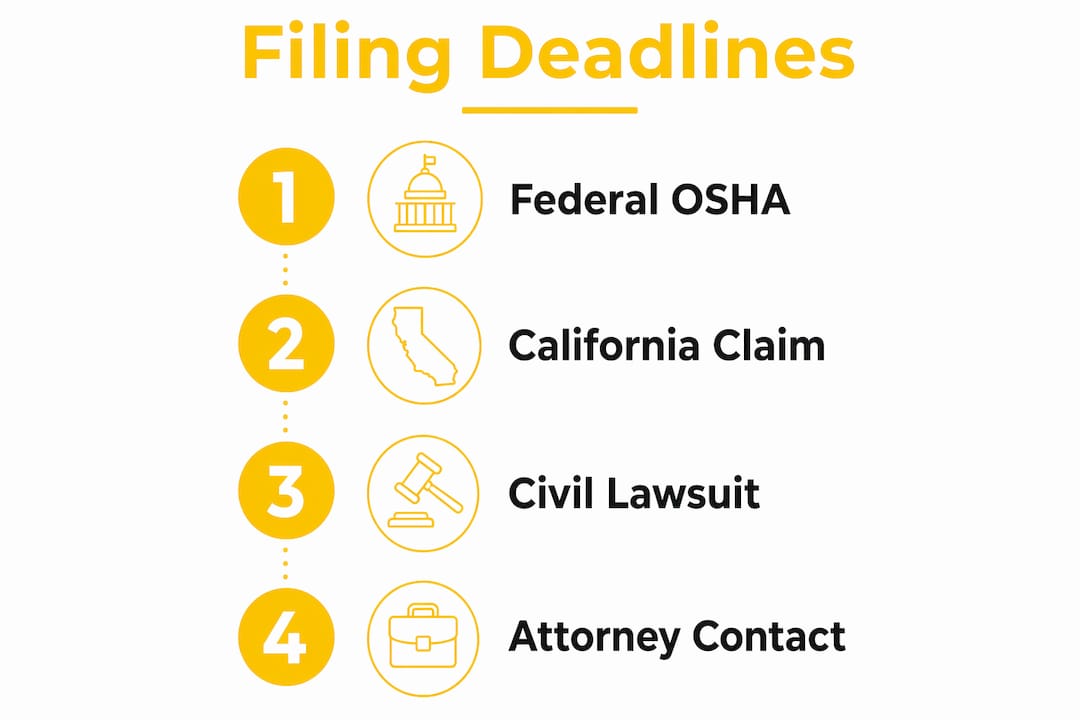
Deadlines in retaliation cases are not flexible. Many retaliation claims fail due to missed filing windows, not because the underlying facts were weak. The table below summarizes the key timelines you face.
| Claim type | Filing deadline | Where to file |
|---|---|---|
| Federal OSHA Section 11© complaint | 30 days from adverse action | U.S. Department of Labor, OSHA |
| Cal/OSHA retaliation complaint (§ 6310) | 1 year from adverse action | California Labor Commissioner |
| Tameny public policy civil lawsuit | 2 years from termination date | California Superior Court |
| DFEH/CRD discrimination complaint | 3 years from adverse action | California Civil Rights Department |
The 30-day federal OSHA deadline is the most dangerous trap. The 30-day clock starts on the date you received notice of the adverse action, not the date you first reported the hazard. A Newport Beach employee terminated on June 1 must file a federal OSHA complaint by July 1. Missing that date by a single day forfeits the federal claim entirely.
The two-year window for a Tameny wrongful termination lawsuit in California civil court is longer, but it should not create a false sense of security. Evidence fades, witnesses move, and employers destroy records. Acting within weeks of termination preserves your strongest position.
Pro Tip: Contact an employment attorney the same week you are terminated. A 15-minute consultation costs nothing at most firms and confirms which deadlines apply to your specific facts before any window closes.
The remedies available to you depend on which legal pathway you pursue, and the differences are significant.
Under federal OSHA Section 11©, successful claimants can receive reinstatement to their former position, full back pay covering lost wages from the termination date, and attorney’s fees paid by the employer. Federal courts use burden-shifting to require employers to prove their termination decision was based on legitimate, non-retaliatory reasons. When employers cannot meet that burden, the financial exposure is substantial.
California civil lawsuits under the Tameny doctrine offer the broadest recovery. Tameny claims allow full tort damages including emotional distress and punitive damages with no statutory cap. A Newport Beach employee who suffered anxiety, depression, or career damage after a retaliatory firing can seek compensation for those harms directly. Punitive damages are available when an employer’s conduct was malicious or oppressive, which courts have found in cases where supervisors explicitly threatened employees who raised safety concerns.
The specific remedies available through each pathway include:
Federal OSHA investigations can also result in referrals to the U.S. Department of Justice when employers engage in particularly egregious retaliation. While that outcome is less common, it signals how seriously federal law treats safety whistleblower protection.
The hours and days after a termination are the most critical period for protecting your legal rights. Acting deliberately and quickly gives your attorney the best possible foundation for your claim.
Pro Tip: Never delay a consultation to “see how things play out.” The 30-day federal OSHA deadline passes faster than most people expect, and no attorney can recover a claim that has already expired.
Wrongful termination in Newport Beach after reporting safety violations is illegal under multiple California and federal statutes, and employees who act quickly have access to reinstatement, back pay, and punitive damages.
| Point | Details |
|---|---|
| Multiple laws protect you | California Labor Code §§ 6310, 6311, 1102.5 and federal OSHA Section 11© each provide independent protections. |
| Deadlines are strict | The federal OSHA Section 11© complaint deadline is just 30 days from the adverse action date. |
| Documentation is decisive | Contemporaneous records, official Cal/OSHA complaints, and saved communications build the strongest cases. |
| Remedies can be substantial | Tameny civil claims allow emotional distress and punitive damages with no statutory cap. |
| Act immediately after termination | Consulting an attorney within days of firing preserves every available legal option. |
Optimum Employment Lawyers focuses exclusively on employee-side cases in California, including wrongful termination and retaliation claims for workers who reported safety violations. Their team understands the specific statutes that protect Newport Beach employees and the aggressive strategies needed to hold employers accountable. With a track record that includes a $2.2 million class action settlement, they bring proven results to workers who have been wronged. If you were fired after raising a safety concern, schedule a free consultation with their Newport Beach employment lawyers today. The sooner you act, the more options you preserve.
Wrongful termination after reporting safety violations occurs when an employer fires, demotes, or disciplines an employee because that employee reported a hazard, refused unsafe work, or filed a complaint with Cal/OSHA or federal OSHA. California Labor Code §§ 6310 and 6311 make this retaliation illegal.
The federal OSHA Section 11© deadline is 30 days from the adverse action. California Labor Code § 6310 retaliation complaints allow one year, and Tameny civil lawsuits have a two-year statute of limitations from the termination date.
Yes. Retaliation includes demotion, discipline, reassignment, and any adverse action designed to discourage protected reporting. You do not need to be formally terminated to pursue a retaliation claim under California or federal law.
Successful claimants can recover reinstatement, back pay, compensatory damages for emotional distress, punitive damages in civil cases, and attorney’s fees. Tameny public policy claims carry no statutory cap on damages, making them particularly powerful for employees who suffered significant harm.
Do not sign any severance agreement before consulting an employment attorney. Severance packages often include broad liability releases that permanently waive your right to pursue a retaliation or wrongful termination lawsuit.

© 2026 Optimum Employment Lawyers, PC
Legal Disclaimer | Privacy Policy
 Share
Share
