
(949) 954-8181 Free Case Review No recovery, no fee.
(949) 954-8181 Free Case Review No recovery, no fee.
If your employer punished you for complaining about unpaid wages, missed meal or rest breaks, or unpaid overtime, California law forbids that retaliation. Westminster employees can file a complaint with the Labor Commissioner’s Office or hire private counsel. Start by preserving pay stubs, texts, and witness names, then file within a year to protect your Westminster wage and hour retaliation employee rights.
TL;DR:
- Employers who retaliate within 90 days of a wage complaint are presumed to be doing so unlawfully, shifting the burden of proof onto the employer.
- Filing a retaliation complaint with the DLSE requires documentation such as pay stubs, emails, and witness contacts, and can lead to reinstatement, back pay, and penalties up to $10,000 per violation.
- Retaliation can include firing, demoting, reducing hours, pay cuts, or threats, especially if these actions follow a wage or safety complaint, and are often supported by the timing within the 90-day rebuttable presumption.
- Federal protections under the FLSA and NLRA provide additional safeguards, allowing employees to pursue claims even if California law does not directly cover certain violations.
- Engaging an employment lawyer is advisable if the case involves termination, intimidating employers, or multiple violations, to strengthen evidence and seek maximum compensation.
California doesn’t leave wage retaliation to interpretation. Labor Code §98.6 makes it illegal for an employer to fire, demote, suspend, cut hours, or otherwise punish a worker for filing a wage claim, testifying in a wage proceeding, or simply telling a coworker what the minimum wage is. The law applies whether you work in a Westminster restaurant kitchen, a warehouse near Beach Boulevard, or a corporate office park.
A companion statute, Labor Code §1102.5, covers whistleblowing more broadly. It protects employees who report a suspected legal violation, whether to a supervisor, a government agency, or another employee with authority to investigate, even if that report happens internally and never reaches a courtroom. Between the two statutes, nearly every version of “I complained about how I was being paid, and then things got worse at work” is covered.
A few other Labor Code sections come up often in wage retaliation cases:
The DLSE’s retaliation complaint procedure explains how the Labor Commissioner’s Office, often called the DLSE, enforces these protections. The DLSE can investigate, order reinstatement, and assess penalties, but it isn’t a substitute for civil court. If you want compensatory damages for emotional distress or a jury trial, you’ll eventually need a private lawsuit, sometimes after going through the DLSE first. The U.S. Department of Labor’s retaliation guidance adds a second layer of protection for employees whose situation touches federal wage law, since state and federal claims can run side by side.
Retaliation doesn’t always look like a pink slip. Employers get creative, and courts have seen most of the tricks. Here’s what typically qualifies:
Consider a realistic scenario: a Westminster line cook tells her manager she hasn’t been paid overtime for the last three pay periods. Within a month, her schedule drops from five shifts to two, and she’s told the restaurant is “cutting back.” No documentation exists, but the timing alone tells a story.
That’s because California uses a 90-day rebuttable presumption. When an adverse action happens within 90 days of the protected activity, courts and agencies presume it’s retaliatory, and the burden shifts to the employer to prove otherwise. The tighter the window between the complaint and the punishment, the stronger the case.
Any employee, current or former, can file a retaliation complaint with the DLSE, and you don’t need an attorney to start the process. You submit a Retaliation Complaint (RCI-1) form, either online or by mail, describing the protected activity, the adverse action, and the timeline connecting them.
Filing generally requires:
Once filed, the case gets assigned to a Deputy Labor Commissioner, who investigates. The employer gets a chance to respond, both sides may submit documentation, and the deputy issues a determination. If the DLSE finds retaliation occurred, it can order reinstatement, back pay, and penalties. If you disagree with the outcome, there are appeal rights.
You don’t always have to choose just one path. If the retaliation involves a safety complaint, you may have a parallel option with Cal/OSHA. If your situation touches federal wage law, the DOL’s Wage and Hour Division accepts complaints too. And nothing stops you from filing a private civil lawsuit, either instead of or after an agency complaint, particularly when you’re seeking damages the DLSE can’t award.
Pro Tip: File your DLSE complaint even if you’re also planning to hire a lawyer. It creates an official timestamp and paper trail that strengthens a later civil case, and it costs you nothing to start.
The remedies aren’t symbolic. Under Labor Code §98.6, an employer who retaliates against a worker for a wage complaint can face penalties up to $10,000 per violation, on top of other remedies. That number applies per affected employee, which is why retaliation against a group of workers, say, an entire shift that complained about unpaid overtime, can add up fast.
Available remedies typically include:
Settlements in these cases commonly bundle lost wages with attorneys’ fees, and sometimes emotional distress damages when the facts support it. Results vary widely depending on how strong the timing evidence is, how many employees were affected, and whether the employer has a pattern of similar conduct. A single, clean-cut termination case settles differently than a class-wide retaliation pattern affecting a dozen workers across multiple Orange County locations.
The DLSE generally requires retaliation complaints to be filed within one year of the retaliatory act. Some claims, like equal pay retaliation or certain whistleblower protections, carry different deadlines, so it’s worth confirming your specific timeline rather than assuming the one-year rule covers everything.
The 90-day rebuttable presumption matters because it changes who has to prove what. If your employer disciplined you within 90 days of your complaint, the law presumes retaliation, and your employer has to come up with a legitimate, non-retaliatory explanation. Outside that window, you still have a case, but you’ll need to build the timing argument yourself.
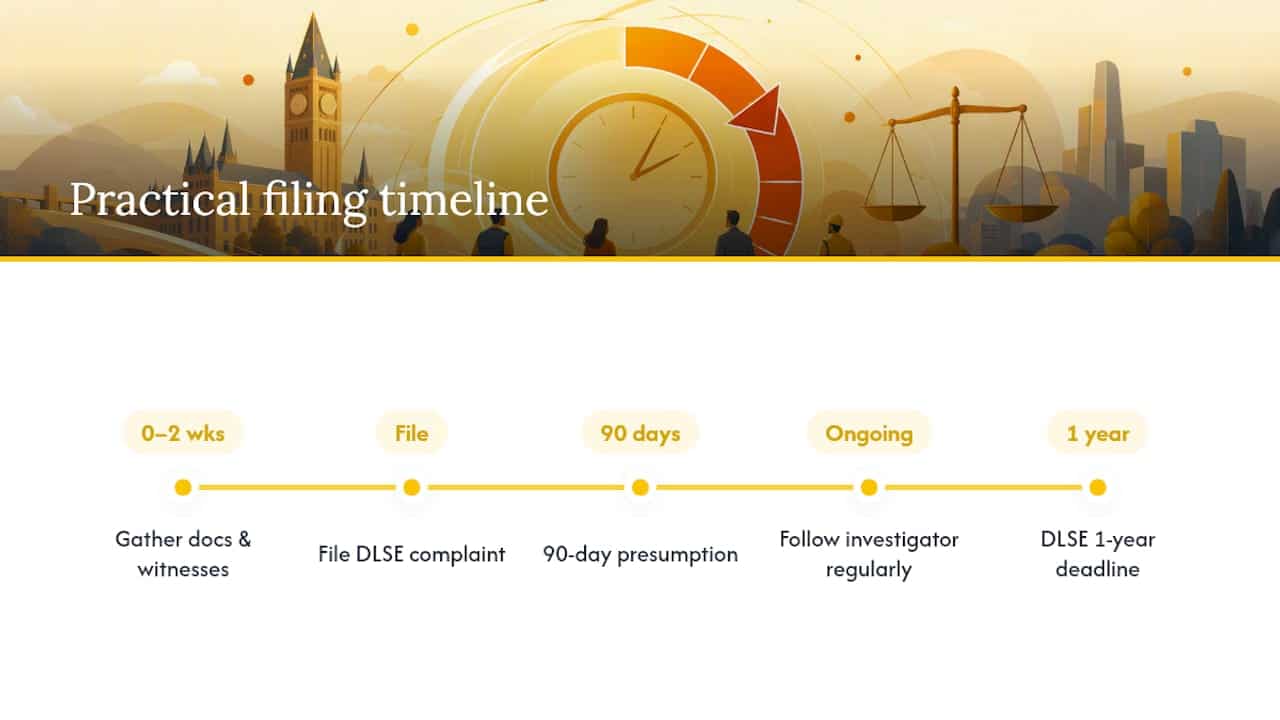
A practical timeline looks like this: gather documents and witness contacts within the first week or two after the adverse action, file your DLSE complaint as soon as your evidence is organized, and follow up with the assigned investigator every few weeks rather than waiting for them to reach out.
Retaliation cases live and die on timing and paper trails. Courts want to see a clear line from “employee complained” to “employer punished them,” and the strength of that line depends entirely on what you saved.
Build your evidence file with:
Practitioners who handle these cases routinely build a side-by-side timeline pairing dates of protected activity with the dates of adverse actions, since that pairing is often what triggers the 90-day presumption or otherwise proves causation.
Pro Tip: Talk to coworkers who witnessed the retaliation before they leave the company. A quick, casual conversation today is far easier to arrange than tracking someone down six months after they’ve moved to a different employer.
Filing a complaint doesn’t just protect you retroactively. It also protects you going forward. The moment you file with the DLSE or report a wage violation internally, additional retaliation for that filing becomes its own separate violation. An employer who fires you for filing the original complaint, then fires you again for cooperating with the investigation, has committed two acts of retaliation, not one.
This matters practically. Some employees worry that filing a complaint will make things worse at work. It’s a real concern, but the law is built to punish exactly that response. If your employer isolates you, cuts your hours further, or pressures you to withdraw your complaint after you’ve filed, document each incident the same way you documented the original retaliation. Each new act adds to your case rather than replacing it.
The DLSE also won’t ask about immigration status when you file, and California explicitly protects workers regardless of documentation status. You don’t need a Social Security number to file a wage or retaliation claim in California, a detail that matters for many workers who assume their status disqualifies them from protection. It doesn’t.
Not every wage retaliation situation requires a lawyer on day one. Some employees file their DLSE complaint, get a fair result, and move on. But certain situations tilt heavily toward getting an attorney involved early: you’ve already been terminated, your employer is threatening further action, the deadline to file is approaching fast, or multiple wage violations are stacked on top of the retaliation itself.
Private employee-side attorneys can do things an agency complaint can’t. Agencies often lack subpoena power during the intake stage, which limits how much internal documentation they can pull from an employer. A lawyer filing a civil suit can use formal discovery to obtain internal emails, scheduling records, and HR files that never would have surfaced through an agency investigation alone.
Beyond law firms, workers can also find support through worker advocacy organizations, legal aid clinics, and union representatives if applicable. These groups won’t replace an attorney handling a lawsuit, but they can help with initial guidance, translation services, or connecting you to the right resource for your specific situation. If discrimination is layered into your retaliation case, the EEOC is another avenue worth exploring alongside your wage claim.
Employers rarely admit retaliation outright. Instead, they typically argue one of a few standard defenses. The most common is the legitimate business reason defense: the employer claims the termination or demotion was unrelated to the complaint, pointing to a company-wide layoff, a documented performance issue, or a restructuring that happened to coincide with your complaint.
Another frequent defense is timing distance. If enough time passed between your complaint and the adverse action, and it falls outside the 90-day presumption window, the employer will argue there’s no causal connection at all.
Employers also sometimes argue the employee didn’t actually engage in protected activity, claiming the complaint was too vague, was never actually made, or didn’t concern a genuine legal violation. This is exactly why documentation matters so much. A dated email or text showing you raised a specific wage issue undercuts that defense immediately.
Knowing these defenses in advance helps you build your evidence file strategically. If you suspect your employer will claim a layoff was unrelated, gather information about who else was let go and whether the pattern matches a genuine reduction in force or looks selectively aimed at complainers.
Act fast, but act carefully. The first 48 hours after a suspected retaliatory action set the tone for everything that follows.
Write down what happened while it’s fresh: dates, exact words used, who was present. Save any termination letter, write-up, or schedule change notice, and don’t delete texts or emails even if they feel embarrassing or incomplete. Request a copy of your personnel file, which California law entitles most employees to receive.
Avoid signing anything your employer hands you immediately after an adverse action, particularly a severance agreement or a document waiving your right to sue, without having it reviewed first. These documents are sometimes offered specifically to head off a retaliation claim before you realize you have one.
Finally, decide quickly whether you’re filing with the DLSE, contacting an attorney, or both. Waiting weeks to decide doesn’t just risk deadlines, it also gives memories time to fade and witnesses time to scatter.
California’s protections are strong, but federal law adds a second layer that sometimes covers gaps state law misses. The Fair Labor Standards Act (FLSA) prohibits retaliation against employees who complain about minimum wage or overtime violations, and it applies even in workplaces where state protections might not clearly reach, such as certain federal contractors.
The National Labor Relations Act (NLRA) protects employees engaging in “concerted activity,” meaning two or more employees acting together to complain about working conditions, including wages. This matters if your wage complaint wasn’t a solo effort. If you and a coworker jointly raised concerns about unpaid overtime and both faced discipline afterward, the NLRA may apply even in a non-union workplace.
The DOL’s Wage and Hour Division accepts retaliation complaints tied to federal wage law, and its process runs parallel to, not instead of, a California DLSE complaint. Employees sometimes qualify for both state and federal protection simultaneously, and pursuing both isn’t double dipping. It’s making sure every available legal avenue is on the table.
Certain moments call for a lawyer rather than a DIY complaint: you’ve already been terminated, your employer is intimidating you or other witnesses, a filing deadline is closing in, or your case involves multiple violations stacked together, unpaid overtime plus missed breaks plus retaliation, for instance. That combination usually means more money is at stake and more evidence needs to be preserved correctly the first time.
There are law firms that represent Westminster employees on a contingency basis, meaning there’s no upfront cost, and the firm only gets paid from a settlement or court award. Such teams preserve evidence, file DLSE and civil claims, negotiate with employers, and litigate when a fair settlement isn’t offered. Successful outcomes have included significant settlements for class actions involving missed meal breaks, showing how wage-and-hour violations paired with retaliation can escalate into substantial compensation for affected employees.
If you’re a Westminster employee dealing with wage and hour retaliation or wrongful termination, waiting rarely helps your case. Evidence disappears, witnesses move on, and filing deadlines don’t pause for indecision. Contact Optimum Employment Lawyers for a case review and find out where you stand before the clock runs further.
A few official sources are worth bookmarking before you file anything. The DLSE’s retaliation complaint page walks through the exact filing process and investigation timeline. The full text of Labor Code §98.6 spells out your remedies and the penalty structure in the law’s own language. For federal overlap, the DOL’s retaliation guidance covers Wage and Hour Division complaints, and if discrimination is part of your situation, the EEOC handles that side separately. Contact your local DLSE office directly or use its online complaint form to get your case moving.
This article is general information, not a substitute for advice from a qualified lawyer. Consult a qualified legal professional about your own circumstances before acting on anything here.
It depends heavily on timing and documentation. Cases where the adverse action happened within 90 days of a protected complaint benefit from a rebuttable presumption of retaliation, which shifts the burden to the employer to justify their decision.
Settlement amounts vary widely based on lost wages, the number of employees affected, and statutory penalties involved, with Labor Code §98.6 allowing penalties up to $10,000 per violation on top of back pay. Some firms have secured multi-million dollar class action settlements in wage-and-hour cases involving missed meal breaks, illustrating how damages can increase when violations accumulate.
Retaliation includes termination, demotion, reduced hours, pay cuts, negative performance reviews, or threats made shortly after an employee reports a wage violation or engages in another legally protected activity.
Three of the most common examples are firing an employee after a wage complaint, cutting their scheduled hours significantly, and demoting them to a lower-paying role, especially when any of these happen within weeks of the original complaint.

© 2026 Optimum Employment Lawyers, PC
Legal Disclaimer | Privacy Policy
 Share
Share
