
(949) 954-8181 Free Case Review No recovery, no fee.
(949) 954-8181 Free Case Review No recovery, no fee.
Yes, California law protects Newport Beach employees from being fired, demoted, or punished for filing wage claims or complaining about unpaid wages. If your employer takes action against you within 90 days of that complaint, the law presumes retaliation and shifts the burden onto them. Your first moves should be filing with the Labor Commissioner’s Office and locking down your records right away.
TL;DR:
- An adverse action within 90 days of wage complaint or protected activity triggers the presumption of retaliation, shifting the burden to the employer to justify their conduct.
- Filing with the Labor Commissioner must be done within one year of the retaliatory act, but shorter deadlines may apply for specific claims like whistleblower cases.
- Evidence such as pay records, emails, and written logs should be collected immediately to support a retaliation claim, with early legal help increasing case strength.
- Remedies can include back pay, reinstatement, record corrections, and civil penalties of up to $10,000 per violation, emphasizing the importance of prompt action.
- Early consultation with an employment lawyer improves the chances of filing correct documentation, meeting deadlines, and building a compelling case for damages and protections.
Retaliation is not limited to getting fired. It covers any adverse action tied to protected activity, and the law recognizes several forms:
The core protection comes from Labor Code §98.6, which makes it illegal for an employer to retaliate against a worker for filing a wage claim or complaining about unpaid wages.
An adverse action taken within 90 days of your protected activity triggers a rebuttable presumption of retaliation, meaning your employer has to prove a legitimate, non-retaliatory reason for what happened. Violations can carry civil penalties of up to $10,000 per employee per violation, on top of reinstatement and back pay.
A separate statute, Labor Code §1102.5, protects employees who report suspected legal violations internally or to a government agency, or who refuse to participate in illegal conduct. Related sections, including Labor Code §96(k) and §1198.3, extend protection to off-duty conduct and other retaliation scenarios, giving Newport Beach workers multiple statutory hooks depending on what happened.
Timing drives everything in a retaliation case, and missing a deadline can end your claim before it starts.
Because these windows vary by claim type, and because the 90-day presumption only helps if you can show the timeline clearly, it pays to talk to counsel as soon as retaliation starts, not after you have already lost pay or your job. A Newport Beach employee weighing whether a demotion two months after a wage complaint counts as retaliation is exactly the kind of case where the 90-day rule can decide the outcome.
Filing with the Division of Labor Standards Enforcement (DLSE) starts with a written complaint, typically DLSE Form 1, which can be submitted online, by mail, or in person at a district office. After filing, a deputy labor commissioner reviews the complaint and decides whether to investigate, dismiss it, or refer it to a hearing.
Remedies can include back pay with interest, reinstatement to your position, restoration of lost benefits, and a purge of negative entries from your personnel file. Civil penalties of up to $10,000 per violation may also apply. The DLSE’s own guidance notes that relief is meant to make the employee whole, not just cover missed wages, so reinstatement and record corrections are worth requesting explicitly when you file.
The strength of a retaliation claim usually comes down to what you can show happened, and when. Start gathering these now, before memories fade or files disappear:
Keep a contemporaneous written log noting dates, exact quotes, and who was present for each incident. Back up electronic files somewhere your employer cannot access or delete, request your personnel file in writing, and avoid deleting old messages even if they seem unfavorable. Limit public posts about your situation, since anything you write can surface later in the case.
Pro Tip: Log incidents the same day they happen, not weeks later. A dated, detailed record almost always carries more weight than a reconstructed memory.
Getting an attorney involved early lets someone issue subpoenas, negotiate before litigation escalates, and make sure your filings line up with DLSE deadlines rather than working against them.
Optimum Employment Lawyers represents employees, not employers, across Newport Beach and handles wage-and-hour retaliation, wrongful termination, and related claims exclusively from the worker’s side. That focus shapes how the firm reviews a case, since every strategy is built around what a fired or demoted employee needs to recover, not what a company needs to defend.
If you are dealing with retaliation after a wage complaint in Newport Beach, you can review the full range of services, including wage and hour violations, unpaid overtime, and wrongful termination claims, or reach out directly through the contact page to schedule a consultation.
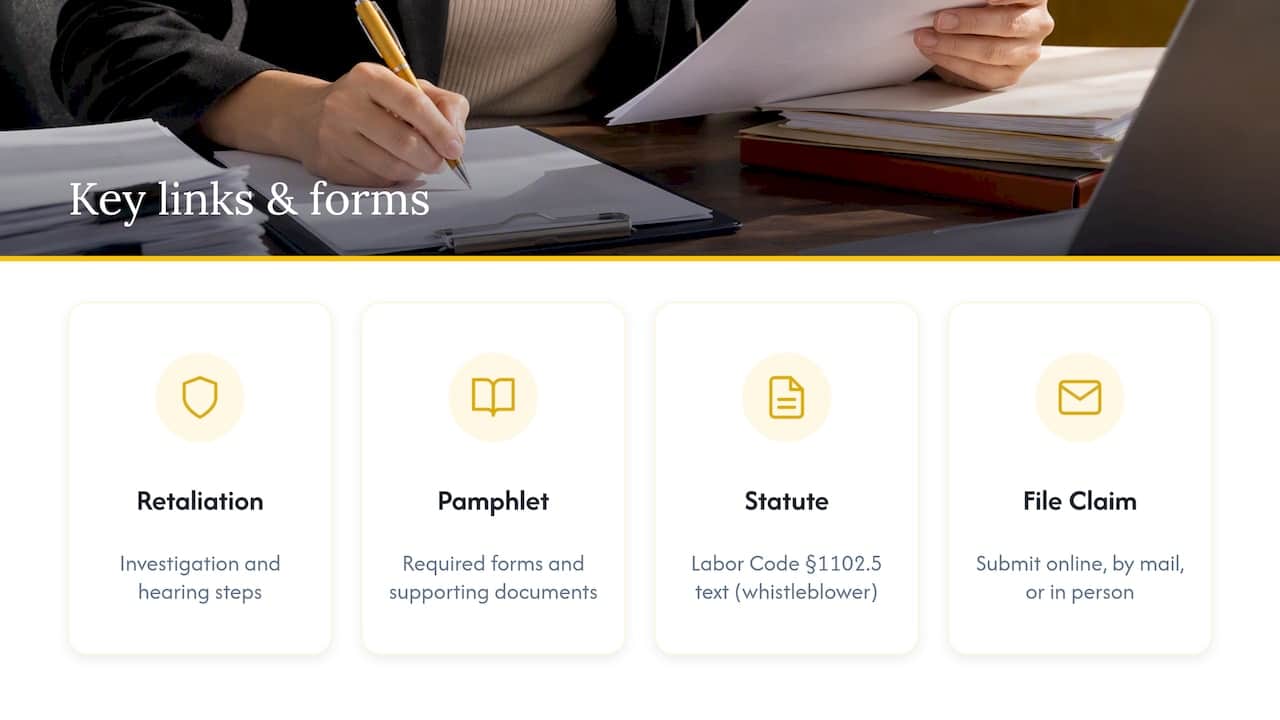
Bookmark and print these before you start a claim. The DLSE retaliation complaint procedure page explains the investigation and hearing process step by step, while the wage claim filing pamphlet covers required forms and supporting documents. Read the statutory text of Labor Code §1102.5 directly if your case involves a whistleblower disclosure, and use the wage claim filing page to submit online, by mail, or in person.
This article is general information, not a substitute for advice from a qualified lawyer. Consult a qualified legal professional about your own circumstances before acting on anything here.
Case value depends on lost wages, benefits, emotional distress, and whether civil penalties apply, so there is no fixed amount. Remedies can include back pay with interest, reinstatement, and civil penalties up to $10,000 per violation under Labor Code §98.6.
The timing for final paychecks when an employee quits without notice follows its own rules, which is separate from wage retaliation deadlines. Retaliation complaints follow their own filing windows, typically one year from the retaliatory act for most DLSE claims.
Proving retaliation requires showing you engaged in protected activity and then suffered an adverse action connected to it, which can be difficult without documentation. The 90-day rebuttable presumption under Labor Code §98.6 helps by shifting the burden to your employer if the adverse action happened within that window.
There is no set cap on damages in a private lawsuit, though administrative penalties through the DLSE can reach $10,000 per violation. A private civil case may also recover back pay, emotional distress damages, and attorney fees depending on which statute applies.

© 2026 Optimum Employment Lawyers, PC
Legal Disclaimer | Privacy Policy
 Share
Share
