
(949) 954-8181 Free Case Review No recovery, no fee.
(949) 954-8181 Free Case Review No recovery, no fee.


Yes, you can act if your employer misclassified you as an independent contractor in Mission Viejo. If your work fails California’s ABC test or the applicable common-law factors, you may recover unpaid wages, overtime, and other damages. The California Division of Labor Standards Enforcement (DLSE), the Employment Development Department, and the U.S. Department of Labor all play a role in enforcing these rules, and Optimum Employment Lawyers represents Mission Viejo workers pursuing these claims on contingency.
Before you do anything else:
A Mission Viejo worker who fails California’s ABC test is legally an employee and can recover unpaid wages, overtime, and penalties regardless of what a contract calls them.
| Point | Details |
|---|---|
| ABC test controls classification | Employers must prove all three prongs, control, outside usual business, independent trade, or the worker is an employee. |
| Evidence wins these cases | Pay stubs, contracts, and scheduling messages typically decide misclassification disputes. |
| Deadlines are real | Wage claims carry statutes of limitations, so confirm your exact window with the DLSE without delay. |
| Penalties hit employers hard | Willful misclassification under Labor Code 226.8 can trigger civil penalties and public notice requirements. |
| Optimum Employment Lawyers offers free review | The firm represents Mission Viejo workers on contingency, with no upfront cost for a case evaluation. |
California uses the ABC test to decide who counts as an employee, and it’s tougher on employers than most people expect. Under Labor Code section 2775, a worker is presumed to be an employee unless the hiring company proves all three of these:
If a company can’t prove all three, the worker is an employee under the law, full stop. Some occupations get evaluated instead under the older Borello multifactor test, which weighs things like who supplies tools, how long the relationship lasts, and whether the work requires special skill. The EDD’s information sheet walks through when Borello applies instead of the ABC test.
Pro Tip: Small details often decide the case. Who sets your schedule? Who owns the equipment? Are you free to work for other companies doing the same job? Those answers usually settle prongs A and C before a court ever gets to the fine print.
Most misclassified workers in Mission Viejo don’t realize it until they hit a wall, denied unemployment benefits, no overtime pay, a surprise tax bill from the IRS. A quick self-check can tell you a lot:
Start collecting evidence now: pay stubs, your 1099 or W-2 forms, any written agreement, and text or email threads that show a supervisor directing your schedule or work. Write down dates, names of managers, and specific incidents while they’re still fresh. If you use a work phone or laptop, don’t wipe it before backing up anything relevant. Legal Aid at Work’s factsheet offers a useful rundown of what evidence tends to matter most.
Misclassification usually isn’t an accident. Calling someone a contractor lets a company skip payroll taxes, overtime, health benefits, and workers’ compensation coverage, all of which add up fast across a workforce. It shifts the cost of doing business onto the worker.
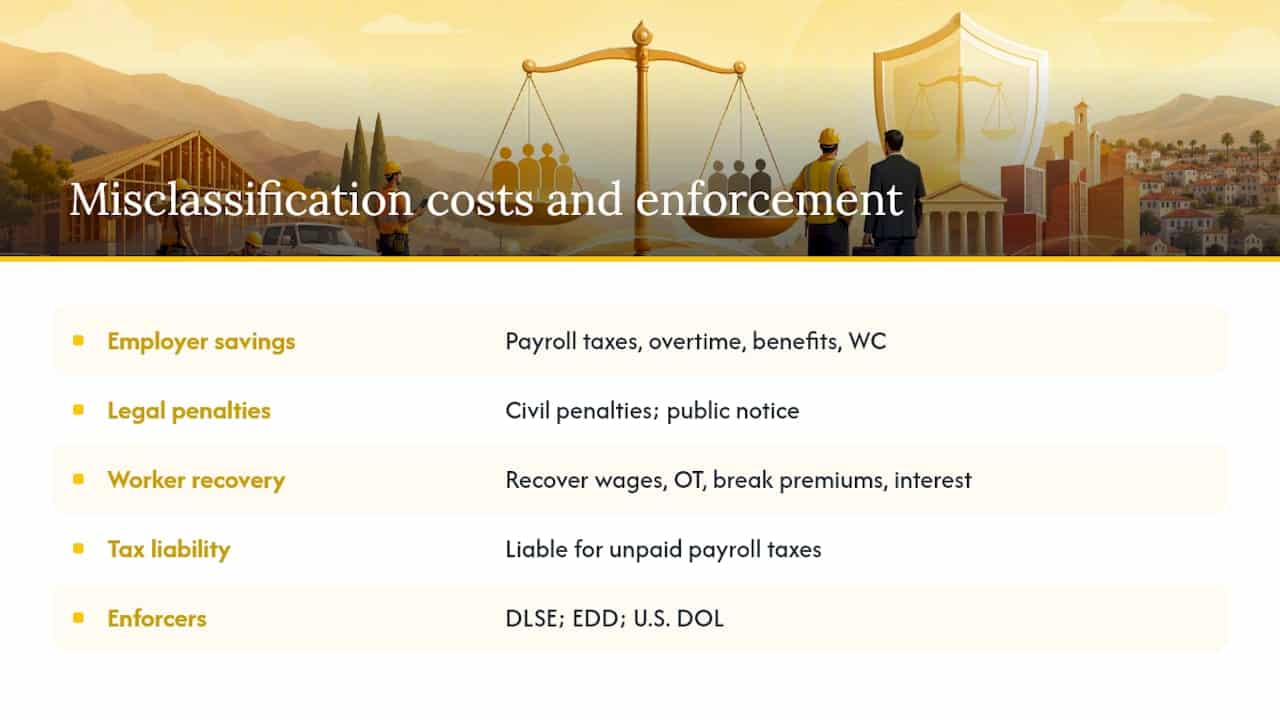
The consequences for getting caught can be steep. Under Labor Code section 226.8, willful misclassification is illegal and can trigger civil penalties along with a public notice requirement once a violation is found. Misclassified workers can recover unpaid wages, overtime, missed meal and rest break premiums, and interest on what they’re owed. The LWDA’s FAQ confirms that employers may also face liability for unpaid payroll taxes on top of these penalties.
Different agencies handle different pieces of this. The DLSE processes wage claims, the EDD pursues payroll tax violations, and the U.S. Department of Labor steps in when federal wage and hour law is also in play.
Acting quickly matters. Wage claims carry statutes of limitations, and evidence gets harder to gather the longer you wait. Here’s a practical order of operations:
Bring these items to whichever path you choose: your contract or offer letter, pay records, correspondence about your schedule or supervision, photos of your workspace if relevant, and the names of coworkers who can back up your account. According to Legal Aid at Work, a mix of paper trail and witness testimony is typically what makes these claims stick. Many employee-side attorneys, including those handling independent contractor misclassification claims, take these cases on contingency so you’re not paying out of pocket while you build your case.
A misclassification claim isn’t just filling out a form. It’s building an argument around the ABC test or Borello factors, backed by evidence that holds up under scrutiny. That’s where an attorney earns their keep.

Optimum Employment Lawyers handles the parts most workers can’t do alone: evaluating whether your situation meets the ABC test’s control and business-independence prongs, gathering documentation, filing DLSE claims, negotiating with employers, and litigating when a fair settlement isn’t on the table. Because the firm works on contingency, you pay nothing upfront. Fees come out of whatever you recover, so there’s no financial risk in finding out where you stand.
Before your free consultation, gather your contract, pay records, and a rough timeline of your work history. During intake, an attorney will walk through whether your classification looks defensible for the employer or not, and outline what recovery might realistically look like. Optimum Employment Lawyers already represents workers across Mission Viejo on these exact claims.

If you’re a Mission Viejo worker wondering whether your “independent contractor” label is legitimate, you don’t need to figure this out alone or pay a retainer to find out. Optimum Employment Lawyers offers a free case review, and because the firm works entirely on contingency, there’s no upfront cost. You only pay if the case results in a recovery.
Most clients hear back within a day or two of reaching out, and the firm will tell you plainly whether your situation looks like a strong misclassification claim or something else entirely. Contact Optimum Employment Lawyers to start your free case review today.
How do I know if I’m misclassified as an independent contractor in Mission Viejo? If your employer controls your schedule, provides your tools, and the work you do is central to their business, you likely fail the ABC test and count as an employee under California law.
What can I recover if I was misclassified? You may recover unpaid overtime, missed meal and rest break premiums, back wages, and interest, and your employer could face civil penalties for willful misclassification.
Does filing a claim cost anything? Not with Optimum Employment Lawyers. The firm works on contingency, so you pay nothing upfront and only pay from a recovery if your case succeeds.
How long do I have to file a misclassification claim? Deadlines vary by claim type, so confirm your specific statute of limitations with the DLSE or an employment attorney as soon as possible rather than assuming you have time.
This article is general information, not a substitute for advice from a qualified lawyer. Consult a qualified legal professional about your own circumstances before acting on anything here.

© 2026 Optimum Employment Lawyers, PC
Legal Disclaimer | Privacy Policy
 Share
Share
