
(949) 954-8181 Free Case Review No recovery, no fee.
(949) 954-8181 Free Case Review No recovery, no fee.
If your work fails any part of California’s ABC test, you are legally an employee and may be owed back pay and benefits. Preserve every pay record now, apply for unemployment through EDD if your income has stopped, and file a wage claim with the Labor Commissioner’s Office or talk to an employment lawyer before evidence disappears.
TL;DR:
- Workers misclassified as contractors often lose access to minimum wage, overtime, paid breaks, workers’ compensation, and unemployment protections, which can amount to thousands of dollars in unpaid wages and benefits.
- To prove misclassification, gathering detailed evidence of control, supervision, tools, and work arrangement is crucial, as agencies prioritize actual work relationships over contract labels.
- Filing for unemployment benefits, wage claims, or lawsuits must be done promptly, especially within deadlines like three years for wage claims or one year for retaliation complaints.
- Employers face significant penalties, including back wages, unpaid premiums, civil fines, and broader audits, if they are found to have systematically misclassified workers.
- Misclassification impacts long-term benefits like health insurance and retirement plans, which are typically only accessible to correctly classified employees.
California starts from the assumption that you are an employee. To classify you as an independent contractor instead, the hiring company must prove all three parts of the ABC test under Labor Code section 2775. Miss any one prong, and the label on your contract does not matter: you are an employee under California law.
A rideshare driver told to follow set routes, wear a company uniform, and work only for one platform likely fails Prong A and Prong C. A delivery worker for a company whose entire business is delivery likely fails Prong B, since the work is not outside the company’s usual operations.
There is a narrow exception. Labor Code section 2775 carves out specific professions and business relationships where the older, more flexible Borello common-law test applies instead of the strict ABC test. These exceptions are limited and fact-specific, so an Irvine worker in construction, delivery, gig platforms, or salon services almost always falls under the ABC test rather than the Borello exceptions.
Misclassification strips away protections that only apply to employees, and each one has a dollar value attached to it.
California’s minimum wage reached $16.90 per hour as of January 1, 2026, which raises the stakes for any Irvine worker who was paid a flat contractor rate below what hourly employee wages would have required.
Tax treatment compounds the damage. A 1099 worker pays both halves of Social Security and Medicare taxes out of pocket, a cost a W-2 employee splits with their employer, on top of losing access to employer-sponsored benefits altogether.
Agencies and courts weigh the actual working relationship over any label in a contract, which means your evidence has to show what really happened day to day.
Pro Tip: Send your records request by email rather than verbally asking HR, so you have a timestamped copy showing exactly when you asked and what you asked for.
The strongest misclassification claims usually come down to who controlled the work. Documenting who set your schedule, who supplied your tools, who supervised your performance, and who had the power to fire you builds the clearest picture of an employment relationship.
Several agencies can act on a misclassification claim, and the right starting point depends on what you need most urgently.
Filing with EDD and filing with DLSE are not mutually exclusive. A favorable EDD determination on your status can support a parallel DLSE wage claim, and either agency’s findings can strengthen a private lawsuit if you decide to pursue one.
An employer that misclassifies workers faces exposure well beyond a single employee’s back pay.
A single Irvine worker’s claim can expose systemic misclassification affecting an entire team, which is part of why employers often move to settle rather than risk a wider audit.
Losing employee status does not just cost wages, it cuts off access to benefits that carry long-term financial weight. Employees are often eligible for employer-sponsored health insurance, while contractors have to buy coverage on their own at full price with no employer contribution.
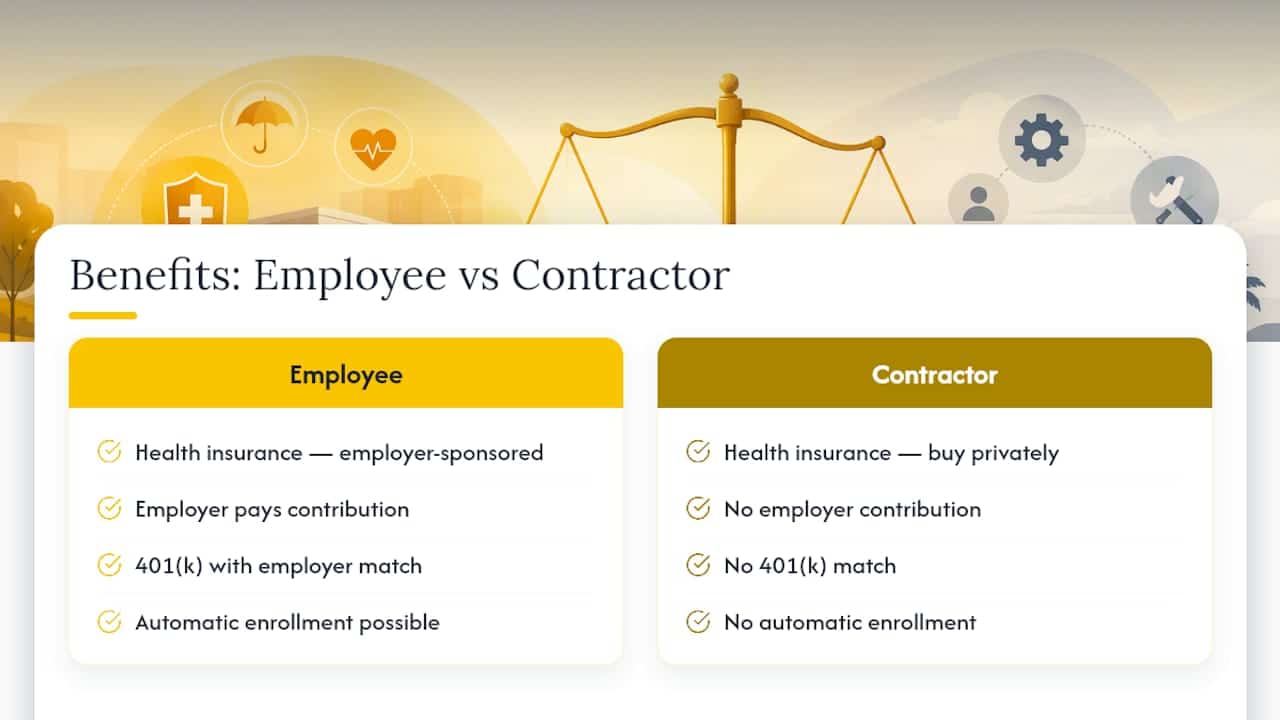
Retirement plans follow the same pattern. Employees may qualify for a 401(k) with an employer match, while a misclassified contractor gets no match and no automatic enrollment, leaving retirement savings entirely on the worker’s own initiative and budget.
Paid time off, disability insurance, and other employer-funded benefits disappear the same way. An Irvine worker classified as a contractor for several years can lose years of retirement contributions and health coverage that a correctly classified employee would have accrued automatically, and recovering that value after the fact is far harder than recovering unpaid wages, since some benefits cannot be reconstructed after the fact even when a claim succeeds.
When misclassification affects more than one worker at a company, a class action can address the pattern instead of forcing each person to file separately. California allows workers who were misclassified under similar conditions, same job title, same contract terms, same company policies, to join together in a single case.
Class actions matter for misclassification because the practice rarely affects just one person. A company that classifies its Irvine delivery drivers, salon technicians, or gig workers as contractors typically applies the same policy across its entire local workforce, which makes group claims a practical way to address the scale of the problem in one proceeding rather than dozens of individual claims.
Collective wage and hour actions can also strengthen leverage, since an employer facing a class of workers has more incentive to settle than one facing a single wage claim. Workers considering whether their situation fits a broader pattern should discuss it with an employment lawyer, since identifying whether a claim is individual or part of a larger group affects both strategy and potential recovery.
Some misclassification claims are simple enough to handle through a DLSE wage claim on your own. Others involve complicated overtime calculations, a group of coworkers in the same situation, retaliation after you raised the issue, or an employer contesting EDD’s findings, and those situations benefit from experienced representation.
Optimum Employment Lawyers represents employees exclusively, never employers, and works on independent contractor misclassification cases for workers across Irvine and Orange County. The firm takes cases on contingency, so you pay nothing upfront: fees come out of a settlement or court award, 40% for a pre-trial settlement or 42% for other wins.
If you believe you were misclassified in Irvine, Optimum Employment Lawyers offers a free case evaluation to review your situation and explain your options at Employees-lawyer.
This article is general information, not a substitute for advice from a qualified lawyer. Consult a qualified legal professional about your own circumstances before acting on anything here.
You are entitled to the same protections as any employee, including minimum wage, overtime, meal and rest breaks, and access to unemployment and workers’ compensation, once your status is corrected. You can pursue these through a DLSE wage claim, an EDD unemployment application, or a private lawsuit.
Value depends on how long you were misclassified, the wages and overtime you were denied, and whether missed meal or rest breaks are included. There is no fixed figure, since it is calculated from your actual pay history and hours worked, which is why a lawyer typically reviews your records before estimating recovery.
Yes, California workers can file a lawsuit for misclassification, in addition to or instead of a DLSE wage claim, and most wage claims carry a three-year filing window. Workers who were misclassified in similar circumstances as coworkers may also be able to join a class action rather than filing individually.
Employers can be ordered to pay back wages, overtime, interest, and missed break premiums, plus civil penalties under Labor Code section 226.8 for willful violations. EDD can also assess back payroll taxes, interest, and penalties once it determines workers were misclassified, and one claim can trigger a broader audit of the employer’s workforce.

© 2026 Optimum Employment Lawyers, PC
Legal Disclaimer | Privacy Policy
 Share
Share
