
(949) 954-8181 Free Case Review No recovery, no fee.
(949) 954-8181 Free Case Review No recovery, no fee.


Receiving a wrongful termination notice can feel like the ground has shifted beneath you. The shock is real, but so is your legal power to respond. Knowing how to respond to a wrongful termination notice correctly and promptly can mean the difference between protecting your rights and losing them entirely. California offers some of the strongest employee protections in the country, and this guide walks you through every step: understanding what happened, gathering your evidence, drafting your response, and taking the legal action that puts you in the best possible position.
| Point | Details |
|---|---|
| Act without delay | Deadlines for filing claims are strict; missing them can permanently bar your case. |
| Gather documentation first | Request your personnel file immediately before your employer can alter or discard records. |
| Write a factual response | Keep your written reply professional and evidence-based to protect your legal position. |
| Know your filing options | You may need to file with the EEOC or California’s Civil Rights Department before suing. |
| Get legal counsel early | An employment attorney can identify claims you may not recognize on your own. |
Before you write a single word in reply, you need to understand what wrongful termination actually means under California law. Not every unfair firing is legally wrongful, and that distinction matters enormously for how you build your response.
California is an at-will employment state, which means an employer can generally fire you for any reason or no reason at all. However, that rule has significant exceptions. Your termination becomes legally wrongful when it crosses specific lines.
Common grounds for wrongful termination in California include:
The EEOC enforces federal anti-discrimination laws, and California’s Civil Rights Department (formerly DFEH) enforces state-level protections. In many cases, both agencies are relevant to your situation. Understanding which laws apply to your firing directly shapes the legal response you will craft.
One more distinction worth knowing: if your working conditions became so intolerable that you were forced to quit, that situation may qualify as constructive discharge, which courts treat as a termination. Your rights in that scenario are largely the same.
Your response is only as strong as the evidence behind it. Before you draft anything, take these steps in order.
Request your complete personnel file immediately. California law gives employees the right to inspect and copy their personnel records. Requesting your file promptly prevents your employer from altering or discarding documents that could support your claim. Do this in writing and keep a copy of your request.
Read your termination letter carefully. A proper termination letter should clarify the effective date, the stated reason for termination, final pay information, benefits continuation details, and any property return requirements. Note exactly what reasons are given, because those stated reasons become the foundation of your dispute.
Build a timeline of events. Write down every relevant interaction, performance review, complaint you filed, or incident that preceded your termination. Include dates, names, and what was said or written. Memory fades quickly under stress, so do this now.
Preserve all communications. Save emails, text messages, voicemails, and any written documentation from your employer. Print or screenshot anything stored on company systems before your access is cut off.
Note what is missing from your notice. Termination letters should be factual and clear. If yours is vague, contradictory, or omits required information like final pay details, that itself can be relevant evidence.
Pro Tip: Many employees do not realize that California law restricts an employer’s ability to withhold or alter your personnel file once you request it. That file may contain performance reviews, disciplinary records, and internal notes that directly contradict the stated reason for your firing.
| Document type | Why it matters |
|---|---|
| Personnel file | Contains performance history, prior reviews, and disciplinary records |
| Termination letter | States the official reason; contradictions become evidence |
| Communications | Emails and texts can show discriminatory intent or retaliation patterns |
| Timeline of events | Establishes context and sequence that supports your claim |

Once you have reviewed your notice and gathered your initial evidence, you are ready to write your wrongful dismissal response. This letter is a legal document. Treat it that way.
Follow these steps when composing your response:
Acknowledge receipt of the notice. State clearly that you received the termination letter on a specific date. This creates a written record and establishes your response timeline.
State your intent to dispute. If you believe the termination was unlawful, say so directly and professionally. You do not need to prove your case in this letter. You only need to put your employer on notice that you are disputing the action.
Address the stated reasons with facts. For each reason your employer gave, respond with factual information that contradicts or contextualizes it. Reference specific documents, dates, or events. Do not speculate and do not editorialize.
Request clarification or corrections if needed. If the letter contains factual errors or omits required information such as final pay details, request those corrections in writing.
State the outcome you are seeking. Be clear about what you want: reinstatement, back pay, severance, or a neutral employment reference. Stating your desired outcome early signals that you are serious and organized.
Submit within any stated deadlines. Some termination notices include response windows. Even when they do not, responding within 10 to 14 business days is standard practice and demonstrates that you are acting in good faith.
Your wrongful termination appeal letter should also avoid these specific pitfalls:
Pro Tip: Responding factually and professionally without emotional language strengthens your legal position significantly. Anything you write can be used in future proceedings, so every word counts.
Submitting your response is not the end of the process. It is the beginning of the formal dispute. Here is what to do next.
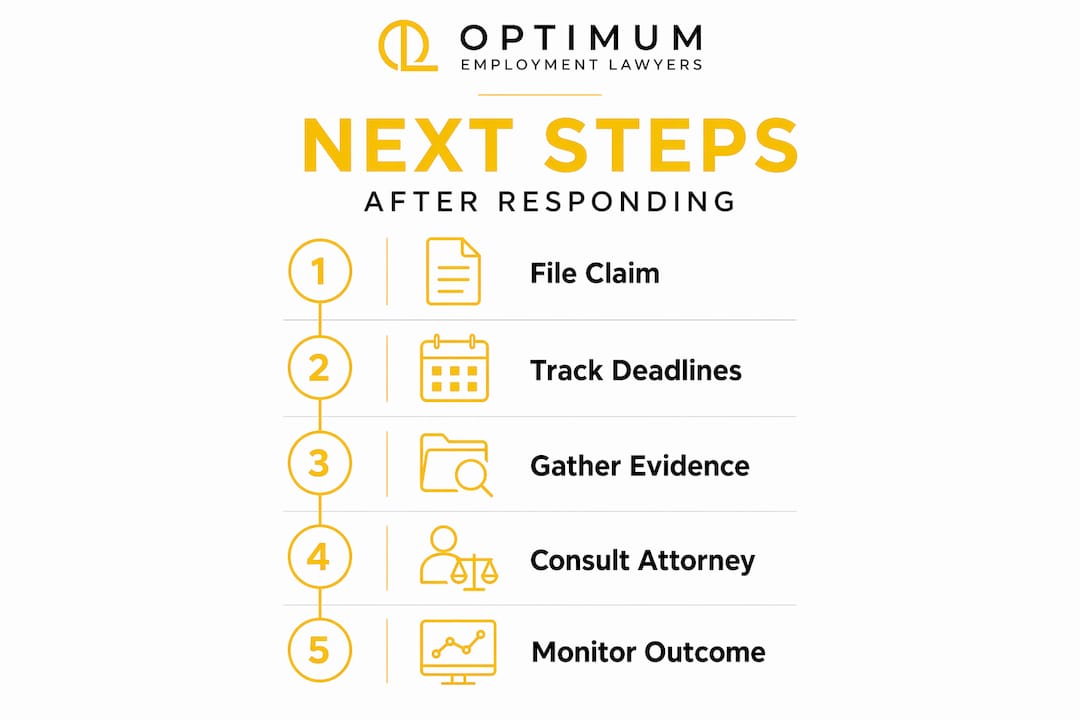
Filing with the EEOC or California’s Civil Rights Department
If your termination involved discrimination or retaliation, you will generally need to file an EEOC charge before you can sue in federal court. The process works like this:
That 90-day window is not flexible. Missing the lawsuit deadline after receiving your right-to-sue letter will almost certainly bar your federal claims permanently. California state claims have their own separate deadlines, which you can review in detail through resources on California lawsuit deadlines.
Mediation as an option
Before a lawsuit is filed, mediation is a common voluntary step that the EEOC or state agencies may facilitate. Mediation does not decide who is right or wrong. It creates a structured conversation aimed at reaching a settlement. Many wrongful termination cases resolve at this stage, often faster and with less cost than litigation.
“The goal of mediation is not to win an argument. It is to find a resolution that compensates you fairly without the uncertainty of a trial. For many California employees, it is the most practical path to justice.”
When to hire an employment attorney
The honest answer is: as early as possible. An experienced California employment attorney can identify claims you may not recognize, advise you on which agency to file with, and help you avoid the procedural mistakes that sink otherwise valid cases. If you were fired under circumstances involving workplace discrimination, retaliation, or a contract breach, the complexity of your case makes legal counsel especially valuable.
Knowing what not to do is just as important as knowing what to do. These are the errors that most frequently damage wrongful termination claims.
Pro Tip: Before making any high-stakes decision, including whether to sign a severance agreement or accept a settlement offer, consult a California employment attorney. A single conversation can prevent a costly mistake.
I have seen hundreds of wrongful termination cases, and the ones that succeed almost always share one thing: the employee acted quickly and kept their composure. The ones that struggle? They waited, they vented in writing, or they signed documents they did not fully understand.
What I have learned is that most employees underestimate the power of their own documentation. A well-organized timeline, a properly requested personnel file, and a calm, factual response letter can shift the entire dynamic of a dispute before an attorney ever gets involved. Employers count on employees being too overwhelmed to act strategically. Proving them wrong starts with your very first response.
I also want to push back on a common misconception: many people believe that because California is an at-will state, wrongful termination claims are a long shot. That is simply not accurate. California’s employee protections are among the strongest in the nation, and the courts here take discrimination and retaliation claims seriously. The problem is not the law. The problem is when employees delay until their options narrow.
If you are reading this after receiving a notice, you are already doing the right thing. Keep going.
If you have received a wrongful termination notice in California, Optimum Employment Lawyers is built for exactly this situation. The firm focuses exclusively on employee-side cases, which means every strategy, every resource, and every attorney on the team is working in your corner. From helping you understand your termination rights to guiding you through EEOC filings and lawsuit deadlines, the firm provides the kind of personalized representation that makes a measurable difference.
Optimum Employment Lawyers has secured significant results for California employees, including a $2.2 million class action settlement. Whether your case involves discrimination, retaliation, or a contract breach, the team can evaluate your situation confidentially and help you understand your options. Visit Optimum Employment Lawyers to schedule your case evaluation and take the next step toward protecting your rights.
Responding to a wrongful termination notice means submitting a written reply that acknowledges the termination, disputes the stated reasons with factual evidence, and formally puts your employer on notice that you intend to challenge the action.
Timelines vary by claim type, but if you file an EEOC charge, you have 180 days for the investigation and then 90 days after receiving your right-to-sue letter to file a federal lawsuit. Missing that 90-day deadline typically bars your federal claims permanently.
Yes. California law gives you the right to inspect and copy your personnel records after termination. Requesting your file immediately after receiving your notice is one of the most important steps you can take to preserve evidence.
No. Severance agreements frequently include waivers of your legal rights, including your right to sue for wrongful termination. Review any agreement with an employment attorney before signing.
A vague or incomplete termination letter is itself a red flag. Termination letters should state the reason, effective date, and final pay details. If yours does not, request written clarification and consult an attorney about what the omission may signal.

© 2026 Optimum Employment Lawyers, PC
Legal Disclaimer | Privacy Policy
 Share
Share
