
(949) 954-8181 Free Case Review No recovery, no fee.
(949) 954-8181 Free Case Review No recovery, no fee.
A class action employment lawsuit is a legal action filed by a group of employees who suffered the same workplace violation, allowing them to pursue justice together under California law. Class Action Employment Lawsuits in Laguna Beach follow this same structure, and they have become an increasingly common tool for workers facing systemic wage theft, wrongful termination, and workplace discrimination in Orange County. California’s Labor Code gives employees some of the strongest workplace protections in the country, and class actions put those protections within reach for workers who could never afford to sue alone. Optimum Employment Lawyers has secured results like a $2.2 million settlement for a class action involving missed meal breaks, proving that collective legal action delivers real outcomes.
Laguna Beach employment claims span several legal categories, but wage and hour violations are the most frequent trigger for class action litigation. Orange County Superior Court filings in 2026 highlight frequent complaints for unpaid overtime, employee misclassification, and mandated unpaid phone expenses. That pattern reflects a broader reality: employers in hospitality, healthcare, and retail often apply the same unlawful policy to dozens or hundreds of workers at once, which is exactly the condition that makes a class action viable.
The most common claim types in Laguna Beach class actions include:
| Claim type | Relevant California law | Typical remedy |
|---|---|---|
| Unpaid overtime | Labor Code Section 510 | Back pay plus penalties |
| Meal and rest break violations | Labor Code Section 226.7 | One hour of pay per missed break |
| Employee misclassification | AB 5 / Labor Code Section 2775 | Back wages, benefits, expense reimbursement |
| Workplace discrimination | FEHA / Government Code Section 12940 | Damages, policy changes, attorney fees |
| Unreimbursed business expenses | Labor Code Section 2802 | Full reimbursement plus interest |
Pro Tip: Keep personal records of every missed break, unpaid hour, and expense you covered out of pocket. Detailed notes with dates and amounts become critical evidence when an attorney evaluates whether your situation qualifies for a class action.

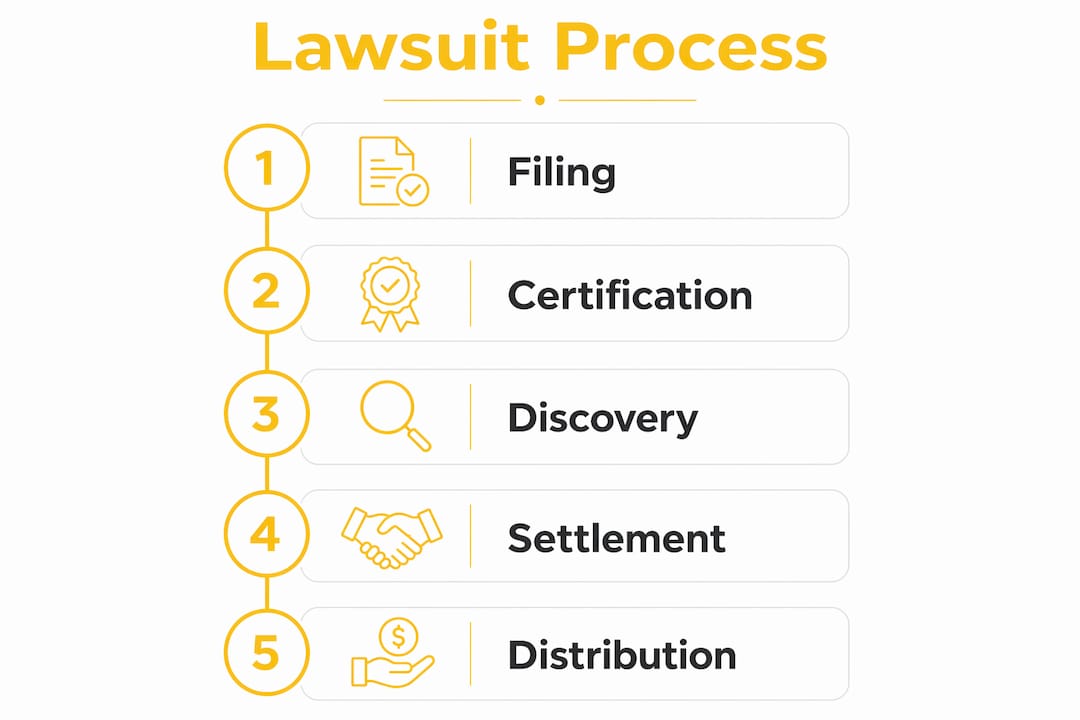
The class action lawsuit process follows four defined phases. Knowing what to expect at each stage helps you make informed decisions about participation.
Filing and pleadings. One or more employees file a complaint in court, naming the employer and describing the shared violation. These initial plaintiffs are called “named plaintiffs” or “lead plaintiffs.” The complaint outlines the legal claims and identifies the proposed class of affected workers.
Class certification. This is the most critical phase. The court reviews whether the case meets the requirements of Rule 23 of the Federal Rules of Civil Procedure, or its California state equivalent. The judge evaluates whether the class is large enough, whether the legal questions are common to all members, and whether the named plaintiffs can adequately represent the group. Without certification, the case cannot proceed as a class action.
Discovery. Both sides exchange evidence, including payroll records, scheduling data, internal communications, and employee files. Discovery is often where the full scope of an employer’s violations becomes clear. Class actions address harms that are too small for individuals to litigate alone but large collectively, and discovery is where that collective scale becomes documented fact.
Settlement or trial. Over 90% of class action employment lawsuits settle before trial. That figure reflects a shared incentive: employers want to limit liability and publicity, while employees want guaranteed compensation. Settlement negotiations follow discovery and result in a distribution plan for class members.
Court approval under Rule 23(e) ensures settlements are fair, reasonable, and adequate, with judicial scrutiny of attorney fees and settlement terms before any money changes hands.
After a settlement receives court approval, class members receive formal notices describing their rights, the settlement amount, and the deadline to file a claim. Class members typically have 60–120 days to submit claim forms after notification. Missing that deadline means forfeiting compensation, even if you were clearly harmed.
The entire process from filing to settlement can take one to three years. That timeline is long, but the collective nature of the lawsuit means you share the legal burden with other affected workers rather than carrying it alone.
California law prohibits employers from retaliating against employees who participate in class action lawsuits. Labor Code Section 98.6 and Section 1102.5 both protect workers who report violations or participate in legal proceedings. Retaliation includes termination, demotion, reduced hours, and hostile treatment. An employer who retaliates faces additional legal liability on top of the underlying class action claims.
Anonymity is a real but limited protection. Class actions provide some anonymity in early litigation phases because most class members are simply identified as part of the group, not named individually in court documents. Named plaintiffs, however, have higher visibility and face greater exposure to employer scrutiny. That distinction matters when you decide whether to step forward as a lead plaintiff or participate as a class member.
Key protections and practical safeguards for participating employees include:
Pro Tip: If you suspect your employer is retaliating after you joined a class action, document every incident in writing with dates, times, and witnesses. Report it to your attorney immediately. Retaliation claims can significantly increase the damages an employer faces.
Consult an employment attorney early, before you take any action at work that could be misread as insubordination. Experienced counsel helps you participate safely and understand exactly what your involvement requires.
Eligibility for a class action depends on whether you experienced the same type of violation as other class members during the relevant time period. You do not need to find the other workers yourself. The legal process handles that through court notices and public filings.
Steps to determine eligibility and take action:
The statute of limitations matters. California generally allows three years to file wage and hour claims and one year for certain Labor Code penalty claims. Waiting too long can eliminate your right to participate entirely. If you believe your employer violated your rights, the time to act is now, not after the deadline passes.
Pro Tip: Even if you have already left the employer, you may still qualify as a class member. Eligibility is based on when the violation occurred, not whether you currently work there.
Laguna Beach employees working in hospitality, retail, healthcare, and service industries are particularly well represented in recent Orange County class action filings. If your employer applied a uniform policy that affected your pay, breaks, or classification, that uniformity is the foundation of a class action claim.
Optimum Employment Lawyers focuses exclusively on employee-side cases throughout California, including class action employment lawsuits filed by Laguna Beach workers. The firm has a documented record of results, including a $2.2 million settlement for a class action involving missed meal breaks. That outcome reflects the firm’s approach: aggressive legal strategy combined with a genuine understanding of what workplace violations cost employees financially and professionally.
If you believe your employer violated your rights, a confidential consultation with a Laguna Beach employment attorney at Optimum Employment Lawyers costs you nothing upfront. The firm works on contingency, meaning you pay only if your case results in a recovery. Whether you are dealing with unpaid wages, misclassification, or a discriminatory workplace policy, the legal team at Optimum Employment Lawyers can evaluate your situation and explain your options clearly.
Class action employment lawsuits give Laguna Beach workers the legal power to hold employers accountable for systemic violations that no single employee could challenge alone.
| Point | Details |
|---|---|
| Class actions address systemic violations | Wage theft, misclassification, and break violations affecting multiple workers are the most common triggers in Laguna Beach. |
| Four defined legal phases | Filing, class certification, discovery, and settlement or trial define the process from start to finish. |
| Most cases settle before trial | Over 90% of employment class actions resolve through settlement, with court approval required to protect class members. |
| Claim deadlines are strict | Class members typically have 60–120 days after notice to file a claim; missing the deadline forfeits compensation. |
| California law protects participants | Anti-retaliation statutes and contingency fee arrangements make joining a class action financially and legally safer for employees. |
A class action employment lawsuit is a legal case filed by a group of employees who experienced the same workplace violation, such as unpaid wages or discrimination, allowing them to pursue compensation collectively rather than through separate individual suits.
You qualify if you experienced the same type of violation as other class members during the covered time period. Check your mail for court notices, review your pay records for discrepancies, and consult an employment attorney to confirm eligibility.
Missing the claims filing deadline, which is typically 60–120 days after court-approved notification, means you forfeit your right to compensation even if the violation clearly affected you.
Retaliation for joining a class action is illegal under California Labor Code Sections 98.6 and 1102.5. An employer who retaliates faces additional legal liability on top of the original class action claims.
Most employment class actions take one to three years from filing to settlement or trial, depending on the complexity of the case and the pace of class certification and discovery.

© 2026 Optimum Employment Lawyers, PC
Legal Disclaimer | Privacy Policy
 Share
Share
