
(949) 954-8181 Free Case Review No recovery, no fee.
(949) 954-8181 Free Case Review No recovery, no fee.
If someone at your workplace in Brea propositions you sexually, California’s Fair Employment and Housing Act (FEHA) already protects you, and a single severe incident can be enough to make it illegal. Your options include documenting what happened, reporting it internally, filing with the California Civil Rights Department (CRD) or the federal EEOC within their respective deadlines, and calling 911 if you were assaulted or threatened. Talking to a California employment lawyer early costs nothing and can shape every decision that follows.
TL;DR:
- A single severe sexual proposition from a supervisor can be enough to establish harassment under California law, regardless of repetition.
- Evidence should be documented immediately, including detailed notes, screenshots of messages, and emergency reports if safety is at risk.
- Employers must implement anti-harassment policies, provide training, and investigate complaints impartially, even if harassment occurs only once.
- Filing deadlines differ: California allows up to three years for CRD complaints, while EEOC claims are limited to 300 days, requiring timely action.
- Seeking legal advice early, especially when facing assault or employer dismissiveness, can protect your rights and strengthen your claim without upfront costs.
What you do in the first few days after a sexual proposition at work often determines how strong your case looks later. Safety comes first, evidence comes second, and paperwork comes third.
Pro Tip: Keep your notes and screenshots somewhere your employer can’t access, like a personal email account or a printed copy at home. Evidence stored only on a company laptop can disappear the moment you’re locked out of your accounts.
A sexual proposition is a form of sexual harassment under FEHA, and California defines that broadly. It includes verbal requests for sexual favors, visual conduct like explicit images or gestures, and physical conduct of a sexual nature, according to California’s Department of Industrial Relations. The law recognizes two main categories, and knowing which one applies to your situation shapes how you frame a complaint.
California’s standard, set out in Government Code §12923, rejects the idea that harassment has to repeat itself to count. One severe proposition, especially from a supervisor, can be enough on its own. These protections extend to employees, job applicants, unpaid interns, and even independent contractors, regardless of how small the employer is, per the California Civil Rights Department.
California doesn’t leave harassment prevention to an employer’s discretion. Under Government Code §12940(k), employers have an affirmative duty to take reasonable steps to prevent and promptly correct harassing conduct, and state regulations spell out what that looks like in practice.
One detail catches a lot of employees off guard: completing mandated training does not shield an employer from liability if harassment still occurs and the company fails to correct it. The CRD’s Harassment Prevention Guide makes clear that training is a floor, not a legal shield, and that anonymous complaints still need investigation when they contain enough detail to act on.
Strong cases are built on details captured close to the moment, not reconstructed months later. A contemporaneous note carries far more credibility than a memory refreshed right before a deposition.
Pro Tip: Ask any coworker who witnessed the incident to write their own account and date it, even informally. A witness statement written the same week is worth far more than one recalled a year into litigation.
You don’t have to exhaust your company’s internal HR process before going to a state or federal agency, and in some cases waiting too long on HR can cost you filing time you can’t get back.
Outcomes vary by case, but California law allows for meaningful compensation when harassment is proven. Available remedies include back pay, compensatory and punitive damages, reinstatement, and injunctive relief requiring policy changes at the company.
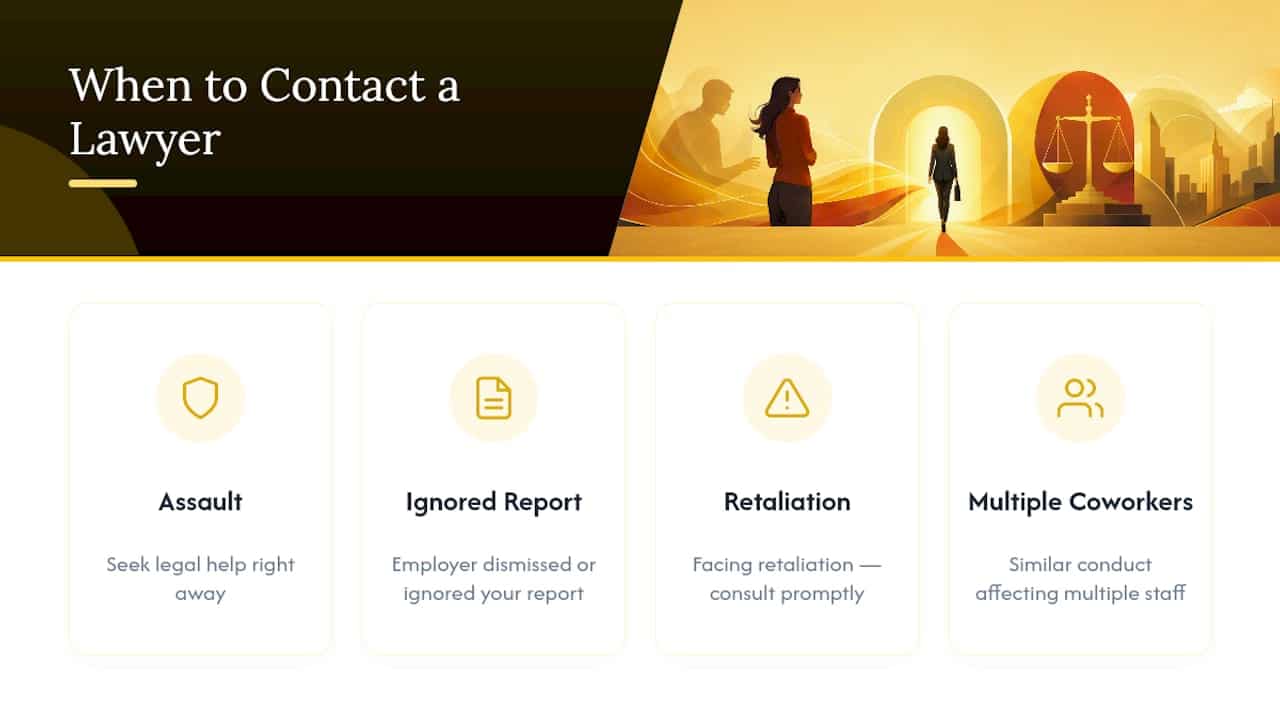
Certain situations call for legal help right away, not after months of waiting to see how things unfold. If you were assaulted, if your employer ignored or dismissed your report, if you’re facing retaliation, or if multiple coworkers experienced similar conduct, a lawyer’s input early can protect both your safety and your claim’s value.
Some employment law firms work exclusively on the employee side, never representing employers, which can shape how aggressively a case gets pursued from day one. Contingency-fee models mean clients pay nothing upfront. Some firms have achieved significant settlements over missed meal breaks, which illustrate what employee-side representation can achieve. Bring your written notes, saved messages, and any internal report confirmations to a consultation, and expect a free case evaluation before any commitment is required.
Filing a complaint on your own means navigating CRD deadlines, EEOC paperwork, and an employer’s legal team without anyone in your corner. Optimum Employment Lawyers is the alternative to going it alone: the firm represents only employees, never employers, and takes sexual harassment, retaliation, and wrongful termination cases on a contingency-fee basis, meaning you owe nothing unless you win. For Brea workers weighing whether a proposition crossed a legal line, the firm’s page on sexual propositions in the workplace breaks down how these claims typically play out.
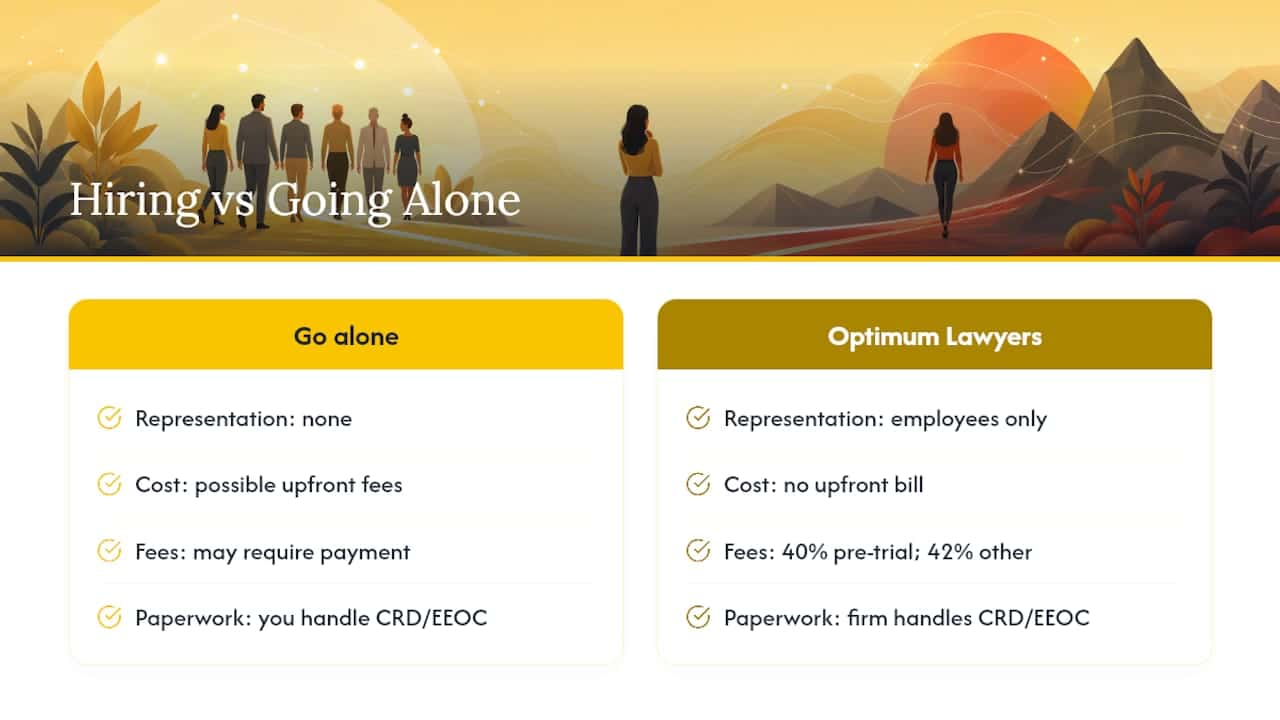
Fees run 40% on a pre-trial settlement or 42% on other wins, detailed on the firm’s cost and fee structure page, so there’s no upfront bill to worry about while you’re already dealing with a hostile situation at work. If you’re in or near Brea and need to know where you stand, schedule a free case evaluation and get a straight answer on your options before any deadline passes.
This article is general information, not a substitute for advice from a qualified lawyer. Consult a qualified legal professional about your own circumstances before acting on anything here.
Yes. Under California Government Code §12923, one severe incident can be legally sufficient without needing a pattern of repeated conduct.
California’s CRD generally allows up to three years to file a harassment complaint, while the federal EEOC deadline is typically 300 days, so the two tracks move on very different clocks.
No. California regulations require complaint channels that don’t force reporting only to a direct supervisor, since that person may be the source of the harassment.
Optimum Employment Lawyers works on contingency, charging 40% on pre-trial settlements or 42% on other wins, with no upfront cost to the client.
Call 911 immediately if you were physically assaulted or threatened; for propositions without physical contact, a police report is optional but documentation and an internal or agency complaint still matter.

© 2026 Optimum Employment Lawyers, PC
Legal Disclaimer | Privacy Policy
 Share
Share
