
(949) 954-8181 Free Case Review No recovery, no fee.
(949) 954-8181 Free Case Review No recovery, no fee.
Don’t sign anything the day you receive it. California law gives you a review window before you agree to a separation deal, the right to talk to an attorney first, and limits on what your employer can legally ask you to accept. If your severance offer includes a broad release, a nondisparagement clause, or anything that feels rushed, Optimum Employment Lawyers can review the agreement for Huntington Beach employees before you put ink on paper.
TL;DR:
- Severance pay typically amounts to one or two weeks of pay per year of service, but specific calculations like the rule of 70 can also apply.
- California law mandates at least five business days for review and attorney consultation before signing a severance agreement, especially if broad releases or nondisparagement clauses are involved.
- Employers cannot require nondisparagement clauses that block reporting unlawful workplace conduct, and out-of-state dispute clauses are generally unenforceable for California employees.
- Always request and confirm in writing key details such as payment timing, COBRA coverage, and equity treatment before signing, to avoid losing rights or facing unexpected terms.
- Call an employment lawyer if the severance offer hints at discrimination, retaliation, or complex equity issues, or if the agreement contains overly broad or suspicious provisions.
Every severance agreement is built from the same handful of parts, even when the language changes from employer to employer. Knowing which piece is which tells you what’s actually negotiable and what’s boilerplate.
The financial terms carry the real weight:
Then come the non-monetary clauses: a general release of claims, confidentiality obligations, a nondisparagement provision, and sometimes a non-compete or non-solicit clause. California generally does not enforce non-compete agreements against employees, which gives you more room to push back on that clause than most people realize.
What’s usually negotiable: the payment amount, the length of benefits continuation, carve-outs for specific claims, and a neutral reference commitment from the employer. Read every line before assuming any of it is fixed. If a document was ever offered to you as your employment agreement, you’re entitled to a copy under California Labor Code §432, and you should request one in writing if you don’t have it.
Three statutes do most of the work limiting what a Huntington Beach employer can put in your severance agreement, and knowing them by name gives you real leverage in a negotiation.
Gov. Code §12964.5 makes it unlawful for an employer to require a nondisparagement clause that blocks you from disclosing unlawful workplace conduct. It also requires the employer to notify you of your right to consult an attorney and give you a review period of not less than five business days before signing. There are carve-outs for negotiated settlement agreements, but a standard separation offer handed to you at a termination meeting doesn’t qualify.
Lab. Code §925 protects employees who primarily live and work in California from being forced to resolve disputes under another state’s law or in another state’s courts. If your contract says disputes go to Delaware or Texas, that provision is voidable at your election, and a court can even award you attorney’s fees for enforcing that right.
Lab. Code §432 gives you the right to a copy of any instrument relating to your employment on request, which matters more than it sounds. Employers sometimes reference policies, handbooks, or side letters that were never handed over. You’re entitled to see them.
Statutory snapshot: §12964.5 requires at least five business days to review a separation agreement and consult counsel; §925 lets California-based employees void out-of-state forum clauses; §432 guarantees a copy of employment-related documents on request.
These aren’t just compliance footnotes. They’re negotiation leverage, because an employer who skipped the notice requirement or slipped in an out-of-state forum clause has handed you grounds to push back before you sign anything.
Some severance language is standard. Some of it should stop you cold. Here’s what deserves a second look before you sign anything an employer in Huntington Beach puts in front of you.
Pro Tip: Keep a copy of every version of the agreement your employer sends you, including redlines. If negotiations fall apart, those drafts show what the employer was willing to offer, which matters if the dispute ever goes further.
Large employers sometimes structure severance in tiers, tying supplemental benefits to signing a release, a practice visible in public severance plan filings from major companies. That structure isn’t illegal, but it means the “extra” money often comes with more strings attached than the base payout.
Treat the days right after you receive an offer as your highest-leverage window. Here’s the order that works.
Severance may already be owed to you contractually, not just offered as a courtesy, if it was promised in a handbook or prior written policy. Severance sometimes qualifies as a contractual obligation rather than a discretionary gesture, which is worth raising if your employer treats the number as fixed.
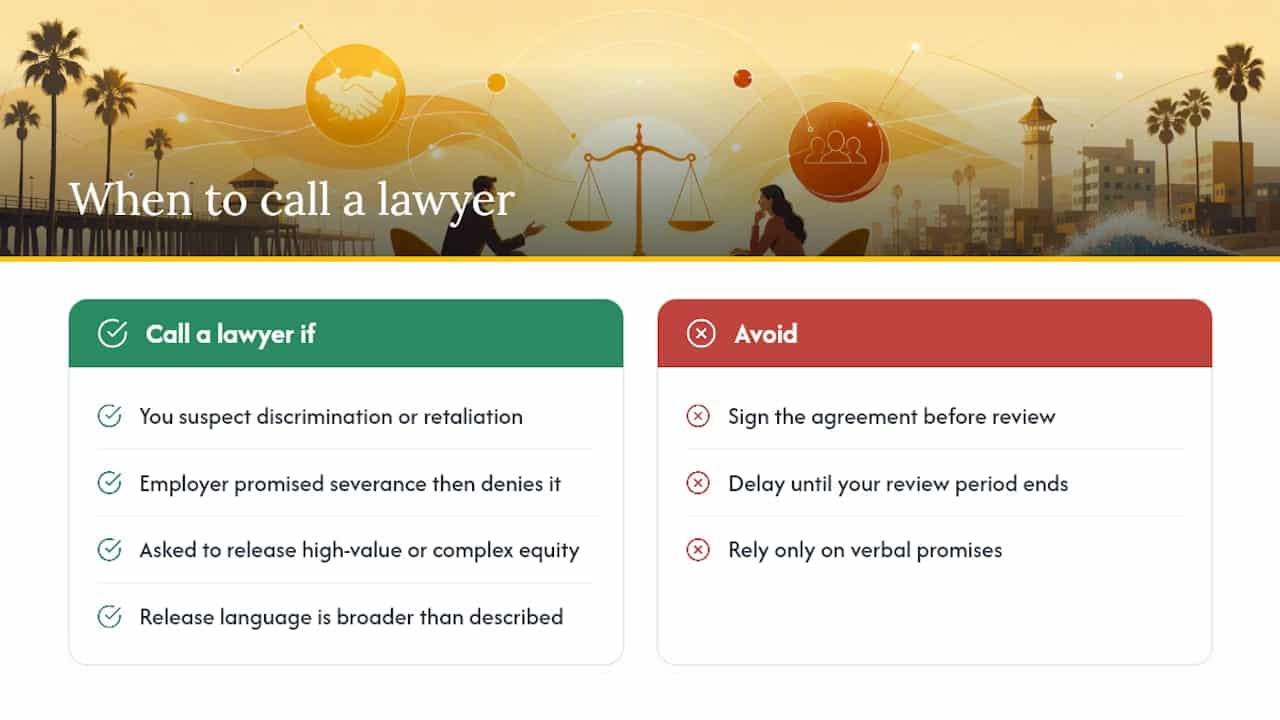
Some severance offers are clean. Others hide a legal problem behind polite language. Call an attorney before signing if you suspect discrimination or retaliation played any role in your termination, if your employer promised severance verbally or in a handbook and now denies it, if you’re being asked to release high-value or complex equity, or if the release language is broader than anything described above.
Optimum Employment Lawyers works exclusively on the employee side of California workplace disputes, including wrongful denial of severance, discrimination, and wage claims, and has secured results including a $2.2 million class action settlement over missed meal breaks. The firm represents employees throughout Huntington Beach on a contingency basis, meaning there’s no upfront cost to have your agreement reviewed.
Bring your offer letter, the proposed separation agreement, any performance reviews, and a timeline of events leading to your departure to an intake call. A contract and severance agreement review typically walks through what’s enforceable, what’s negotiable, and whether any clause crosses a line the law doesn’t allow. If your situation involves questions about high-risk termination practices your employer may have followed, general guidance on those risk factors can help you understand what employers are often trained to avoid. When you’re ready to move forward, contact Optimum Employment Lawyers to have your specific agreement reviewed before the clock on your review period runs out.
Get every promise in writing before you sign anything. Verbal assurances from HR disappear the moment there’s a dispute.
Ask HR directly: “Can you confirm this in an email so I have it for my records?” Most HR representatives will comply because it protects them too. If they won’t put it in writing, that hesitation tells you something on its own, and it’s worth revisiting the offer with a detailed review of the severance language before you respond.
This article is general information, not a substitute for advice from a qualified lawyer. Consult a qualified legal professional about your own circumstances before acting on anything here.

© 2026 Optimum Employment Lawyers, PC
Legal Disclaimer | Privacy Policy
 Share
Share
