
(949) 954-8181 Free Case Review No recovery, no fee.
(949) 954-8181 Free Case Review No recovery, no fee.
If your employer in Irvine denied you a required meal or rest break, you are generally owed one extra hour of pay at your regular rate for each workday it happened, under Labor Code §226.7. That premium applies whether the break was skipped entirely, cut short, interrupted by work, or scheduled too late in your shift.
Before you do anything else, take these three steps:
Irvine’s mix of tech offices, retail centers around the Irvine Spectrum, and healthcare employers makes break violations common in specific, predictable ways. The rest of this guide walks through exactly what the law requires, how violations happen, and how to build a claim that holds up.
California employers owe one hour of premium pay per missed meal or rest break, and Irvine employees generally have three years to claim it.
| Point | Details |
|---|---|
| Premium pay entitlement | Missed meal or rest breaks trigger one hour of pay at your regular rate, per violation, per day. |
| Duty-free requirement | Employers must fully relieve you of duties during meal periods, per the Brinker standard, not just let you clock out. |
| Three-year filing window | Murphy v. Cole confirmed the break premium is a wage, giving you three years to file a claim. |
| Document everything now | Start a contemporaneous shift log today; pay stubs and schedules alone often aren’t enough. |
| Get a case review | Optimum Employment Lawyers offers a contingency-fee case evaluation for Irvine employees with missed break claims. |
California’s meal and rest break rules aren’t vague suggestions. They’re spelled out in the Labor Code and the Industrial Welfare Commission’s wage orders, and courts have sharpened the details over the past decade. If you work a shift in Irvine that runs past five hours, the law gives you a specific, enforceable entitlement, not a courtesy your manager can waive on your behalf.
Meal periods. You’re entitled to a 30-minute, duty-free meal period if you work more than five hours in a day. Work more than ten hours, and you get a second 30-minute meal period, though a few narrow waiver rules apply. Here’s the breakdown:
Rest breaks work differently. You’re owed a 10-minute paid rest period for every four hours worked, or “major fraction thereof,” which in practice means any shift of at least three and a half hours triggers one rest break. Both meal and rest periods should fall as close to the middle of each work period as practical.
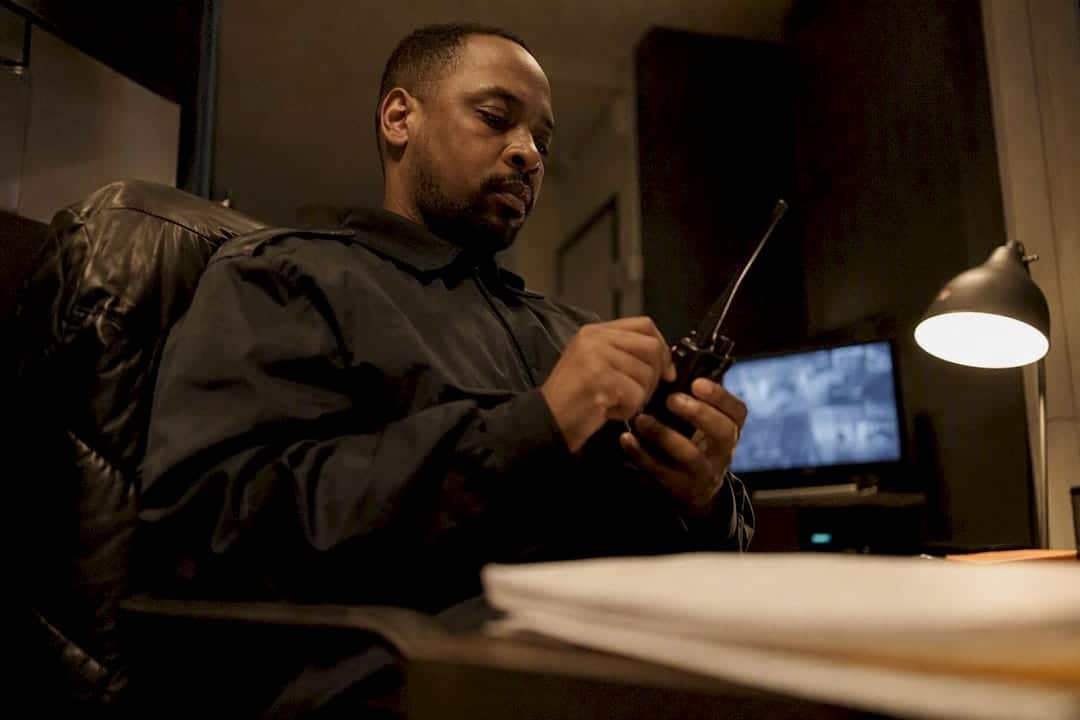
The duty-free standard matters more than most employees realize. Your employer can’t just tell you to clock out for lunch. It has to actually relieve you of all duties: no answering calls, no covering the register “just in case,” no staying reachable on radio. The DLSE’s guidance on meal periods is explicit that on-duty meal periods are permitted only when the nature of the work objectively prevents relief from duty, such as a solo security guard with no relief coverage, and only with a written agreement you can revoke at any time.

Pro Tip: If you signed an “on-duty meal agreement” when you were hired, that doesn’t automatically make every skipped lunch legal. The agreement has to be tied to a genuine job-based necessity, and you can revoke it in writing whenever you choose.
This duty-free requirement traces directly back to Brinker Restaurant Corp. v. Superior Court, the California Supreme Court decision that remains the controlling precedent on what “providing” a meal period actually means. Brinker held that employers must relieve employees of all duty, relinquish control over their activities, and give them a reasonable opportunity to take an uninterrupted 30 minutes, but employers don’t have to police whether employees actually eat. The distinction matters: if your employer scheduled the break and let you go, but you chose to keep working, that’s different from a manager who pressured you to stay at your station.
Employers also have a practical obligation that’s easy to overlook: if you’re required to stay on the premises during a meal period, they must provide a suitable place to sit and eat, according to the DLSE’s rest and meal period guidance. A dark break room with no chairs isn’t compliance.
Most violations don’t look like a manager announcing “no lunch today.” They’re quieter and more structural, which is exactly why so many Irvine employees don’t realize they have a claim until they add up the missed breaks over months.
Here’s what these violations tend to look like on the ground:
The line between voluntary skipping and coerced skipping usually comes down to staffing. If your employer schedules enough people to cover breaks and you personally choose to work through lunch, that’s a harder case. If your employer chronically understaffs shifts so that taking a real break means leaving customers unattended or falling behind on quotas, the “choice” isn’t really a choice, and the employer bears responsibility for the missed break.
Industries with thin staffing margins, restaurants, retail, healthcare, and private security, generate a disproportionate share of these claims. Sole-worker shifts are a particular red flag: if you’re the only person on site, there’s often no one to relieve you, which by definition makes the meal period non-compliant unless your employer has arranged coverage.
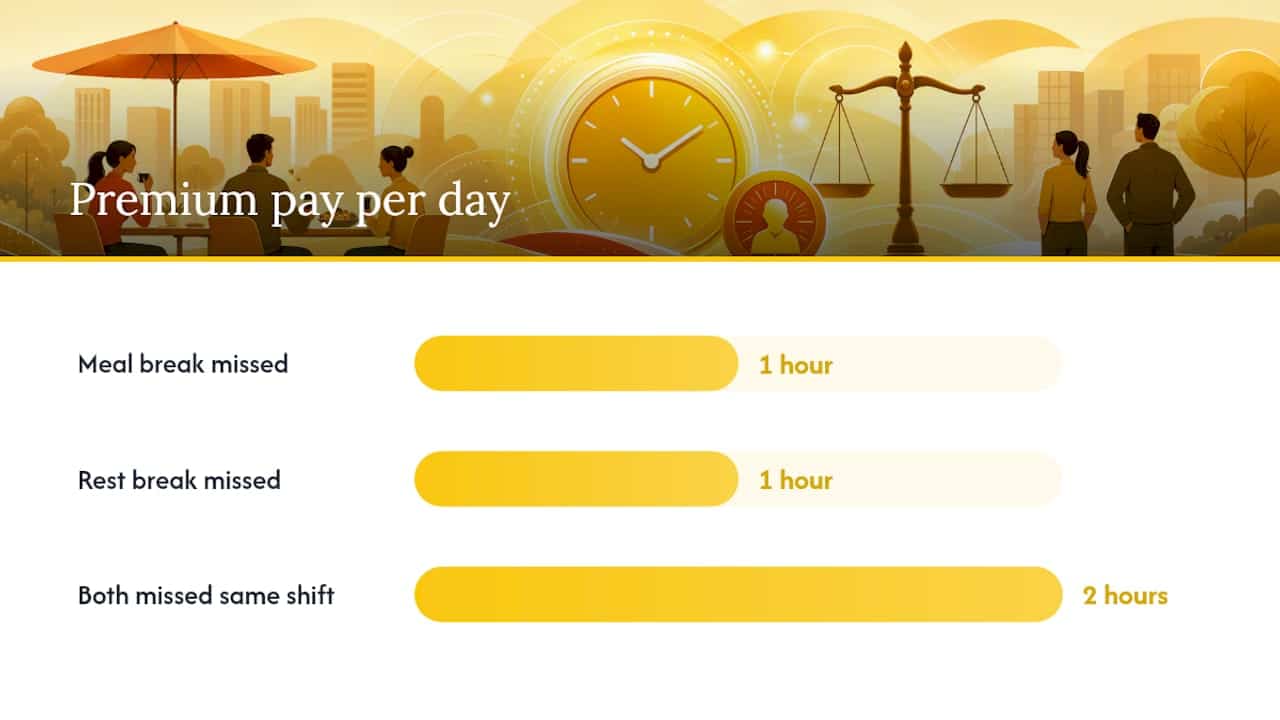
The core remedy is straightforward: one additional hour of pay at your regular rate of compensation for each workday a required meal or rest period wasn’t provided, capped at two premium payments per day (one for meal, one for rest), under Labor Code §226.7. If you missed both a meal break and a rest break on the same shift, you may be owed two hours of premium pay for that single day, not just one.
That premium isn’t a penalty tacked on top of your regular wages. It’s treated as wages itself, which matters for how long you have to claim it and what interest or penalties can attach if your employer refuses to pay.
You generally have three paths to enforce this right, and they aren’t mutually exclusive:
Timing matters more than most people expect. The statute of limitations for meal and rest break premium claims is generally three years from the date of the violation, a rule reinforced by Murphy v. Cole, which classified the one-hour premium as a wage rather than a penalty, and wages get the longer three-year window rather than the shorter period that applies to certain penalty claims. That distinction, wage versus penalty, is why the case matters: it gave employees a meaningfully longer runway to bring claims for missed breaks.
Practically, this means if you left a job in Irvine two years ago after a pattern of skipped lunches, you likely still have time to file. Don’t assume a past job is off the table without checking the actual dates.
Winning a meal break claim isn’t about knowing the law, it’s about proving what actually happened on specific shifts. Here’s the order to work through.
Pro Tip: Keep your break log in a personal notebook or a private note app, not a company system your employer controls. If a dispute arises later, you want records nobody can quietly edit or delete.
Raising a meal break issue is protected activity under California law, meaning your employer can’t legally fire you, cut your hours, demote you, or otherwise punish you for complaining, whether you complain internally, to the DLSE, or to an attorney.
Watch for these warning signs after you raise the issue:
If any of that happens, write down the date, who was involved, and exactly what changed, then compare it to how things worked before your complaint. You can report retaliation directly to the DLSE, which can result in reinstatement, back pay, and additional penalties against the employer on top of whatever you recover for the underlying meal break violations.
Optimum Employment Lawyers represents employees exclusively, never employers, which shapes every part of how the firm builds a meal break case. Attorney Dean Ho and the firm’s team have handled wage and hour disputes across Orange County, including a $2.2 million settlement in a class action involving missed meal breaks, the kind of outcome that reflects what’s possible when a scheduling problem turns out to affect an entire workforce, not just one person.
If you bring your case to Optimum Employment Lawyers, expect a free case evaluation first, where the firm reviews your pay records and shift history to gauge whether you have an individual claim or something broader. From there, the firm helps collect evidence, files DLSE claims or civil suits where appropriate, and typically works on contingency, meaning you owe nothing upfront and pay only if the case recovers money for you.
Filing a DLSE claim on your own is possible, but calculating premium pay across months of shifts, proving a coercive scheduling pattern, and figuring out whether your case is worth pursuing as a class action are exactly the kinds of things a generalist can get wrong. Optimum Employment Lawyers focuses solely on employee-side cases, which means the firm isn’t splitting attention between representing workers one week and employers the next.
For Irvine employees specifically, that focus translates into a faster read on whether your scheduling problem looks like an isolated mistake or a company-wide policy, the distinction that often separates a few hundred dollars in premium pay from a settlement with real leverage. The firm’s meal break violation practice reviews your timesheets and pay stubs at no upfront cost, and because representation is contingency-based, you don’t pay unless the firm recovers money on your behalf.
If you’ve been denied breaks at an Irvine job and want to know what your specific claim might be worth, contact Optimum Employment Lawyers for a case review before your three-year window narrows any further.
Do I have to prove my employer forced me to skip breaks, or is it enough that I never got one?
You don’t need proof of explicit coercion. If your employer never provided a compliant, duty-free break opportunity, that alone is a violation regardless of whether anyone directly told you to skip it. The burden falls on the employer to show it genuinely relieved you of duty.
What if I signed a meal period waiver when I was hired?
A waiver only holds up if your job’s actual duties objectively prevent relief from duty and the agreement is in writing, and you can revoke that waiver at any time going forward. A waiver signed years ago doesn’t lock you out of a claim for breaks you were denied more recently.
Can I still file a claim if I no longer work for the employer?
Yes. Meal and rest break premium claims generally follow a three-year statute of limitations from the date of each violation, regardless of your current employment status.
How is the one-hour premium calculated if I earn a different rate depending on shift or role?
The premium is paid at your regular rate of compensation for that workday, which can include shift differentials or other compensation factored into your regular rate, not just your base hourly wage.
Is it worth filing a DLSE claim, or should I go straight to a lawyer?
For a single, well-documented claim, a DLSE wage claim can resolve things without litigation costs. If your case involves a broader company policy affecting coworkers, talking to a California Employment lawyer first can help you assess whether a class action or PAGA claim would recover significantly more.
This article is general information, not a substitute for advice from a qualified lawyer. Consult a qualified legal professional about your own circumstances before acting on anything here.

© 2026 Optimum Employment Lawyers, PC
Legal Disclaimer | Privacy Policy
 Share
Share
