
(949) 954-8181 Free Case Review No recovery, no fee.
(949) 954-8181 Free Case Review No recovery, no fee.
If you’re a Seal Beach employee who suspects your employer has shorted your pay, the single most important step is to act now — either file a wage claim with the California Division of Labor Standards Enforcement (DLSE) or contact Optimum Employment Lawyers for a free consultation under a contingency-fee arrangement (no upfront cost to you). California law gives you strong protections under the Labor Code, but deadlines are real and evidence disappears fast.
Immediate action checklist:
When to file alone vs. when to call a lawyer now:
Pro Tip: Keep a personal time log in a notes app on your personal phone, not a work device. Record your start time, end time, and any missed breaks every single day. This log can be decisive at a DLSE settlement conference when employer records are incomplete or inconsistent.
Seal Beach employees who act quickly, preserve evidence, and understand their California wage rights are in the strongest position to recover what they are owed.
| Point | Details |
|---|---|
| File or call immediately | File a DLSE wage claim or contact Optimum Employment Lawyers before evidence disappears or deadlines pass. |
| Know your statute of limitations | Most unpaid wage, overtime, and meal/rest break claims have a 3-year filing window under DLSE guidance. |
| Penalties multiply your recovery | Waiting-time penalties (up to 30 days’ wages) and meal-break premiums can far exceed the base unpaid amount. |
| Retaliation is illegal | California Labor Code §98.6 and §1102.5 protect you for filing or complaining; document every adverse action immediately. |
| Optimum Employment Lawyers | The firm handles Seal Beach wage claims on contingency, no upfront fee, with a track record including a $2.2M class-action settlement. |
Seal Beach’s economy runs heavily on hospitality, retail, food service, and local contractors. Those industries are also where California labor law violations show up most often. Here is what to look for.
Unpaid wages and off-the-clock work. California requires employers to pay for every minute worked. Unlike federal law, California does not apply a de minimis exception, meaning even a few minutes of unpaid pre-shift setup or post-shift cleanup is compensable under state law. A restaurant in Seal Beach that requires servers to roll silverware before clocking in owes pay for that time.
An employee working 10-hour shifts four days a week is owed daily overtime even if the weekly total is only 40 hours. This is a common gap in retail and hospitality scheduling.
Missed meal and rest breaks. Under Cal. Lab. Code §226.7, employers must provide a 30-minute unpaid meal break for shifts over 5 hours and a paid 10-minute rest break for every 4 hours worked. When they don’t, each missed break triggers a one-hour premium pay penalty. A hotel worker in Seal Beach who routinely skips lunch because the front desk is understaffed has a recoverable claim for every missed break.

Illegal time-clock rounding. California courts have increasingly limited rounding policies. ADP’s analysis of recent California rulings recommends paying to the minute because rounding must be statistically neutral over time — a standard many employers cannot demonstrate. If your employer rounds your clock-ins forward and your clock-outs back, that pattern is a violation.
Reporting/show-up pay. If you report to a scheduled shift and your employer sends you home after less than half your scheduled hours, California law generally requires reporting time pay of 2–4 hours at your regular rate. This applies to retail workers called in for a shift that gets cut short.
Misclassification as an independent contractor. Seal Beach contractors, gig workers, and delivery drivers are frequently misclassified. California’s ABC test (under AB 5) sets a high bar for independent contractor status. Misclassified workers miss out on overtime, meal breaks, expense reimbursements, and workers’ compensation.
Other violations to watch for:
California Labor Code §203 imposes waiting-time penalties equal to up to 30 days of an employee’s daily wages when an employer willfully fails to pay all final wages at termination. Cal. Lab. Code §226 requires itemized wage statements showing gross wages, hours worked, all deductions, net wages, and the applicable hourly rate. Missing any of these items is itself a violation carrying civil penalties of $50 for the first pay period and $100 for each subsequent period, up to $4,000 per employee.
You don’t need an accountant. A basic audit takes about 30 minutes and can reveal whether you have a claim worth pursuing.
Worked example: Suppose you earn $20/hour and worked Monday through Friday, 9 hours each day (45 hours total). Your employer paid you for 45 hours at straight time.
Multiply that across a year and the number grows fast.
Pro Tip: California does not follow the federal de minimis doctrine — even a few minutes of unpaid work each shift is compensable. If your employer requires you to boot up a computer, put on a uniform, or attend a pre-shift meeting before clocking in, that time counts.
The DLSE wage claim process is designed to be accessible to employees without attorneys, though having counsel at the hearing stage significantly improves outcomes.
What the DLSE can order: back wages, overtime premiums, meal/rest break premiums, waiting-time penalties under §203, and wage statement penalties under §226. The DLSE can also order interest on unpaid wages.
What requires a separate civil action: PAGA (Private Attorneys General Act) civil penalties and certain class-action damages are not awarded through the DLSE process. An attorney can advise whether a parallel or alternative civil suit would recover more.
Timing note: The DLSE explicitly allows workers of any immigration status to file wage claims. From filing to hearing, the process often takes 6–18 months depending on caseload and complexity. Converting your DLSE claim to a civil lawsuit (by requesting a “Right to Sue” notice) is an option if you want a jury trial or if your damages are large enough to justify litigation costs.
Retaliation for filing a wage complaint is illegal under California law, and the protections are broad.
Protected activities include:
Common retaliation actions to document:
California Labor Code §98.6 and §1102.5 both prohibit retaliation for wage complaints and whistleblowing. If your employer retaliates, you can file a separate retaliation complaint with the DLSE in addition to your wage claim. Retaliation complaints carry their own remedies, including reinstatement and lost wages.
Practical safety steps:
Pro Tip: If your manager makes a verbal threat (“If you keep complaining, you won’t have a job”), write it down the same day with the exact words, date, and any witnesses. Send yourself an email with that note so it has a timestamp. That contemporaneous record can be the difference between a retaliation claim that sticks and one that doesn’t.
The financial recovery from a California wage claim can be substantially larger than the raw unpaid wages alone.
Possible remedies include:
How penalties multiply a recovery: An employee earning $200/day who was not paid their final wages for 30 days is owed $6,000 in waiting-time penalties alone, on top of the actual unpaid wages. An employee who missed one meal break per day for a year at $20/hour is owed roughly $5,200 in meal-break premiums — separate from any overtime shortfall.
PAGA and class actions: Under California’s Private Attorneys General Act, employees can sue on behalf of themselves and other aggrieved employees to recover civil penalties that would otherwise go to the state. A class action or PAGA representative action can dramatically increase total recovery when a violation is systemic. Optimum Employment Lawyers secured a $2.2 million class-action settlement for a group of employees involving missed meal breaks — the type of claim that often looks small on a per-employee basis but adds up fast across a workforce.
Contingency-fee representation means you pay nothing upfront. Optimum Employment Lawyers takes a percentage of the settlement or court award, so your net recovery is the gross award minus that fee. For most employees, the alternative — paying hourly attorney rates out of pocket — is not realistic, which is why contingency representation exists.
Evidence disappears. Employers sometimes alter or destroy records. Act before that happens.
Evidence checklist:
Keep originals where possible. Make photocopies of paper documents and store them somewhere your employer cannot access. Export digital records to a personal email or cloud account.
Statute of limitations for California wage claims:
| Claim Type | Time Limit |
|---|---|
| Bounced-check / certain penalties | 1 year |
| Oral wage agreements | 2 years |
| Unpaid minimum wage, overtime, meal/rest breaks | 3 years |
| Written employment contracts | 4 years |
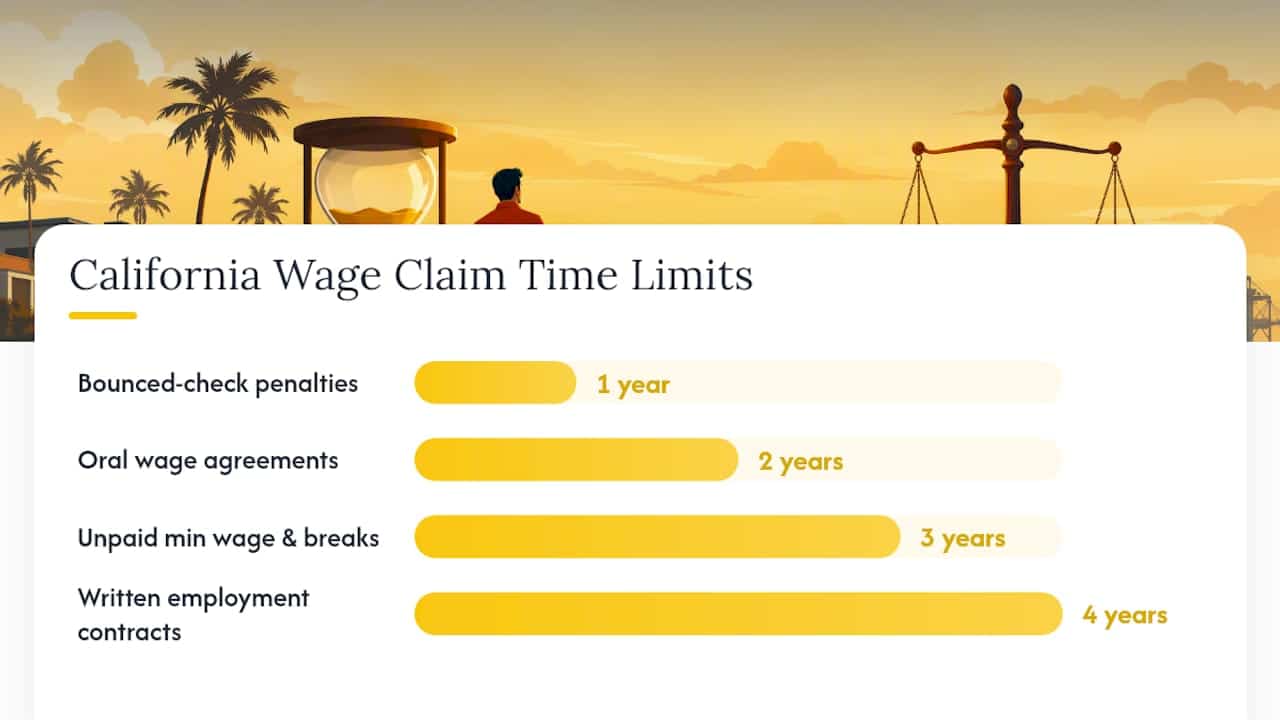
These periods are drawn from DLSE guidance on claim filing deadlines. The clock generally starts from the date each paycheck was due, not the date you discovered the violation — so older violations may already be partially time-barred.
A note on safe preservation: Never delete employer messages, even ones that seem unrelated to pay. A text about a schedule change can corroborate that you worked hours your employer later denies. If you have access to a work scheduling app, export your history before you leave the job or before the employer can revoke your access.
Seal Beach employees dealing with wage and hour violations face a system that is procedurally complex and often intimidating when you’re navigating it alone. Optimum Employment Lawyers works exclusively on the employee side — no employer defense work — which means every strategy, every negotiation, and every filing is built around maximizing your recovery.
What the firm provides:
The firm handles claims across Seal Beach and the broader Orange County area, with direct experience in the hospitality, retail, food service, and contractor industries that drive the local economy. If you work at a hotel, restaurant, retail store, or as a contractor in Seal Beach, the firm understands the specific pay structures and violation patterns common in those workplaces.
What to bring to your consultation: your most recent paystubs, any time records you have, a written summary of the violations you experienced (dates, amounts, names), and any communications from your employer about pay or hours. You don’t need a complete file — the firm will help you identify what else to gather.
Contact Optimum Employment Lawyers to schedule a free consultation. There is no fee unless you recover.
Most Seal Beach employees who have been shorted on pay face the same problem: they know something is wrong, but they don’t know how much they’re owed, whether it’s worth pursuing, or how to navigate the DLSE process without losing their job in the process. That’s exactly the gap Optimum Employment Lawyers fills.
The firm represents only employees, never employers. Every case is taken on contingency, meaning you pay nothing unless the firm recovers money for you. From the first call through DLSE filing, settlement conferences, and, when necessary, civil litigation, the firm handles the procedural complexity so you can focus on your job and your family.
Seal Beach workers in hospitality, retail, food service, and contracting face wage violations that are often systemic, affecting entire teams rather than one person. That’s where class and PAGA representative actions become powerful tools — and where the firm’s experience with large-scale recoveries, including a $2.2 million class-action settlement for missed meal breaks, becomes directly relevant to your situation.
Schedule a free consultation with Optimum Employment Lawyers today. Bring what you have; the firm will help you build the rest.
This article is general information, not a substitute for advice from a qualified lawyer. Consult a qualified legal professional about your own circumstances before acting on anything here.
These are the official and authoritative resources referenced throughout this guide. Bookmark the ones relevant to your situation before you file.

© 2026 Optimum Employment Lawyers, PC
Legal Disclaimer | Privacy Policy
 Share
Share
