
(949) 954-8181 Free Case Review No recovery, no fee.
(949) 954-8181 Free Case Review No recovery, no fee.
If your employer controls when, where, and how you work, and that work is central to their business, you are likely misclassified as an independent contractor. The single best immediate step: file a wage claim with the California Labor Commissioner’s Office (DLSE) or get a free case review with an employee-side attorney before evidence disappears or deadlines pass.
Fountain Valley workers across industries, from delivery and janitorial services to healthcare staffing and construction, are routinely labeled “independent contractors” when California law says they are employees. That label costs them overtime pay, meal break premiums, workers’ compensation coverage, and unemployment benefits. The good news: California law is among the strongest in the country for workers in this situation, and the remedies are real.

Contact Optimum Employment Lawyers for a no-cost case evaluation. The firm works on contingency, meaning you pay nothing unless you win.
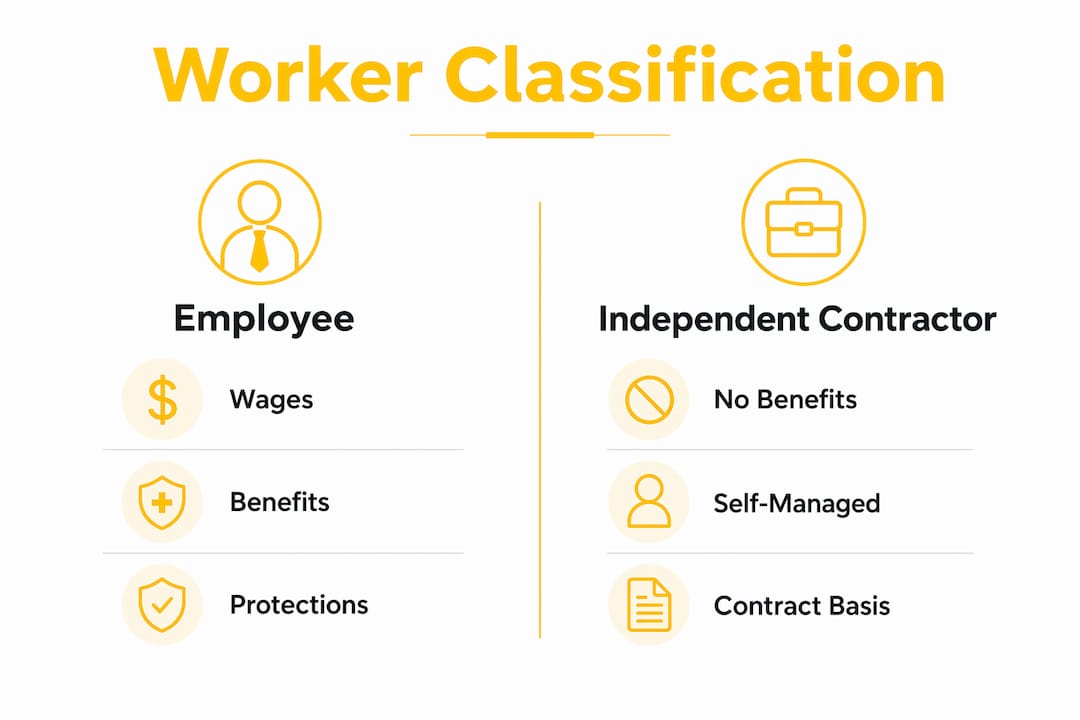
California starts from a clear presumption: you are an employee. The burden falls on the hiring entity to prove otherwise. Under the ABC test, codified in Labor Code §2775 following the California Supreme Court’s ruling in Dynamex Operations West, Inc. v. Superior Court (2018) 4 Cal.5th 903 and later enacted into statute by AB 5 and amended by AB 2257, a company must satisfy all three conditions below to legally classify you as an independent contractor.
| ABC Test Element | What It Requires | Fountain Valley Example |
|---|---|---|
| A — Control | Worker is free from the hiring entity’s control and direction, in contract and in fact | A janitorial worker in Fountain Valley who is told which supplies to use, which rooms to clean first, and when to show up fails Part A |
| B — Outside usual business | Work is outside the usual course of the hiring entity’s business | A delivery driver for a Fountain Valley retailer whose core business is shipping goods fails Part B |
| C — Independent trade | Worker is customarily engaged in an independently established trade or business of the same nature | A worker who has no other clients, no business license, and no separate business identity fails Part C |
The company must prove all three. Failing even one means you are an employee under California law.
The Borello multi-factor test still applies in a narrow set of contexts, primarily for certain licensed professionals and business-to-business relationships carved out under AB 2257. If you work in one of those categories, the analysis is more fact-intensive, but the default remains employee status. You can track California AB5 developments as the law continues to evolve.
The law is direct: A signed contract calling you an “independent contractor” does not control the legal analysis. California’s DIR and DLSE look at the actual working relationship, not the label on the paperwork.
Pro Tip: If your employer handed you a contractor agreement on your first day as a condition of getting the job, that alone is a red flag under Part C of the ABC test. Courts have found that unilaterally assigned labels do not satisfy the independent business requirement.
Run through this checklist honestly. The more boxes you check, the stronger your potential claim.
What employers typically argue: “You signed the contract.” “You set your own hours sometimes.” “You could have worked for others.” None of these rebuttals automatically wins. California agencies look at the totality of the relationship, and a single strong control fact can outweigh several contractor-friendly ones.
Employers in Fountain Valley’s staffing, logistics, and home-services sectors frequently use these arguments. Document every instance of control with dates, names, and specifics. That paper trail is what wins claims.
The financial stakes are significant. California law gives misclassified workers access to a broad set of remedies, and willful misclassification by an employer triggers additional penalties on top.
Recoverable damages and penalties include:
| Remedy Type | Trigger | Notes |
|---|---|---|
| Unpaid wages and overtime | Any misclassification | Calculated from the date misclassification began |
| Meal/rest break premiums | Missed breaks during misclassification period | One hour of pay per violation |
| Waiting-time penalties | Unpaid wages at separation | Up to 30 days of daily wages |
| Labor Code §226.8 civil penalties | Willful misclassification | $5,000–$25,000 per violation |
| EDD tax penalty | Intentional disregard of tax reporting | 15% of tax deficiency |
| PAGA penalties | Any Labor Code violation | Can be filed individually or as a group |
Optimum Employment Lawyers secured a $2.2 million class action settlement for workers whose meal breaks were systematically denied, a case that illustrates what coordinated wage-and-hour litigation can recover for Orange County workers. If your situation involves multiple coworkers facing the same contractor label, a class action claim may multiply your recovery significantly.
You have three main routes, and they are not mutually exclusive. Filing through one does not prevent you from pursuing another.
Evidence checklist for each filing stage:
Pro Tip: Filing for EDD unemployment benefits early often triggers an independent EDD review that can uncover systemic misclassification and strengthen a separate DLSE claim or civil suit. File even if you are unsure whether you qualify.
Orange County / Fountain Valley local contact: California Labor Commissioner’s Office, Santa Ana District Office 28 Civic Center Plaza, Room 625, Santa Ana, CA 92701 Phone: (714) 558-4910
Deadlines vary by claim type, and missing one can permanently bar recovery. Act quickly.
The urgency is real: Evidence disappears. Employers delete records, witnesses move on, and electronic communications get overwritten. Every week you wait is a week of potential recovery you may not get back. If you are within a few months of any of these windows, treat it as an emergency.
California’s statute of limitations for wage claims is longer than the federal Fair Labor Standards Act’s two-year window (three years for willful violations). That is one of the concrete advantages California workers have over federal-only claims. Still, “longer” does not mean “unlimited.” File as soon as you have enough facts to support a claim, and let an attorney assess the rest.
The strongest misclassification cases are built on control evidence, not just pay records. Here is what to gather, in priority order.
Pro Tip: Save metadata. When you screenshot a text or email, the file’s creation date is embedded. Store copies in a personal cloud account (Google Drive, iCloud) that your employer cannot access. Take dated photos of your workspace and any tools or uniforms the company provided.
How to build a control log: open a notes app or a simple spreadsheet. Each entry should have (1) the date, (2) the name and title of the person who gave the instruction, (3) exactly what they said or wrote, and (4) any witnesses present. Update it after every shift. Courts and agencies have found this kind of contemporaneous record far more credible than reconstructed timelines.
Misclassification cases are exactly the kind of fight where having the right attorney changes the outcome. Optimum Employment Lawyers represents California employees exclusively, which means every strategy, every filing, and every negotiation is built around getting workers paid, not protecting employers.
The firm works on a contingency-fee basis: no upfront cost, no hourly billing. You pay only if the case resolves in your favor. For Fountain Valley workers dealing with unpaid overtime, missed meal breaks, or years of contractor status that should have been employment, that model removes the financial barrier to pursuing a real claim.
The firm’s track record includes a $2.2 million class action settlement for workers whose meal breaks were systematically denied, a result that reflects both the scale of what California wage law allows and the firm’s willingness to take cases through full litigation when necessary. If your situation involves coworkers who were classified the same way, a class or PAGA filing could multiply the recovery across the entire group.
Ready to find out what your claim is worth? Schedule a free case review with Optimum Employment Lawyers. There is no obligation, and the consultation costs you nothing.
California’s ABC test presumes you are an employee, and a company that cannot satisfy all three parts of that test owes you wages, benefits, and penalties as if you were on payroll from day one.
| Point | Details |
|---|---|
| California presumes employee status | Under the ABC test, the hiring entity must prove all three conditions; failing one means you are an employee. |
| Willful misclassification triggers steep penalties | Labor Code §226.8 authorizes civil penalties per violation within a statutory range, on top of unpaid wages and overtime. |
| File early across multiple routes | A DLSE wage claim, EDD unemployment application, and BOFE report can run in parallel and reinforce each other. |
| Evidence is time-sensitive | Build a control log now; electronic records disappear and witnesses move on faster than deadlines do. |
| Optimum Employment Lawyers | The firm offers contingency-fee representation and free case evaluations for Fountain Valley misclassification claims. |
This article provides general legal information, not legal advice. Employment law facts and deadlines vary by situation. Confirm the rules that apply to your case with a qualified California employment attorney.
Use these directly to file claims, verify the law, or learn more about your rights.
Bottom line for Fountain Valley workers: If you suspect misclassification, the worst thing you can do is wait. California law gives you powerful tools, but every one of them has a deadline. Start with the EDD application and a call to an employee-side attorney. Both are free, and either one can change what happens next.

© 2026 Optimum Employment Lawyers, PC
Legal Disclaimer | Privacy Policy
 Share
Share
