
(949) 954-8181 Free Case Review No recovery, no fee.
(949) 954-8181 Free Case Review No recovery, no fee.
A class action wage and hour claim is a legal process that lets groups of Costa Mesa employees collectively pursue unpaid wages and penalties from employers who violate California labor laws. These claims fall under the California Labor Code and the Private Attorneys General Act, known as PAGA. Both legal tools give workers real power against employers who systematically shortchange their staff. The 2024 PAGA reforms under Assembly Bill 2288 changed the rules significantly, and every Costa Mesa worker considering a claim needs to understand what those changes mean for their case. Optimum Employment Lawyers has secured results like a $2.2 million settlement for a class action involving missed meal breaks, which shows what is possible when employees act collectively.
Wage and hour violations in Costa Mesa follow the same California Labor Code framework that applies statewide, but local industries, including retail, hospitality, and healthcare, produce a high volume of these cases. Common violations that trigger class actions include missed meal and rest breaks, unpaid overtime, minimum wage violations, and inaccurate wage statements. These are the most frequently litigated claims under both PAGA and traditional class actions in California. Each category represents a distinct legal theory, and a single employer can face multiple simultaneous claims.

What turns an individual complaint into a class action is a pattern. When an employer applies the same unlawful policy to a group of workers, every affected employee becomes a potential class member. A Costa Mesa restaurant that automatically deducts 30 minutes for a meal break regardless of whether the break was taken is a textbook example. That single payroll policy can affect dozens or hundreds of workers, making it the foundation of a class action.
Other qualifying violations include:
Pro Tip: Save every pay stub, schedule, and work-related text message from your employer. Courts treat contemporaneous records as strong evidence of systematic violations, and they are much harder for employers to dispute than your memory alone.
Filing a wage and hour class action in Costa Mesa involves several distinct stages, and the order matters. Missing a procedural step can delay or kill a valid claim.
Consult a wage and hour attorney. Before filing anything, get a legal evaluation. An attorney will assess whether your situation involves a widespread employer policy, which is the core requirement for class certification.
Submit a PAGA notice. If you plan to pursue a PAGA representative action, you must submit written notice to both your employer and the Labor and Workforce Development Agency (LWDA). This starts a 65-day administrative period during which the agency can investigate or the employer can respond.
Wait out the administrative period. The LWDA has 65 days to decide whether to investigate. If it declines or does not respond, you can proceed to file in court. This step is mandatory and cannot be skipped.
File the lawsuit. Your attorney files the complaint in California Superior Court. For a traditional class action, the complaint must describe the class of affected employees and the common policies that harmed them.
Class certification (for class actions). The court must certify the class before the case proceeds as a group claim. This requires showing that the class members share common legal questions and that a class action is the best way to resolve them. PAGA claims skip this step entirely.
Discovery. Both sides exchange evidence, including payroll records, timekeeping data, and employer policies. This phase often reveals the full scope of violations.
Mediation and settlement. Most wage and hour class actions settle before trial. PAGA cases can generate settlements ranging from tens of thousands to hundreds of millions of dollars, depending on employer size and the scale of violations.
Trial or final approval. If no settlement is reached, the case goes to trial. Class action settlements require court approval to protect class members.
Statute of limitations: PAGA claims carry a one-year window from the date of your last personal violation. Traditional class action wage claims reach back 3–4 years. Filing late eliminates your claim entirely, so acting quickly is critical.
Pro Tip: File your PAGA notice as soon as you identify a violation. The one-year clock runs from your last personal experience of the violation, not from when you learned about your legal rights.
Costa Mesa employees have two primary legal vehicles for collective wage claims: PAGA representative actions and traditional class action lawsuits. They work differently, recover different things, and suit different situations.
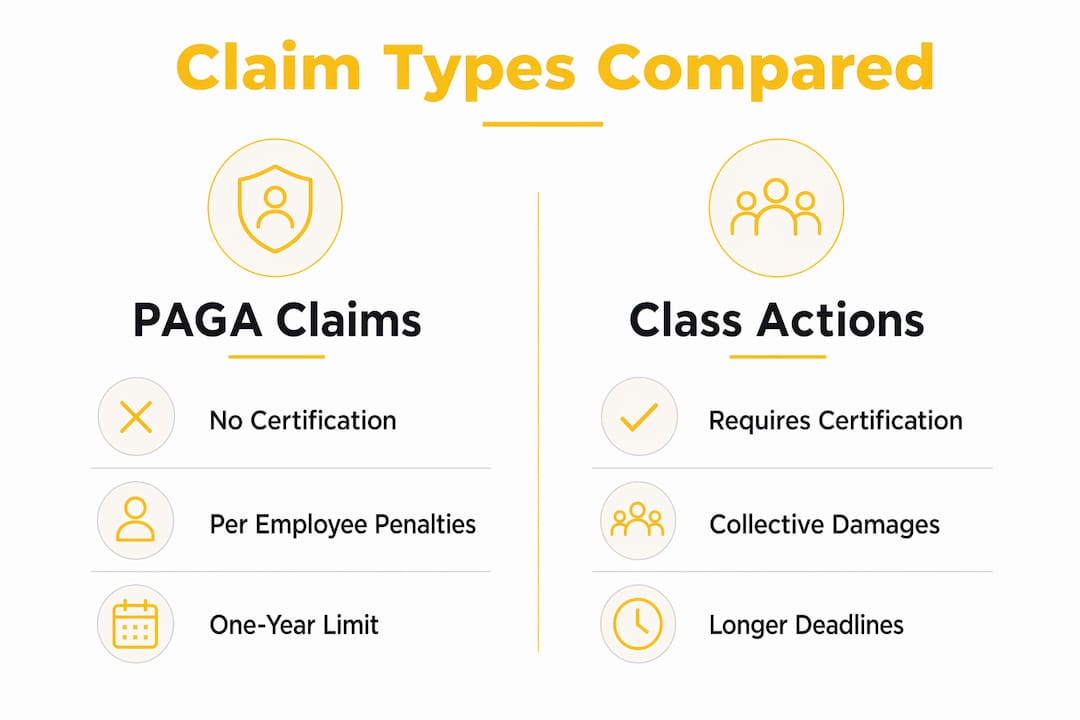
PAGA does not require class certification. Any employee who personally experienced a Labor Code violation can file a PAGA action on behalf of all similarly aggrieved coworkers without needing a court to certify a class. That makes PAGA faster to initiate and harder for employers to block on procedural grounds.
The 2024 reforms under Assembly Bill 2288 added a critical restriction. An employee must have personally experienced the exact Labor Code violation alleged within one year before filing the PAGA notice. You cannot file a PAGA claim for violations that only happened to your coworkers. This change narrowed who can serve as a PAGA plaintiff.
The penalty structure also differs sharply from class actions. PAGA penalties are calculated per aggrieved employee per pay period, with 65% going to the state and 35% distributed to affected employees. Class action recoveries, by contrast, go entirely to the class members as compensatory damages rather than civil penalties.
| Feature | PAGA representative action | Traditional class action |
|---|---|---|
| Class certification required | No | Yes |
| Who can file | Any personally aggrieved employee | Named plaintiff on behalf of class |
| Recovery type | Civil penalties | Compensatory damages |
| State share of recovery | 65% | None |
| Employee share of recovery | 35% | 100% |
| Statute of limitations | 1 year | 3–4 years |
| Employer cure option | Yes, under AB 2288 | Limited |
The cure provision introduced by Assembly Bill 2288 gives employers a window to fix certain violations before penalties attach. Employers who self-cure specific violations within statutory windows can reduce their penalty exposure. This changes litigation strategy because employers now have a financial incentive to correct violations early, which can reduce the total recovery for employees.
For Costa Mesa workers, the best approach often combines both claim types. A PAGA action can cover penalties for a broad group quickly, while a parallel class action pursues full compensatory damages for the same period.
Pursuing a wage and hour class action in Costa Mesa is not simple. Employees face real obstacles, and knowing them in advance improves your odds.
The biggest challenge is proving that violations were systematic rather than isolated. A single missed break is a personal grievance. A policy that routinely skips breaks for all warehouse workers is a class action. Your attorney needs payroll records, scheduling data, and witness statements from coworkers to establish that pattern.
Meeting PAGA’s personal experience requirement is another hurdle after the 2024 reforms. You must show that you personally suffered the violation within the past year. Employees who left a job more than a year ago may find their PAGA standing limited, even if the violations were severe.
Practical steps that strengthen your claim:
Optimum Employment Lawyers focuses exclusively on employee-side cases in Costa Mesa and across California. Their team handles wage and hour disputes from initial evaluation through settlement or trial, which means you get consistent representation at every stage. You can also review your broader employment rights in Costa Mesa before deciding how to proceed.
Pro Tip: Do not wait to see if your employer fixes the problem on their own. The statute of limitations runs whether or not you are aware of it, and delay costs you recoverable wages.
For a broader picture of active class action categories affecting California workers in 2026, wage and hour claims consistently rank among the most common and highest-value filings.
Costa Mesa employees pursuing wage and hour claims have the strongest outcomes when they act quickly, document violations thoroughly, and work with attorneys who specialize in employee-side class actions.
| Point | Details |
|---|---|
| Two legal paths exist | PAGA representative actions and traditional class actions serve different purposes and recover different amounts. |
| PAGA requires personal experience | Under 2024 reforms, you must have personally suffered the violation within one year before filing. |
| Statute of limitations differs | PAGA claims have a one-year window; class action wage claims reach back 3–4 years. |
| Penalty distribution matters | PAGA splits recovery 65% to the state and 35% to employees; class action damages go entirely to class members. |
| Documentation is decisive | Time records, pay stubs, and coworker statements are the foundation of any successful class or PAGA claim. |
Wage and hour violations cost Costa Mesa employees real money every pay period, and the legal window to recover those wages is shorter than most people realize. Optimum Employment Lawyers works exclusively on behalf of employees, never employers, handling everything from initial case evaluation to final settlement approval. Their track record includes a $2.2 million class action settlement for missed meal breaks, a result that reflects what collective legal action can achieve. If you believe your employer has violated California wage laws, contact a California employment lawyer at Optimum Employment Lawyers to get a confidential case review. The Costa Mesa employment law team is available to assess your situation and explain your options at no upfront cost.
A class action wage and hour claim is a lawsuit filed by a group of employees who experienced the same employer violations, such as unpaid overtime or missed breaks, under California labor law. It allows employees to combine their claims for greater legal leverage and efficiency.
PAGA claims must be filed within one year of your last personal violation, while traditional class action wage claims can cover a 3–4 year period under California law.
No. California class action members are typically included automatically unless they choose to opt out. PAGA actions do not require any opt-in or opt-out process from coworkers.
Assembly Bill 2288 requires employees to have personally experienced the alleged violation within one year before filing a PAGA notice. It also introduced cure provisions that let employers reduce penalties by correcting violations within a set window.
Recovery depends on the number of affected employees, the duration of violations, and the employer’s size. PAGA settlements in California have ranged from tens of thousands to hundreds of millions of dollars, with employees receiving 35% of PAGA penalties and 100% of class action damages.

© 2026 Optimum Employment Lawyers, PC
Legal Disclaimer | Privacy Policy
 Share
Share
