
(949) 954-8181 Free Case Review No recovery, no fee.
(949) 954-8181 Free Case Review No recovery, no fee.
Unwanted sexual touching in Newport Beach workplaces is illegal under California’s Fair Employment and Housing Act (FEHA), which classifies it as sexual harassment when it is severe enough to create a hostile work environment or constitutes a single egregious physical act. The California Civil Rights Department (CRD) enforces these protections for employees at companies with five or more workers. Victims can recover lost wages, emotional distress damages, punitive damages, and attorney fees. You do not need a pattern of repeated incidents to have a valid claim. One serious act of physical touching can be enough to take legal action.
The legal term for this conduct under California law is “sexual harassment,” specifically the hostile work environment category. Unwanted sexual touching refers to any physical contact of a sexual nature that is not welcomed by the recipient. Courts apply the “reasonable person” standard: would a reasonable person in your position find the conduct intimidating, hostile, or offensive?

Under FEHA, a single egregious act of unwanted touching can establish a hostile work environment claim without any pattern of behavior. That means a one-time incident of groping, grabbing, or forced physical contact can be enough to file a claim. The law does not require you to endure repeated incidents before you have rights.
Common forms of workplace inappropriate touching that qualify under FEHA include:
The harasser’s intent does not matter under California law. The legal standard focuses on whether the conduct was unwelcome and whether a reasonable person would find it hostile or offensive. A coworker who claims they were “just joking” or that the touch was accidental has no legal defense if the conduct was unwelcome and created an intimidating environment.
Pro Tip: If you are unsure whether what happened to you qualifies as sexual harassment, ask yourself: did the physical contact make you feel unsafe, demeaned, or uncomfortable in a way that affected your ability to do your job? If yes, it likely meets the legal threshold.
Employer liability under California law depends on who committed the harassment. The rules differ significantly between supervisors and coworkers, and understanding that difference affects your legal strategy.
California law holds employers strictly liable for sexual harassment committed by supervisors, regardless of whether the employer knew it was happening. That means your employer cannot escape responsibility by claiming they had no idea a manager was touching employees inappropriately. Strict liability applies the moment a supervisor commits the act.
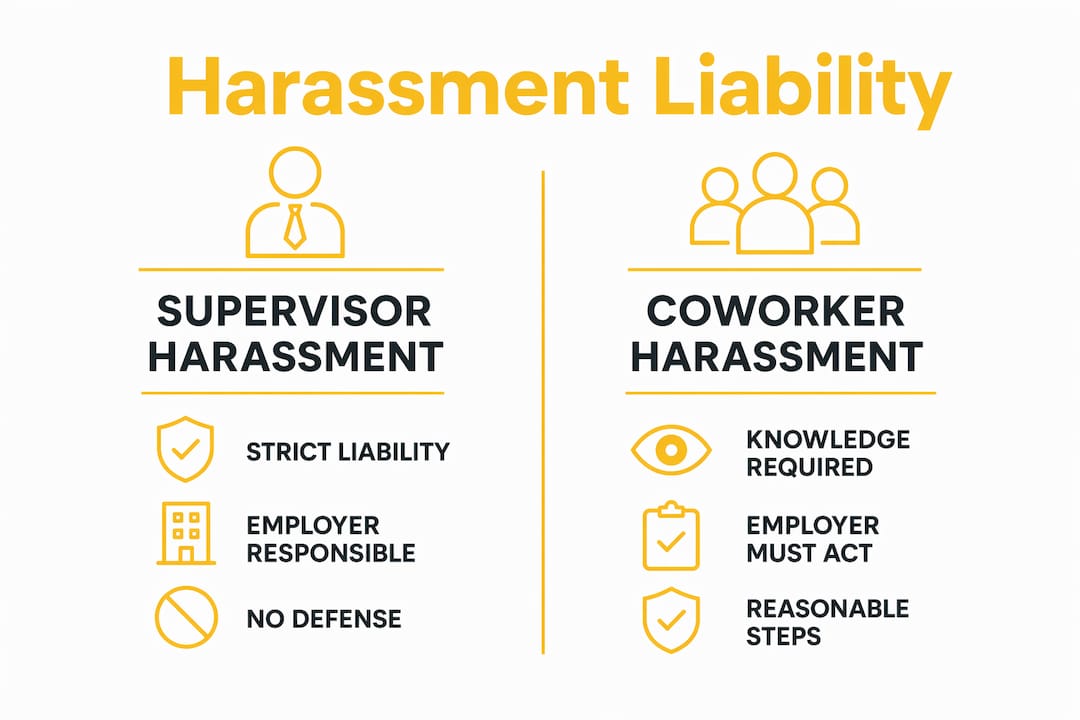
For harassment by coworkers or third parties, the standard shifts. Employers face liability when they knew or should have known about the harassment and failed to take corrective action. This is why reporting the conduct to your employer is not just a formality. It is the legal trigger that creates employer liability for coworker harassment.
Key facts about employer liability in Newport Beach workplaces:
For more on how supervisor liability works in California, the legal standards are detailed and worth understanding before you take any action.
Reporting is the most important step you can take, both for your own protection and to create a legal record. The process has clear steps, and California law gives you meaningful time to act.
Document everything immediately. Write down the date, time, location, exactly what happened, who was present, and how the incident affected you. Keeping a detailed journal with this information strengthens your claim significantly. Do this as soon as possible after each incident while details are fresh.
Report to your employer. Notify your HR department or a manager above the harasser in writing. This step is critical for coworker harassment claims because it triggers employer liability. Keep a copy of everything you submit.
File a complaint with the California Civil Rights Department. You have up to three years from the last incident to file with the CRD. This is a mandatory step before you can file a civil lawsuit under FEHA. You can file online, by mail, or in person at a CRD office.
Understand what happens next. The CRD may investigate your complaint, offer mediation, or issue a right-to-sue letter. A right-to-sue letter allows you to take your case to civil court.
Know your anti-retaliation rights. California law prohibits retaliation against employees who file harassment complaints. If your employer fires you, demotes you, cuts your hours, or gives you worse assignments after you report, that retaliation is itself an illegal act you can pursue as a separate claim.
Pro Tip: Send your internal complaint to HR by email rather than verbally. An email creates a timestamp and a written record that is much harder for an employer to deny or ignore later.
Employees who experience unwanted sexual advances at work have multiple paths to pursue their claims, including both administrative and civil court options.
The remedies available under FEHA are substantial. California law is designed to make victims whole and to punish employers who allow harassment to continue.
Victims may recover damages including lost wages, compensation for emotional distress, punitive damages, and attorney fees. In cases where the harassment forced you out of your job, you may also be entitled to reinstatement. Courts can also order employers to change their workplace policies or training programs.
The financial exposure for employers in these cases is real. Punitive damages are available when the employer’s conduct was especially egregious or when a supervisor was directly involved. Attorney fees being recoverable means you can pursue your claim without paying legal costs out of pocket if you win.
Key remedies available under California’s FEHA:
Filing a complaint with the CRD costs nothing. Retaliation for filing is illegal. There is no financial risk to starting the process, and the potential recovery is significant.
Optimum Employment Lawyers has secured major results for California employees, including a $2.2 million settlement in a class action case. That track record reflects what aggressive, employee-focused legal representation can achieve.
Several myths prevent employees from pursuing valid claims. Clearing them up can change whether you act or stay silent.
Myth: The harasser has to intend to harm you. False. California’s legal standard focuses entirely on whether the conduct was unwelcome and whether a reasonable person would find it hostile. Intent is irrelevant. A coworker who says “I didn’t mean anything by it” has no legal defense.
Myth: You have to be touched multiple times before it counts. False. A single severe act of physical touching can establish a hostile work environment claim under FEHA. One incident of groping or sexual assault at work is enough.
Myth: You have to confront the harasser directly before reporting. False. You are never required to confront the person who harassed you. Reporting directly to HR or a supervisor above the harasser is the correct and legally recognized step.
Additional misconceptions that affect Newport Beach employees:
Pro Tip: Do not let an employer tell you the incident was “not serious enough” to investigate. Under California law, that determination belongs to the CRD and the courts, not your HR department.
Experiencing sexual harassment at work is serious, and you deserve legal representation that puts your interests first.
[IMAGE:cta_image]Optimum Employment Lawyers focuses exclusively on employee-side cases throughout California, including sexual harassment claims in Newport Beach. The firm’s approach centers on understanding your experience fully, building a strong factual record, and pursuing every remedy available under FEHA. Every case receives personalized attention, not a one-size-fits-all response. If you have experienced unwanted physical contact at work, a confidential consultation with an experienced employment lawyer costs you nothing and gives you a clear picture of your options. You do not have to navigate this alone.
Unwanted sexual touching is any physical contact of a sexual nature that is not welcomed by the recipient and that a reasonable person would find hostile, intimidating, or offensive. Under FEHA, even a single egregious act qualifies as sexual harassment.
You have three years from the last incident to file a complaint with the California Civil Rights Department. Filing with the CRD is required before you can pursue a civil lawsuit under FEHA.
No. California law prohibits retaliation against employees who report sexual harassment. Firing, demotion, or any adverse action taken in response to a complaint is itself an illegal act you can pursue as a separate claim.
No. A single severe act of unwanted sexual touching can establish a hostile work environment claim under FEHA without any pattern of repeated behavior.
Your employer is still liable if they knew or should have known about the harassment and failed to act. Reporting the conduct to HR is the step that triggers that liability.
Unwanted sexual touching in Newport Beach workplaces is illegal under FEHA, and a single severe incident is enough to file a valid claim for a hostile work environment.
| Point | Details |
|---|---|
| One act can be enough | A single egregious incident of physical touching can establish a hostile work environment claim under FEHA. |
| Supervisor harassment means automatic liability | Employers are strictly liable for harassment by supervisors, regardless of whether they knew it occurred. |
| Report in writing to trigger liability | Submitting a written complaint to HR is the legal step that creates employer liability for coworker harassment. |
| You have three years to file | Employees have up to three years from the last incident to file a complaint with the California Civil Rights Department. |
| Retaliation is illegal | Any adverse action taken against you for reporting harassment is a separate violation of California law. |

© 2026 Optimum Employment Lawyers, PC
Legal Disclaimer | Privacy Policy
 Share
Share
