
(949) 954-8181 Free Case Review No recovery, no fee.
(949) 954-8181 Free Case Review No recovery, no fee.
Independent contractor misclassification is defined as the illegal practice of labeling a worker as an independent contractor when California law requires that worker to be treated as an employee. In Cypress, California, this misclassification directly causes the denial of employee benefits including overtime pay, workers’ compensation, unemployment insurance, and meal break premiums. California’s ABC test, codified under Labor Code § 2775, governs worker classification statewide. The California Labor Commissioner actively enforces these protections, and Optimum Employment Lawyers has built a track record helping Cypress workers recover what they are owed. If you work in Cypress and suspect your employer has mislabeled you as a contractor, the law is almost certainly on your side.
Worker classification in California starts with a legal presumption: every worker is an employee unless the hiring entity proves otherwise. That burden of proof falls entirely on the employer, not on you. This default presumption is one of the strongest worker protections in the country.
California’s ABC test sets three specific conditions an employer must satisfy to legally classify you as an independent contractor:
The employer must prove all three prongs. Failure of any single prong means you are legally an employee, regardless of what any contract says.
Prong B is the most common failure point. Workers performing core business tasks are almost always employees under California law. A delivery driver working for a logistics company, a technician servicing a company’s primary product, or a writer producing content for a media outlet all fail Prong B. This pattern is especially common in Cypress industries like healthcare staffing, construction, and retail services.

Pro Tip: A signed “independent contractor agreement” does not protect your employer. California law overrides contractual labels. What matters is the actual working relationship, not what the paperwork calls it.
Misclassification strips you of concrete, dollar-valued protections that California law guarantees to employees. The financial loss is not abstract. It accumulates every week you are misclassified.
The core benefits denied to misclassified workers include:
The combined value of these denied benefits is substantial. A Cypress worker misclassified for two years could be owed tens of thousands of dollars in back wages, premiums, and reimbursements. Employers also face liability for unpaid payroll taxes including Social Security and Medicare contributions, costs that were illegally shifted onto you.
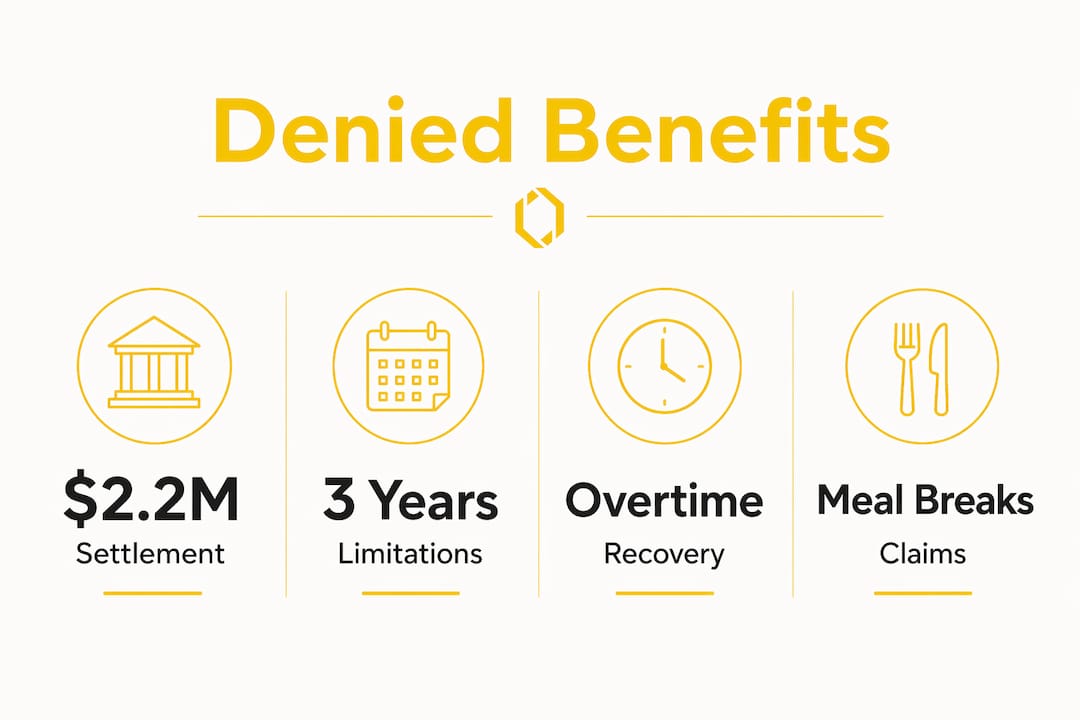
Optimum Employment Lawyers secured a $2.2 million settlement in a class action case involving missed meal breaks alone. That outcome illustrates how quickly denied break premiums accumulate across a workforce.
Recognizing misclassification requires looking past the label on your contract and examining the actual working relationship. The following signs indicate you are likely an employee under California law, regardless of what your employer calls you.
Cypress has a high concentration of workers in logistics, healthcare support, and construction trades. These sectors frequently misuse contractor labels to avoid payroll costs. If you work in any of these fields in Cypress and recognize three or more of the signs above, your classification is worth examining closely.
Pro Tip: Keep records of your schedule, communications with supervisors, and any expenses you paid out of pocket. This documentation becomes critical evidence in a wage claim or lawsuit.
Cypress workers who have been misclassified have real legal options, and the remedies are specific and enforceable. The California Labor Commissioner’s Office accepts wage claims from affected workers and can order employers to pay back wages, overtime, and penalties.
The recoverable damages in a misclassification case include:
The statute of limitations for most wage claims is three years. Under California’s Unfair Competition Law, that window extends to four years. Filing a wage claim within these deadlines is critical. Missing the deadline eliminates your right to recover, regardless of how strong your case is.
Workers injured on the job while misclassified can still pursue workers’ compensation benefits. California courts have consistently held that misclassification does not strip an injured worker of the right to file a workers’ compensation claim.
If multiple workers at the same company are misclassified, a class action lawsuit may be the most effective path. Class actions pool claims, increase leverage, and often result in larger settlements than individual filings.
The process for pursuing a claim involves several steps:
Consulting an employment attorney before filing is the most effective first step. Wage claim procedures involve specific deadlines, documentation requirements, and strategic choices that significantly affect outcomes. Optimum Employment Lawyers focuses exclusively on employee-side cases and has direct experience with contractor misclassification claims in California.
Independent contractor misclassification in Cypress causes direct, recoverable financial harm, and California law gives workers strong tools to fight back through the ABC test, the Labor Commissioner, and civil litigation.
| Point | Details |
|---|---|
| ABC test governs classification | Employers must prove all three prongs; failure of any one prong makes you a legal employee. |
| Benefits denial is financially significant | Lost overtime, break premiums, and expense reimbursements can total tens of thousands of dollars. |
| Contracts do not override California law | A signed independent contractor agreement does not determine your legal classification. |
| Statute of limitations is 3–4 years | File wage claims promptly; the window closes and cannot be reopened after the deadline. |
| Civil penalties are severe for employers | Willful misclassification triggers fines of $5,000 to $25,000 per violation under Labor Code § 226.8. |
Cypress workers who have been denied wages, benefits, and legal protections because of misclassification have a clear path forward with the right legal team. Optimum Employment Lawyers focuses exclusively on employee-side cases across California, including Cypress, and has recovered millions for workers in wage and hour disputes.
If you believe your employer has mislabeled you as an independent contractor to avoid paying benefits, the time to act is now. The statute of limitations runs continuously, and every week of delay reduces what you can recover. Optimum Employment Lawyers offers personalized legal evaluations for Cypress workers facing denied wages and benefits. Contact the firm through the Cypress legal consultation page to get a direct assessment of your situation from attorneys who work only for employees.
The ABC test is the legal standard California uses to determine whether a worker is an employee or an independent contractor. An employer must prove all three prongs of the test to legally classify a worker as a contractor; failing any single prong means the worker is an employee by law.
No. Under Prong B of the ABC test, workers who perform tasks central to the hiring company’s usual business are classified as employees regardless of any contract or label the employer uses.
You can recover unpaid overtime, missed meal and rest break premiums, business expense reimbursements under Labor Code § 2802, and potentially civil penalties against your employer ranging from $5,000 to $25,000 per violation.
The standard statute of limitations for wage claims is three years. Under California’s Unfair Competition Law, you may have up to four years to file, depending on the specific claims involved.
No. California law overrides contractual labels. Courts apply the ABC test to the actual working relationship, not to what the contract says. A signed agreement calling you a contractor carries no legal weight if the ABC test prongs are not met.

© 2026 Optimum Employment Lawyers, PC
Legal Disclaimer | Privacy Policy
 Share
Share
