
(949) 954-8181 Free Case Review No recovery, no fee.
(949) 954-8181 Free Case Review No recovery, no fee.
Sexual harassment in the workplace is illegal under California’s Fair Employment and Housing Act (FEHA), and employees in San Clemente have specific, enforceable rights that go well beyond what federal law provides. FEHA defines sexual harassment as unwelcome conduct based on sex or gender that interferes with your work conditions or creates a hostile environment. California law covers employers with 5 or more employees, compared to the federal Title VII threshold of 15 or more employees. That difference matters enormously for workers at smaller businesses along San Clemente’s coastline and commercial corridors. If you are dealing with sexual harassment in San Clemente workplaces, your rights under California law are stronger than most employees realize.
FEHA gives San Clemente employees two distinct legal protections against sexual harassment: protection from quid pro quo harassment and protection from a hostile work environment. Understanding both is the first step toward knowing when you have a valid claim.
Quid pro quo harassment occurs when a supervisor conditions your job, raise, or promotion on accepting sexual advances. A manager who tells you that your schedule depends on agreeing to a date is engaging in textbook quid pro quo conduct. California courts treat this as automatic employer liability when a supervisor is involved.

Hostile work environment harassment covers a broader range of conduct. It includes repeated sexual jokes, unwanted touching, explicit messages, or comments about your appearance that make your workplace uncomfortable or threatening. California law does not require this conduct to be severe or pervasive to be actionable. Instead, FEHA asks whether the conduct would interfere with a reasonable person’s ability to do their job. That lower standard means more employees can bring valid claims under California law than under federal standards.
Key protections under FEHA include:
Pro Tip: If you are unsure whether what happened to you qualifies as harassment, apply the “reasonable person” test. Ask yourself whether a reasonable person in your position would find the conduct hostile or offensive. If yes, California law likely covers it.
For a detailed breakdown of how California defines these two forms of harassment, the quid pro quo and hostile work environment guide from Optimum Employment Lawyers is a practical starting point.
Reporting sexual harassment correctly protects your legal rights and creates the paper trail you need if the case goes further. The process has clear steps, and skipping any of them can weaken your position.
Document every incident immediately. Write down the date, time, location, what was said or done, and the names of any witnesses. Thorough documentation is the single most powerful tool you have. Save emails, texts, voicemails, and any written communications related to the harassment.
Report through your employer’s internal channels. Most San Clemente employers are required to have a written anti-harassment policy with a complaint procedure. Submit your complaint in writing to HR or a designated manager. If the harasser is your direct supervisor, California law requires your employer to provide an alternative reporting channel so you are not forced to report to the person harassing you.
File a complaint with the California Civil Rights Department (CRD). You have three years from the last incident to file a formal complaint with the CRD. That deadline is significantly longer than the 180 to 300 days allowed under federal law through the EEOC. Missing this deadline eliminates your right to sue under FEHA.
Request a right-to-sue notice. After filing with the CRD, you can request an immediate right-to-sue notice, which allows you to take your case to civil court. Once issued, you generally have one year to file a lawsuit.
Consult an employment attorney before responding to any employer investigation. Employers sometimes use the investigation process to build a defense. Speaking with a California employment lawyer before you give a formal statement protects your interests.
Pro Tip: Never resign because of harassment before speaking with an attorney. Quitting can sometimes be treated as a “constructive discharge” claim, but only if documented correctly. Resigning without legal advice may cost you significant compensation.
For a broader look at what constitutes harassment and how to respond, the workplace harassment examples resource from Optimum Employment Lawyers covers real scenarios employees face.
California law places clear legal duties on employers to prevent sexual harassment before it starts and to respond promptly when it is reported. These obligations directly protect you as an employee.
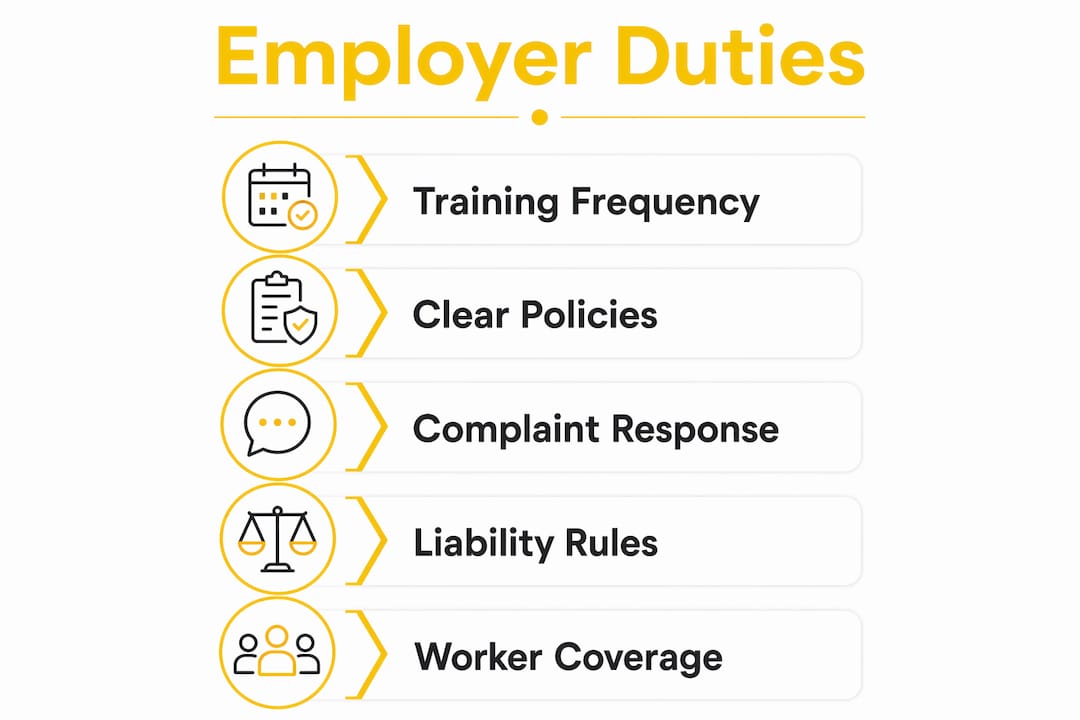
Employers with 5 or more employees must provide two hours of sexual harassment prevention training every two years. New supervisors must receive this training within six months of being hired or promoted into a supervisory role. This is not optional. Employers who skip this training face regulatory exposure and weakened legal defenses if harassment occurs.
Beyond training, California employers must:
| Employer obligation | Requirement under California law |
|---|---|
| Training frequency | Every 2 years for all employees |
| Training for new supervisors | Within 6 months of hire or promotion |
| Minimum employer size covered | 5 or more employees |
| Written policy distribution | Required for all employees |
| Alternative complaint channel | Required when supervisor is the harasser |
Employer liability under FEHA is strict when a supervisor commits harassment. The employer is automatically liable in quid pro quo cases. In hostile environment cases, the employer is liable if it knew or should have known about the harassment and failed to act. Understanding supervisor liability under California law helps you assess whether your employer’s response met its legal obligations.
FEHA provides some of the strongest remedies available to harassment victims in the country. Unlike federal law, California places no cap on compensatory or punitive damages in sexual harassment cases. That means your recovery is not artificially limited by a statutory ceiling.
Remedies available under FEHA include:
“California’s Fair Employment and Housing Act gives employees one of the broadest sets of legal remedies in the nation. There is no damages cap, the filing window is three years, and coverage starts at five employees. For workers in San Clemente and across Orange County, that means real legal leverage against employers who fail to act.”
Retaliation after you report harassment is itself a separate legal violation under FEHA. If your employer cuts your hours, gives you a negative performance review, or fires you after you complain, you have an independent claim. The whistleblower and retaliation protections under California law are substantial and worth understanding before you take any action at work.
Employees who pursue claims through the CRD and then civil court consistently recover more than those who rely solely on the federal EEOC process. The EEOC caps damages based on employer size, with a maximum of $300,000 for the largest employers. FEHA has no such cap. That structural difference makes California courts the preferred venue for most San Clemente employees with strong harassment claims.
For a full overview of how California law defines and enforces these protections, the sexual harassment law guide from Optimum Employment Lawyers covers the legal framework in plain language.
California’s FEHA gives San Clemente employees broader harassment protections than federal law, including a lower legal threshold, a three-year filing deadline, and uncapped damages.
| Point | Details |
|---|---|
| FEHA coverage starts at 5 employees | Smaller San Clemente workplaces are covered, unlike federal law’s 15-employee minimum. |
| Three-year filing deadline | You have three years from the last incident to file with the California CRD. |
| Lower harassment standard | Conduct that interferes with a reasonable person’s work qualifies, without needing to be severe or pervasive. |
| No damages cap under FEHA | California law allows full compensatory and punitive damages with no statutory ceiling. |
| Document everything immediately | Dates, witnesses, and written records are the foundation of any successful harassment claim. |
Facing sexual harassment at work is stressful, and the legal process can feel complicated without the right guidance. Optimum Employment Lawyers focuses exclusively on employee-side cases in California, which means every strategy they develop is built around protecting your rights, not your employer’s interests.
Optimum Employment Lawyers has recovered significant results for California employees, including a $2.2 million settlement in a class action case. Their team evaluates sexual harassment claims with a focus on the specific facts of your situation, the strength of your documentation, and the full range of remedies available under FEHA. If you work in San Clemente and believe your employer has failed to protect you, speaking with a California employment attorney is the most direct way to understand your options and protect your future.
Sexual harassment under FEHA includes any unwelcome conduct based on sex or gender that interferes with your work or creates a hostile environment. This covers verbal, physical, and visual conduct, including comments, touching, and explicit messages.
You have three years from the last harassing incident to file a complaint with the California Civil Rights Department. This deadline is longer than the federal EEOC window, giving California employees more time to act.
Retaliation for reporting harassment is a separate violation under FEHA. If your employer fires, demotes, or penalizes you after you report, you have an independent legal claim on top of the original harassment complaint.
Yes. FEHA covers full-time, part-time, temporary, and seasonal workers, as well as interns and independent contractors, regardless of immigration status.
California law prohibits harassment from supervisors, coworkers, clients, and contractors. Your employer is liable if it knew or should have known about the harassment and failed to take corrective action.

© 2026 Optimum Employment Lawyers, PC
Legal Disclaimer | Privacy Policy
 Share
Share
