
(949) 954-8181 Free Case Review No recovery, no fee.
(949) 954-8181 Free Case Review No recovery, no fee.


An opposite sex-based hostile work environment is defined as a workplace where gender-based harassment or discriminatory conduct is severe or pervasive enough to create conditions a reasonable person would find intimidating, hostile, or abusive. Westminster employees face this form of unlawful harassment under both federal Title VII of the Civil Rights Act and California’s Fair Employment and Housing Act (FEHA). These laws protect you regardless of whether the harasser is a supervisor, coworker, or even a client. Understanding your rights under these overlapping legal frameworks is the first step toward taking effective action.
The legal definition of a hostile work environment based on sex requires more than a single rude comment or isolated incident. Courts apply the severe or pervasive standard, meaning the conduct must be intense enough or frequent enough to alter the terms and conditions of your employment. A one-time offensive joke rarely meets this threshold. A pattern of degrading comments, exclusion, or intimidation based on gender typically does.
Federal law under Title VII prohibits sex-based harassment that creates a hostile or abusive work environment. The landmark Supreme Court case Bostock v. Clayton County (2020) confirmed that Title VII’s sex discrimination protections extend to gender identity and sexual orientation. That ruling remains binding law even after the EEOC rescinded its 2024 guidance in january 2026. Federal statutory protections and Supreme Court precedent do not disappear when agency guidance is withdrawn.

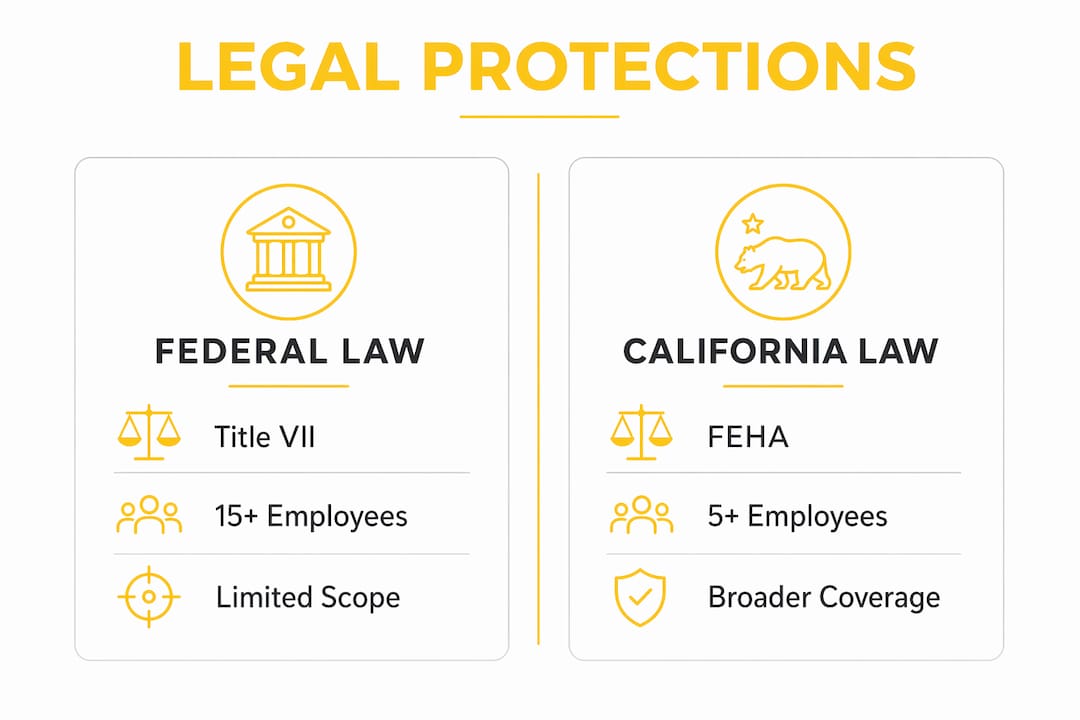
California’s FEHA goes further than federal law in several important ways. California FEHA covers employers with five or more employees, compared to Title VII’s threshold of fifteen. FEHA also covers gender identity and expression explicitly, and it applies a broader definition of harassment. Westminster employees benefit directly from these stronger state-level protections.
Two types of sex-based harassment exist under the law:
Courts focus on the objective effect of the conduct, not the harasser’s intent. A supervisor who claims he was “just joking” does not escape liability if a reasonable person in your position would find the behavior hostile or demeaning.
Pro Tip: Keep a written log of every incident as it happens. Courts and agencies give far more weight to contemporaneous records than to memory alone.
Employees in Westminster often underestimate what qualifies as unlawful harassment because they assume it must be physical. Verbal and digital harassment constitute hostile environment behavior under current legal standards. Physical contact is not required.
The following behaviors commonly form the basis of opposite sex-based hostile work environment claims:
Remote and hybrid work settings in Westminster do not reduce employer liability. Harassment that occurs over video calls, in group chats, or through company messaging tools carries the same legal weight as in-person conduct. Many Westminster employees now work in hybrid arrangements, and courts have confirmed that the workplace extends to any digital environment the employer controls.
The key distinction between unlawful harassment and ordinary workplace conflict is the connection to a protected characteristic. A difficult manager who treats everyone poorly may not create a hostile work environment in the legal sense. A manager who singles out employees of a particular sex for harsh treatment crosses the legal line.
Pro Tip: Screenshot or save digital messages immediately. Employers sometimes delete internal communications during investigations, and your own copies can be critical evidence.
Taking the right steps early protects your legal rights and strengthens any future claim. Documenting incidents with specific details is the single most important action you can take. Record the date, time, location, what was said or done, who was present, and how the conduct affected your work.
Your response options include:
One common mistake Westminster employees make is waiting too long to act. California law imposes filing deadlines. Missing those deadlines can permanently bar your claim, regardless of how strong the underlying facts are.
The EEOC voted 2-1 to rescind its 2024 Enforcement Guidance on Harassment in the Workplace in january 2026. That guidance had provided detailed interpretive direction on harassment related to gender identity, sexual orientation, and pregnancy. Its removal created uncertainty for employees and employers relying on federal agency direction.
The rescission does not eliminate your rights. Bostock v. Clayton County remains binding Supreme Court precedent. Title VII’s prohibition on sex discrimination still covers gender identity and sexual orientation under that ruling. Federal courts are bound by Supreme Court decisions, not EEOC guidance documents.
California fills the gap left by the federal rollback. The table below compares key protections under federal law and California FEHA as of 2026.
| Protection Area | Federal Title VII | California FEHA |
|---|---|---|
| Employer size threshold | 15 or more employees | 5 or more employees |
| Gender identity coverage | Yes, via Bostock | Explicit statutory protection |
| Sexual orientation coverage | Yes, via Bostock | Explicit statutory protection |
| Harassment guidance status | 2024 guidance rescinded | State guidance remains in effect |
| Filing deadline | 300 days (in California) | 3 years under SB 807 |
California offers broader protections than federal law on nearly every dimension that matters to Westminster employees. The EEOC rescission increases the practical importance of filing under FEHA rather than relying solely on federal channels. Westminster employees should treat California law as their primary shield in 2026.
Employers in Westminster face compliance pressure from both directions. Some may interpret the federal rollback as permission to relax enforcement. California law does not allow that interpretation. Employers who reduce harassment prevention efforts in response to federal changes still face full liability under FEHA.
Employees-lawyer, operating as Optimum Employment Lawyers, focuses exclusively on employee-side California employment law cases. If you work in Westminster and are experiencing gender-based hostility, sex discrimination, or retaliation for reporting harassment, the firm provides personalized legal representation built around your specific situation. Optimum Employment Lawyers has secured significant results for California employees, including a $2.2 million settlement in a class action case. The firm handles hostile work environment claims, workplace harassment issues, wrongful termination, and discrimination under both FEHA and Title VII. Contact Employees-lawyer for a free case evaluation and find out what your rights are worth.
An opposite sex-based hostile work environment in Westminster is unlawful under both California FEHA and federal Title VII, and California’s broader protections make state law your strongest tool in 2026.
| Point | Details |
|---|---|
| Legal standard | Conduct must be severe or pervasive enough to alter your working conditions. |
| California advantage | FEHA covers employers with 5 or more employees and provides explicit gender identity protections. |
| 2026 EEOC change | The 2024 federal guidance was rescinded, but Bostock v. Clayton County and FEHA remain fully in force. |
| Documentation matters | Record every incident with dates, witnesses, and saved digital evidence to support your claim. |
| Act before deadlines | California’s 3-year filing window under SB 807 still requires prompt action to preserve your rights. |
An opposite sex-based hostile work environment is a workplace where gender-based harassment is severe or pervasive enough to create conditions a reasonable person would find intimidating or abusive. It is unlawful under Title VII and California FEHA.
No. Verbal conduct, digital messages, and nonverbal behavior all qualify as hostile environment harassment under current legal standards. Courts recognize cyber harassment through platforms like Slack or email as fully actionable conduct.
California FEHA covers employers with five or more employees, compared to fifteen under Title VII, and provides explicit statutory protections for gender identity and sexual orientation. These protections remain fully in effect regardless of the 2026 EEOC guidance rescission.
Document every incident immediately with dates, times, witnesses, and saved evidence. Then report the conduct through your employer’s official harassment reporting process to trigger the employer’s legal duty to investigate.
Retaliation for reporting harassment is a separate and independent legal violation under both FEHA and Title VII. If your employer fires, demotes, or punishes you for making a complaint, you have additional legal claims beyond the original harassment.

© 2026 Optimum Employment Lawyers, PC
Legal Disclaimer | Privacy Policy
 Share
Share
