
(949) 954-8181 Free Case Review No recovery, no fee.
(949) 954-8181 Free Case Review No recovery, no fee.
Contracts and severance agreements define the legal terms under which Garden Grove employees separate from their employers, and signing one without a thorough review can permanently waive rights worth thousands of dollars. These documents are legally binding the moment you sign them. California employees, especially those 40 and older, face a tighter set of rules under the federal Older Workers Benefit Protection Act (OWBPA) and California Senate Bill 331 (SB 331). Understanding what to look for in contracts in Garden Grove is not optional. It is the difference between a fair exit and a costly one.
A severance agreement is a contract where your employer pays you money in exchange for you giving up the right to sue them. That exchange is the core of every deal, and it means you are literally purchasing your own legal claims back from yourself. Knowing which rights you can and cannot waive is the first step in any review.
Federal OWBPA timing rules

If you are 40 or older, the OWBPA gives you 21 days to consider a severance agreement before signing. In a group layoff, that window extends to 45 days. After signing, you have 7 days to revoke your decision. These are federal minimums. Your employer cannot legally shorten them.
Pro Tip: Never sign before the 21-day window closes. Signing early forfeits negotiation leverage and eliminates your ability to push for better terms.
California SB 331 and confidentiality limits
California SB 331 prohibits employers from using severance agreements to silence employees about workplace harassment or discrimination. Any confidentiality clause lacking explicit “right to disclose” language is unenforceable under California law. Garden Grove employees should flag any non-disparagement clause that does not include this carve-out.
Non-waivable rights every employee must know
Certain rights cannot be signed away, no matter what the agreement says. These include:
Some waivers are unenforceable by law, even when an employee signs them. An employer cannot contract around these protections. If your agreement tries to waive any of these rights, that specific clause is void, but the rest of the agreement may still bind you.
Earned wages versus severance pay
California Labor Code §§ 201 and 202 require your employer to pay all earned wages immediately upon termination or within 72 hours if you resign. Severance pay is different. Severance payments may be delayed until after the revocation period ends without any legal penalty. Do not confuse a delayed severance check with a withheld paycheck. They are two separate legal obligations.
Seven clause categories drive most of the value in any severance deal. Reviewing each one carefully gives you a clear picture of what you are actually receiving and what you are giving up.
Release of claims. This is the clause that waives your right to sue. Read it carefully to confirm it covers only claims through the signing date, not future claims. A release that extends to future conduct is a red flag.
Non-compete clauses. California Business and Professions Code § 16600 makes most non-compete agreements unenforceable in California. Non-compete agreements with broad geographic or duration limits are especially problematic. If your agreement includes one, it is likely void, but you should still get it removed to avoid future disputes.
Non-solicitation clauses. These restrict you from contacting former clients or colleagues. California courts have narrowed their enforceability significantly. Push to remove or limit the scope.
Non-disparagement clauses. Under SB 331, these must include language permitting you to disclose harassment or discrimination. Any clause without that language is partially unenforceable. Negotiate for a mutual non-disparagement provision so your employer cannot speak negatively about you either.
Severance payment structure. Lump sum payments are preferable to installments. Installments create risk: if your employer faces financial trouble, you may not collect. Negotiate for a single payment within 30 days of the revocation period ending.
COBRA and health insurance bridge. Your employer can agree to pay your COBRA premiums for a set period. This is a negotiable benefit that many employees overlook. Even three months of COBRA coverage can be worth $1,500 or more.
References and departure narrative. Agree in writing on what your employer will say when contacted by future employers. A neutral reference letter or a “mutual separation” framing protects your career.
Pro Tip: Request a mutual separation agreement that frames your departure as voluntary. This protects your professional reputation and can strengthen future job applications.
Clawback provisions are another clause worth scrutinizing. These require you to repay severance if you violate any term of the agreement. Negotiate to limit clawback triggers to material breaches only, not minor technical violations.
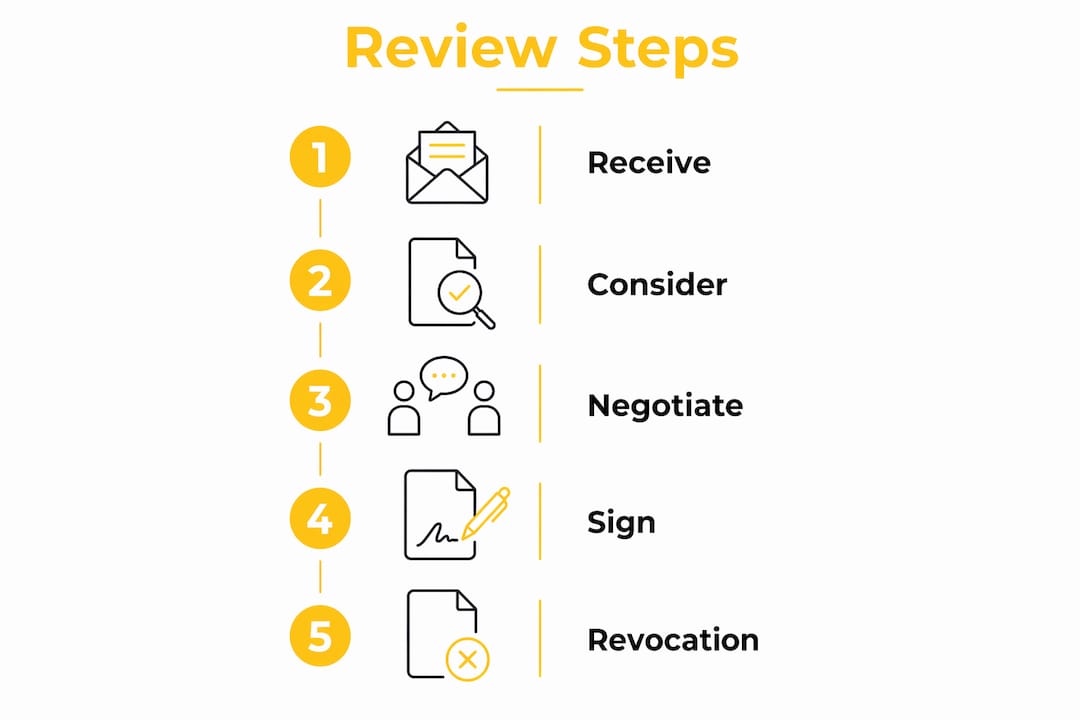
A structured review process protects you from missing critical issues under time pressure. Follow these steps before you sign anything.
Review and negotiation timeline
| Stage | Action | Timing |
|---|---|---|
| Day 1 | Receive agreement, begin document collection | Immediately |
| Days 2–7 | Complete clause review, consult an employment lawyer | Within first week |
| Days 8–14 | Send written counter-offer letter | Before day 14 |
| Days 15–21 | Finalize negotiation, sign or decline | Before OWBPA deadline |
| Days 22–28 | Revocation window (employees 40+) | 7 days post-signing |
Hiring an employment lawyer is the highest-return step in this process. Legal review for packages over $50,000 often recovers 5 to 20 times the cost of legal fees. Attorney fees for a severance review in Garden Grove typically range from $200 to $700, with an average cost of approximately $410. That is a small investment against a package worth tens of thousands of dollars.
A common pitfall is signing early because the employer pressures you or because you want the money quickly. Signing before the 21-day window closes eliminates your negotiation window entirely. Employers know this. Do not let urgency work against you.
California provides stronger employee protections than federal law in several areas. Garden Grove employees benefit from this layered system, but only if they know it exists.
“Employers increasingly include ‘right to disclose’ language per SB 331, but incomplete clauses cause partial unenforceability, making legal review vital.” — Leeran S. Barzilai, California Employment Attorney
California courts interpret ambiguous severance terms in favor of the employee when the employer drafted the agreement. This is called the contra proferentem doctrine. It means that vague language in your agreement is not automatically your enemy. A skilled employment lawyer can use it as leverage.
Garden Grove sits within Orange County, where local courts have consistently upheld SB 331 protections and scrutinized overbroad non-disparagement clauses. Employees who understand their California rights before signing are far better positioned to negotiate fair terms.
Common employer mistakes in severance agreements, such as failing to include proper OWBPA disclosures or omitting SB 331 carve-outs, can expose employers to lawsuits. Knowing these vulnerabilities gives you real negotiating power.
Employees in Garden Grove who review every clause before signing a severance agreement protect their legal rights, preserve negotiation leverage, and avoid waiving protections that California law makes non-waivable.
| Point | Details |
|---|---|
| OWBPA timing is mandatory | Employees 40+ have 21 days to review and 7 days to revoke after signing. |
| SB 331 limits confidentiality | Non-disparagement clauses without disclosure carve-outs are unenforceable in California. |
| Some rights cannot be waived | Wage claims, unemployment benefits, and whistleblower protections survive any release. |
| Legal review pays for itself | Attorney review of packages over $50,000 typically recovers 5 to 20 times the legal fee cost. |
| Negotiate in writing | A written counter-offer letter creates a record and strengthens your negotiating position. |
Employees-lawyer, operating as Optimum Employment Lawyers, focuses exclusively on employee-side cases throughout California. The firm has secured significant results for workers, including a $2.2 million class action settlement for missed meal breaks. For Garden Grove employees facing a severance agreement, that same level of advocacy applies to every clause review and negotiation. The firm’s attorneys understand the local Orange County legal environment and the specific protections California law provides. If your package exceeds $50,000, the return on a professional review is clear. Contact a California employment lawyer to schedule a consultation and protect what you have earned.
A severance agreement is a legally binding contract where an employer pays an employee a sum of money in exchange for the employee waiving the right to sue. Signing one permanently releases most legal claims against your employer.
Employees 40 and older have at least 21 days to review a severance agreement under the OWBPA, plus 7 days to revoke after signing. Employees under 40 have whatever time the agreement specifies, but California courts expect a reasonable review period.
No. Unemployment insurance benefits are non-waivable rights under California law. Any clause attempting to waive them is unenforceable.
California Business and Professions Code § 16600 makes most non-compete clauses unenforceable. Even if your severance agreement includes one, a California court will likely void it. You should still negotiate its removal to avoid future disputes.
Legal fees for a severance review in Garden Grove typically range from $200 to $700, with an average cost of approximately $410. For packages over $50,000, that investment routinely returns 5 to 20 times its cost in improved terms.

© 2026 Optimum Employment Lawyers, PC
Legal Disclaimer | Privacy Policy
 Share
Share
