
(949) 954-8181 Free Case Review No recovery, no fee.
(949) 954-8181 Free Case Review No recovery, no fee.
Family leave retaliation is defined as any adverse action an employer takes against an employee for exercising legally protected family leave rights under California or federal law. If you work in Aliso Viejo and your employer demoted you, cut your hours, or fired you after you took leave, that is illegal. The California Family Rights Act (CFRA), the federal Family and Medical Leave Act (FMLA), and the Fair Employment and Housing Act (FEHA) all prohibit this conduct. Understanding family leave retaliation in Aliso Viejo gives you the knowledge to recognize what happened, document it correctly, and take action that protects your career and your income.
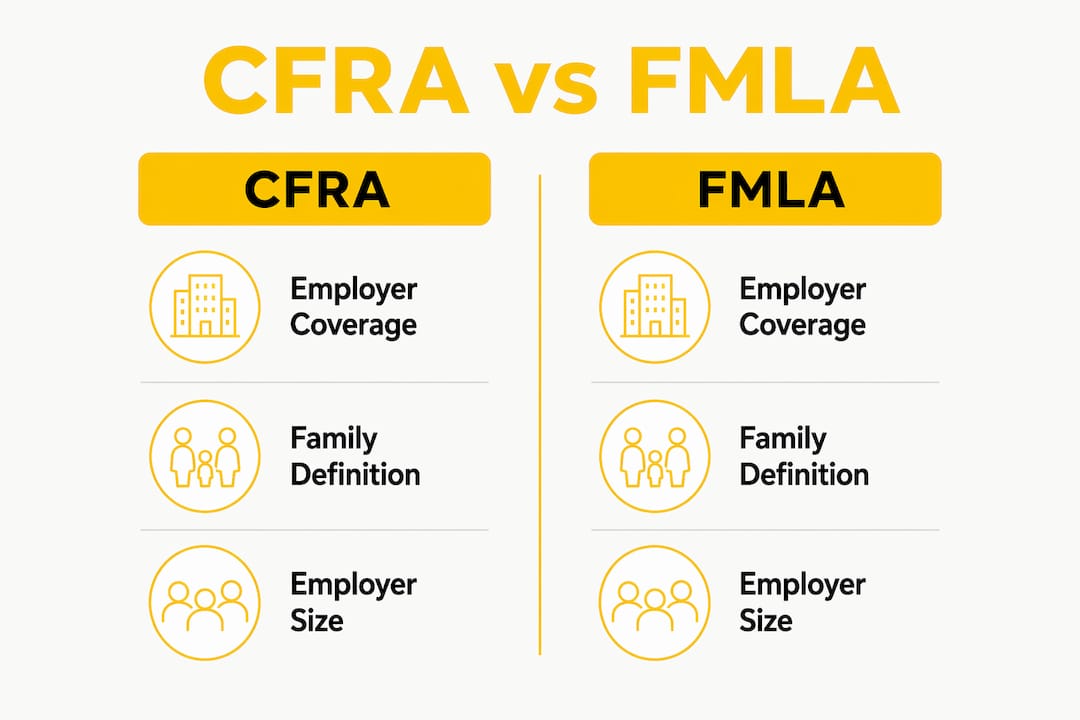
California employees in Aliso Viejo benefit from two overlapping layers of protection: state law and federal law. The CFRA is the stronger shield for most workers in the area.
The table below shows the most important distinctions between the two laws.
| Factor | CFRA (California) | FMLA (Federal) |
|---|---|---|
| Employer size | 5 or more employees | 50 or more employees within 75 miles |
| Family members covered | Spouse, child, parent, sibling, grandparent, grandchild, domestic partner, designated person | Spouse, child, parent |
| Leave duration | Up to 12 weeks per year | Up to 12 weeks per year |
| Job protection | Yes | Yes |
| Retaliation prohibited | Yes | Yes |
To qualify under either law, you must have worked at least 1,250 hours in the 12 months before your leave and have been employed for at least 12 months. CFRA’s employer threshold of just 5 employees means that most small businesses in Aliso Viejo are covered, while FMLA would not reach them.
Beyond CFRA and FMLA, the FEHA and the Americans with Disabilities Act (ADA) add another layer. Both laws prohibit retaliation against employees who request leave as a reasonable accommodation for a disability or serious health condition. If your leave overlapped with a medical condition, FEHA and the ADA may give you additional claims on top of CFRA or FMLA. You can learn more about California family leave rights and how these statutes interact before deciding which path to pursue.
Key protections under CFRA and FMLA include:
Employers cannot retaliate by terminating, demoting, reducing hours, cutting pay, or disciplining an employee because of family leave use. That covers the obvious cases. The harder ones involve subtler conduct that builds over time.
Common retaliatory actions Aliso Viejo employees report include:
The timing of adverse action is the most telling signal. Courts treat close timing between protected leave and an employer’s negative action as significant circumstantial evidence of a retaliatory motive. If your employer fired you two weeks after you returned from CFRA leave, that sequence matters in court.
A sudden drop in performance evaluations after leave is one of the strongest pieces of evidence in a retaliation case. Positive reviews before leave followed by negative reviews after raise immediate red flags for any employment attorney or agency investigator.

Pro Tip: Save every performance review, email, and written communication from before and after your leave. The contrast between pre-leave and post-leave treatment is often the clearest proof of retaliation.
Solid documentation is what separates a winning retaliation claim from one that stalls. The steps below are the same ones employment attorneys advise their clients to follow from day one.
Start a written timeline immediately. Contemporaneous notes that include dates, locations, witnesses, and exact words carry far more weight in litigation than summaries written from memory months later. Write down what happened the same day it occurs.
Follow every verbal complaint with an email. Relying solely on verbal complaints is one of the most common mistakes employees make. After any conversation with HR or a manager about retaliation, send a written summary by email. This creates a record the employer cannot later deny receiving.
Report internally to HR or a supervisor. Put your complaint in writing and keep a copy. Internal reporting is a required step in many legal processes, and it also puts the employer on notice, which strengthens your claim if they fail to act.
File an external complaint if the employer does not respond. Internal reporting alone is rarely sufficient. You can file a complaint with the California Civil Rights Department (formerly the DFEH) or the federal Equal Employment Opportunity Commission (EEOC). Both agencies investigate retaliation claims and can issue right-to-sue letters.
Consult an employment attorney before deadlines pass. California has strict filing deadlines. Missing the statute of limitations can bar your claim entirely, regardless of how strong the evidence is.
Pro Tip: Screenshot or print any digital communications, including texts and workplace messaging apps like Slack, before your employer can delete them. Courts accept these as evidence.
For related guidance on how California law handles similar situations, the article on medical leave retaliation in Mission Viejo covers overlapping legal principles that apply to Aliso Viejo workers as well.
California’s protections go significantly further than federal law on every major dimension. This matters directly for workers in Aliso Viejo, where many employers have fewer than 50 employees and would fall outside FMLA coverage entirely.
| Protection area | CFRA advantage over FMLA |
|---|---|
| Employer coverage | Covers employers with 5+ employees vs. FMLA’s 50+ threshold |
| Family member definitions | Includes siblings, grandparents, grandchildren, and designated persons |
| Pregnancy disability | Separate California law adds up to 4 months of additional leave |
| Paid leave integration | California Paid Family Leave (PFL) provides partial wage replacement during CFRA leave |
CFRA covers employers with 5 or more employees and includes siblings, grandparents, and designated persons, while FMLA covers employers with 50 or more employees and uses narrower family definitions. That gap is enormous for Aliso Viejo employees working for small or mid-size companies.
California Paid Family Leave (PFL) is a separate program administered by the Employment Development Department (EDD). PFL provides partial wage replacement, currently up to 60–70% of weekly wages, while you are on CFRA leave. Taking PFL does not create additional retaliation protection on its own, but using it in connection with CFRA leave means your employer knows you exercised a protected right. Any adverse action after that combination is subject to the same retaliation analysis.
The broader family member definitions under CFRA also matter practically. If you took leave to care for a sibling or grandparent and your employer retaliated, CFRA protects you. FMLA would not. Aliso Viejo employees caring for extended family members should always evaluate their claims under CFRA first.
For a detailed look at how FMLA and CFRA violations are handled in California courts, the legal framework is well established and courts have consistently sided with employees who can show a clear connection between leave use and adverse action.
Employees who prove family leave retaliation in California are entitled to meaningful remedies. The law does not simply require the employer to stop the bad behavior.
Available remedies include:
Filing claims with the California Civil Rights Department or the EEOC is the standard starting point. The agency will investigate, attempt mediation, and may issue a right-to-sue letter that allows you to file a civil lawsuit. Many retaliation cases settle before trial, but having strong documentation and legal representation significantly increases the settlement value.
Job-protected leave means you cannot be terminated for taking leave, though employers can still terminate for legitimate, unrelated reasons such as independently discovered misconduct or a genuine layoff. The burden shifts to the employer to prove the reason was unrelated to the leave. An experienced employment attorney can challenge pretextual justifications and expose the real motive.
California’s retaliation protections also extend to whistleblower protections when an employee reports a violation of law in connection with their leave rights. If you complained about a leave denial and faced retaliation, that complaint itself may be protected under Labor Code Section 1102.5.
Employees-lawyer, the team at Optimum Employment Lawyers, represents workers throughout the Aliso Viejo area who have faced retaliation for exercising their family leave rights. The firm focuses exclusively on employee-side cases, which means every strategy is built around protecting your interests, not your employer’s. Their track record includes a $2.2 million class action settlement for missed meal breaks, demonstrating the firm’s ability to hold employers accountable at scale. If you believe your employer retaliated against you for taking CFRA or FMLA leave, contact an Aliso Viejo employment attorney for a case evaluation. The consultation is free, and the deadlines for filing are strict, so acting quickly protects your rights.
California employees facing family leave retaliation have strong legal protections under CFRA, FMLA, and FEHA, and the most effective response combines immediate documentation with prompt legal action.
| Point | Details |
|---|---|
| CFRA covers more employers | California law applies to employers with 5+ employees, far below FMLA’s 50-employee threshold. |
| Timing is critical evidence | Courts treat adverse action shortly after leave as strong circumstantial proof of retaliation. |
| Document everything in writing | Contemporaneous notes and email follow-ups create the evidentiary record that wins cases. |
| Multiple remedies are available | Back pay, reinstatement, emotional distress damages, and attorney’s fees are all recoverable. |
| File before deadlines expire | Missing the statute of limitations bars your claim regardless of the strength of your evidence. |
Family leave retaliation occurs when an employer takes an adverse action, such as termination, demotion, or a pay cut, because an employee exercised their right to take CFRA or FMLA leave. Both state and federal law prohibit this conduct.
CFRA applies to employers with 5 or more employees, which covers most businesses in Aliso Viejo. FMLA requires 50 or more employees within a 75-mile radius, a much higher threshold.
Report retaliation in writing to your HR department first, then file a complaint with the California Civil Rights Department or the EEOC if the employer does not act. Consulting an employment attorney before filing protects you from procedural mistakes.
An employer cannot terminate you because you are on protected leave, but they can terminate you for a legitimate reason unrelated to the leave, such as a documented layoff or independently discovered misconduct. The employer must prove the reason was genuinely unrelated.
California employees can recover back pay, front pay, reinstatement, emotional distress damages, punitive damages in FEHA cases, and attorney’s fees. The specific remedies depend on the facts of your case and the laws under which you file.

© 2026 Optimum Employment Lawyers, PC
Legal Disclaimer | Privacy Policy
 Share
Share
