
(949) 954-8181 Free Case Review No recovery, no fee.
(949) 954-8181 Free Case Review No recovery, no fee.
Wage and hour violations are defined as employer practices that deny workers their legally earned pay, breaks, or overtime under California law. In Laguna Hills and across Orange County, these violations are far more common than most workers realize. The U.S. Department of Labor assessed nearly $318 million in back pay and penalties for minimum wage, overtime, and child labor violations in fiscal year 2025 alone. That number reflects a nationwide enforcement push, and California sits at the center of it. If you work in Laguna Hills and suspect your employer is shortchanging you, this guide explains the most common unlawful practices, how to spot them, and what your rights are under California wage laws.
The term “wage and hour violations” covers a broad range of unlawful employer conduct. California employment law, enforced by the California Labor Commissioner’s Office, sets some of the strongest worker protections in the country. Yet violations remain widespread in Laguna Hills and throughout Orange County, particularly in retail, hospitality, healthcare, and construction.
Here are the most frequent violations Laguna Hills workers encounter:
Pro Tip: If your employer pays you in cash or refuses to provide written paystubs, treat that as a red flag. California law requires itemized wage statements for every pay period, and the absence of one is itself a violation.

Spotting a wage violation is the first step. Proving it is what gets you paid. California courts and the Labor Commissioner’s Office rely heavily on records, and your personal documentation can be the deciding factor in your case.
Follow these steps to build a strong record:
Pro Tip: Keep a dedicated folder, physical or digital, with every paystub, schedule, and work-related text message. Detailed personal logs are the most powerful evidence when an employer’s records are incomplete or altered.
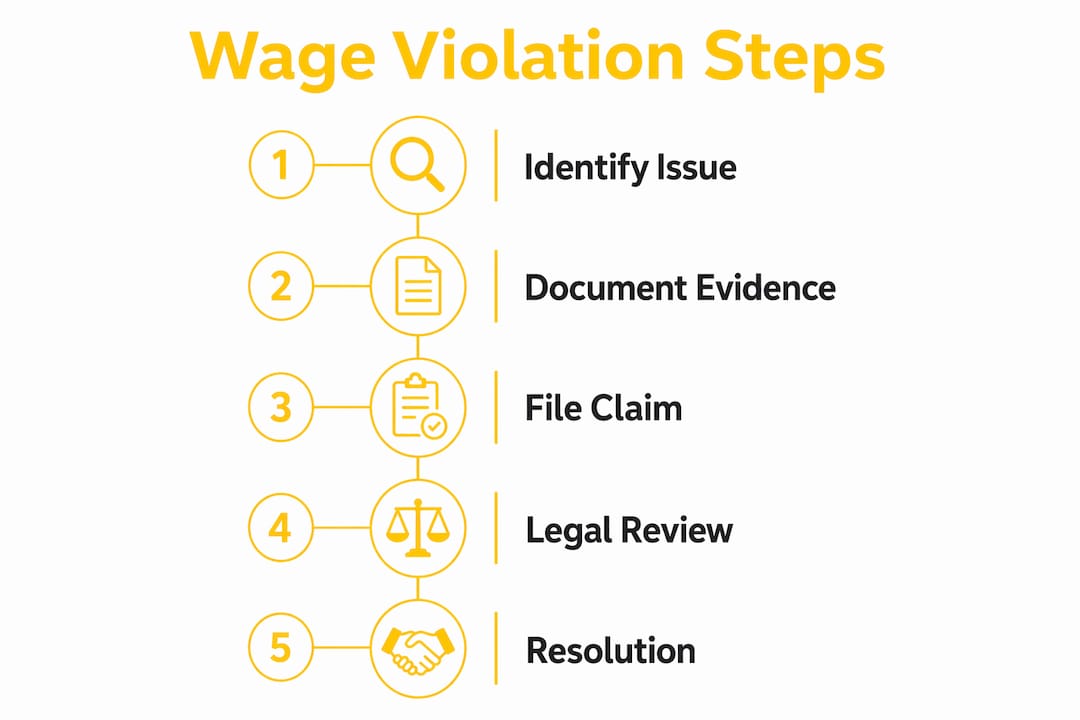
California wage law gives Laguna Hills workers some of the strongest legal protections available anywhere in the United States. Knowing these protections tells you exactly what your employer owes you and what you can recover when they fail to deliver.
The table below summarizes the key protections and remedies under California law:
| Protection | What It Covers | Remedy for Violation |
|---|---|---|
| Minimum Wage | $16.50/hr statewide in 2026; $20.00/hr for fast food | Back pay plus penalties |
| Daily Overtime | 1.5x pay over 8 hrs/day; 2x pay over 12 hrs/day | Unpaid wages plus interest |
| Meal and Rest Breaks | 30-min meal per 5 hrs; 10-min rest per 4 hrs | One hour premium pay per missed break |
| Misclassification (AB5) | Workers controlled by employer are employees | Full wage protections and back pay |
| Accurate Paystubs | Itemized statements required each pay period | Up to $4,000 in statutory penalties |
California employees have three years to file a wage and hour lawsuit, or four years under the state’s unfair competition law. That window gives you real time to gather evidence and consult an attorney before acting.
You file wage claims with the California Labor Commissioner’s Office, also called the Division of Labor Standards Enforcement (DLSE). For Laguna Hills workers, the nearest office is in Santa Ana. You can also pursue a wage and hour claim through a private lawsuit, which often results in larger recoveries, especially in class action cases.
California law also prohibits employer retaliation. If your employer fires, demotes, or threatens you for reporting a wage violation or filing a claim, that retaliation is itself an unlawful act with separate legal remedies. The Orange County courts have seen multiple cases where retaliation claims added significant damages on top of the original wage recovery.
Not every wage violation in Laguna Hills is deliberate. Some arise from genuine payroll errors. Others are calculated strategies to cut labor costs. Knowing the difference helps you understand what you are dealing with and how to respond.
Administrative payroll errors contribute significantly to wage disputes in Orange County. Common mistakes include misconfigured timekeeping software, incorrect pay rate entries, and failure to update records when California’s minimum wage increases. These errors still cost you money, and your employer is still legally required to correct them and pay you back.
Intentional violations look different. Watch for these patterns:
Sectors with the highest rates of violations in Laguna Hills and surrounding Orange County include food service, retail, home care, and construction. Workers in these industries should be especially alert to the practices listed above. If your employer operates across multiple locations or employs dozens of workers under similar conditions, your case may qualify as a class action, which can significantly increase the total recovery for all affected employees.
Wage and hour violations in Laguna Hills follow predictable patterns that California law directly addresses, and employees who document their hours and breaks hold the strongest position when pursuing claims.
| Point | Details |
|---|---|
| Most common violations | Unpaid overtime, missed breaks, misclassification, and off-the-clock work top the list in Laguna Hills. |
| California overtime rules | Daily overtime applies over 8 hours per day, not just 40 hours per week, making California stricter than federal law. |
| Document everything | Personal logs of hours and breaks are the most powerful evidence when employer records are missing or altered. |
| Statute of limitations | You have three to four years to file a wage claim in California, giving you time to build a solid case. |
| Retaliation is illegal | Employers cannot legally fire or demote you for reporting wage violations or filing a claim with the Labor Commissioner. |
Employees-lawyer, operating as Optimum Employment Lawyers, focuses exclusively on employee-side cases in California. If you work in Laguna Hills and believe your employer has violated your wage rights, the firm offers direct, personalized legal representation with a track record that includes a $2.2 million class action settlement for missed meal breaks. The team handles everything from individual wage dispute claims to large class actions across Orange County. If you are considering joining other affected workers, resources on how to join a class action can help you understand the process. Contact a California employment lawyer at Employees-lawyer today for a free consultation and find out exactly what your employer owes you.
A wage and hour violation occurs when an employer fails to pay minimum wage, overtime, or meal and rest break premiums as required by California law. It also includes off-the-clock work, misclassification, and inaccurate paystubs.
Under California’s AB5 law, if your employer controls your schedule, tools, and work process, you are legally an employee. Your job title or contract label does not override the actual working relationship.
California employees have three years to file a wage and hour lawsuit, or four years under the state’s unfair competition law. Filing sooner preserves more evidence and increases your recovery options.
No. California law prohibits retaliation for reporting wage violations or filing a claim with the Labor Commissioner. Retaliation is a separate legal violation that carries its own penalties and damages.
California law requires employers to pay one additional hour of pay at your regular rate for each missed meal break and each missed rest break. These penalties accumulate daily and can add up to significant amounts over time.

© 2026 Optimum Employment Lawyers, PC
Legal Disclaimer | Privacy Policy
 Share
Share
