
(949) 954-8181 Free Case Review No recovery, no fee.
(949) 954-8181 Free Case Review No recovery, no fee.

Race discrimination in employment is defined as adverse treatment of an employee or job applicant based on race, color, or ethnicity, and it is strictly illegal in Anaheim workplaces under both federal and California law. Title VII of the Civil Rights Act and California’s Fair Employment and Housing Act (FEHA) prohibit this conduct across every stage of employment, from hiring to termination. The Equal Employment Opportunity Commission (EEOC) and the California Civil Rights Department (formerly the Department of Fair Employment and Housing) both enforce these protections. If you work in Anaheim and believe your employer has treated you differently because of your race, you have concrete legal rights and real options for recourse.
Race discrimination in employment covers a wider range of conduct than most employees realize. The law recognizes two primary categories: disparate treatment and disparate impact. Disparate treatment means your employer deliberately treated you worse because of your race. Disparate impact means a neutral policy disproportionately harms employees of a particular race, even without any stated intent to discriminate.
Overt examples include being passed over for a promotion given to a less qualified White colleague, receiving lower pay for identical work, or being terminated while non-minority employees who committed the same policy violation kept their jobs. Anaheim employers in industries ranging from hospitality and theme park operations to healthcare and logistics have faced discrimination claims across all of these categories.
Subtle forms of workplace racism are equally unlawful and often harder to identify:
A newer and increasingly documented form of race bias in employment involves algorithmic hiring tools. Callback rates for Black and Hispanic men in management positions are 28% to 43% lower than identical White applicants, revealing that AI screening systems can embed and amplify racial bias. This means Anaheim job seekers rejected by automated systems may have a discrimination claim even when no human decision-maker was directly involved.
Pro Tip: Keep a running log of every incident you believe reflects racial bias, including the date, location, who was present, and exactly what was said or done. Courts and agencies treat contemporaneous records as far more credible than reconstructed timelines.

Two laws form the foundation of racial discrimination protections for Anaheim workers, and understanding the differences between them matters significantly for your case.
Title VII of the Civil Rights Act applies to private employers with 15 or more employees, as well as federal, state, and local government employers. It prohibits discrimination based on race, color, religion, sex, and national origin. Employees must file a charge with the EEOC before pursuing a federal lawsuit, and federal damage awards are capped based on employer size.
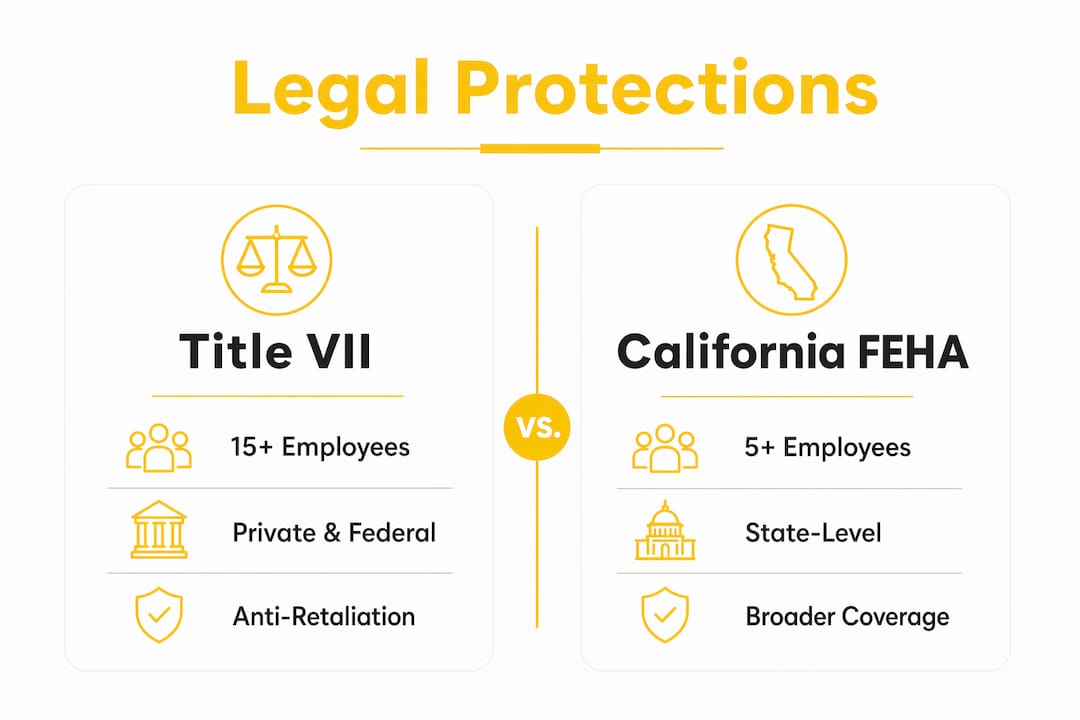
California’s Fair Employment and Housing Act (FEHA) goes further. FEHA covers employers with 5 or more employees and provides broader protections with stronger remedies than federal law. This matters for Anaheim employees working at smaller businesses who would have no federal recourse but retain full state law protections. California courts have also consistently interpreted FEHA more expansively than federal courts interpret Title VII.
| Protection | Title VII | California FEHA |
|---|---|---|
| Employer size threshold | 15+ employees | 5+ employees |
| Damage caps | Yes, based on employer size | Generally higher, fewer caps |
| Anti-retaliation coverage | Yes | Yes, with broader scope |
| Filing agency | EEOC | California Civil Rights Department |
| Filing deadline | 180 to 300 days | 3 years from violation |
Anti-retaliation protections are built into both laws. Retaliation against employees who report race discrimination, file complaints, or participate in investigations is independently unlawful under both FEHA and Title VII. If your employer demotes you, cuts your hours, or creates a hostile environment after you speak up, that retaliation is a separate legal violation on top of the original discrimination.
Proving racial discrimination in the workplace follows a structured legal framework called the McDonnell Douglas burden-shifting test, established in McDonnell Douglas Corp. v. Green. Understanding how it works gives you a clear picture of what evidence you need to build.
Establish a prima facie case. You must show you belong to a protected racial group, you were qualified for the position or benefit at issue, you suffered an adverse employment action, and similarly situated employees outside your racial group were treated more favorably.
The employer responds. Once you present this initial evidence, your employer must articulate a legitimate, non-discriminatory reason for the action taken against you. This shifts the burden back to you.
Prove pretext. You must then show that the employer’s stated reason is false or a cover for discrimination. This is where documentation becomes decisive. Emails, performance reviews, witness statements, and records of how comparable employees were treated all serve as evidence of pretext.
Address algorithmic bias if applicable. If an AI hiring tool screened you out, position-level statistical analysis is required to expose adverse racial impact. Aggregate fairness metrics used by vendors often mask discrimination that only appears when you examine specific job categories. About 25.87% of Black applicants in one 2026 study applied to positions where the algorithm produced adverse impact against them, a fact invisible in the overall numbers.
Gather circumstantial evidence. Direct admissions of racial bias are rare. Circumstantial evidence, including statistical patterns, shifting explanations from management, and documented departures from standard procedure, carries significant legal weight. Documenting performance reviews and emails immediately after incidents is critical to showing that an employer’s stated reasons are pretextual.
Pro Tip: Request copies of your personnel file, performance evaluations, and any written policies governing promotions or discipline. California law gives employees the right to inspect their personnel records, and this material often contains the inconsistencies that prove pretext.
A successful race discrimination claim in California can produce several categories of relief, and the combination often exceeds what employees initially expect.
“Employees who retain experienced legal counsel in race discrimination cases consistently achieve better outcomes, both in settlement negotiations and at trial, because attorneys understand how to quantify damages and counter employer defenses that non-represented claimants often cannot anticipate.”
Settlements through EEOC conciliation or direct negotiation resolve the majority of race discrimination claims before trial. The EEOC’s conciliation process can produce binding agreements that include policy changes, training requirements, and monetary relief. For Anaheim employees, having an attorney who understands both FEHA and Title VII remedies is the single most significant factor in maximizing recovery.
If you are experiencing racial harassment or discrimination at work in Anaheim, the sequence of your actions matters as much as the actions themselves. Missing a deadline or skipping a step can limit your legal options significantly.
Document everything immediately. Record each incident with the date, time, location, who was present, and verbatim quotes where possible. Save copies of relevant emails, texts, and performance reviews to a personal device or account outside company systems.
Report internally if it is safe to do so. Many employers require employees to use internal complaint procedures before pursuing external claims. Report to HR or a supervisor above the offending party and keep a written record of your report and any response.
Consult an employment attorney before filing. An attorney specializing in Anaheim employment law can assess the strength of your claim, identify the correct agency and deadline, and prevent procedural errors that forfeit your rights.
File with the correct agency within the deadline. Employees have 180 to 300 days to file a charge with the EEOC, while FEHA complaints must be filed within three years of the discriminatory act. Missing these deadlines eliminates your right to sue.
Recognize and document retaliation. If your employer responds to your complaint with adverse actions, document those separately. Retaliation claims are often stronger than the underlying discrimination claim and carry independent legal weight.
Avoid signing anything without legal review. Employers sometimes present severance agreements or settlement offers quickly after a complaint. These documents often contain broad releases of your discrimination claims. Never sign without an attorney reviewing the terms.
Race discrimination in Anaheim workplaces is illegal under both Title VII and California FEHA, and employees who document incidents, file within deadlines, and retain qualified legal counsel have the strongest path to full compensation.
| Point | Details |
|---|---|
| FEHA covers more employers | California’s FEHA applies to employers with 5+ employees, covering more Anaheim workers than federal law. |
| AI tools can discriminate | Algorithmic hiring systems show adverse racial impact in about 10% of positions, creating valid legal claims. |
| McDonnell Douglas is the standard | Employees must establish a prima facie case, then prove the employer’s stated reason is pretextual. |
| Filing deadlines are strict | EEOC charges must be filed within 180 to 300 days; FEHA complaints within three years of the violation. |
| Remedies can be substantial | Successful claims can yield back pay, compensatory damages, punitive damages, and attorney’s fees under FEHA. |
Employees-lawyer, operating as Optimum Employment Lawyers, represents Anaheim employees exclusively on the employee side. The firm handles workplace discrimination cases under both FEHA and Title VII, helping clients document claims, navigate EEOC and California Civil Rights Department filings, and pursue maximum compensation. Their track record includes a $2.2 million class action settlement, demonstrating the firm’s ability to deliver results in complex employment cases. If you are facing racial discrimination or harassment at work in Anaheim, the team at Optimum Employment Lawyers offers personalized consultations to assess your situation and outline your legal options before any deadlines pass.
Race discrimination under California’s FEHA includes any adverse employment action, such as termination, demotion, or pay reduction, taken because of an employee’s race, color, or ethnicity. Hostile work environment conduct, including racial slurs and microaggressions, also qualifies when severe or pervasive enough to alter working conditions.
FEHA complaints must be filed with the California Civil Rights Department within three years of the discriminatory act, while EEOC charges carry a 180 to 300 day deadline. Missing either deadline can permanently forfeit your right to pursue the claim.
Yes. Algorithmic hiring bias that produces adverse racial impact is actionable under both Title VII and FEHA, even without a human decision-maker. Position-level statistical analysis is typically required to establish the claim.
Document every retaliatory act with dates and details, and report the retaliation separately to the EEOC or California Civil Rights Department. Retaliation is an independent violation under both FEHA and Title VII, and it strengthens your overall legal position.
You are not legally required to have an attorney to file with the EEOC or California Civil Rights Department, but legal representation significantly improves outcomes. An attorney who handles California hiring discrimination cases can identify evidence, meet deadlines, and negotiate settlements that unrepresented employees routinely leave on the table.

© 2026 Optimum Employment Lawyers, PC
Legal Disclaimer | Privacy Policy
 Share
Share
