
(949) 954-8181 Free Case Review No recovery, no fee.
(949) 954-8181 Free Case Review No recovery, no fee.
Independent contractor misclassification is defined as the illegal practice of treating workers as self-employed contractors when California law classifies them as employees. For Lake Forest workers, this distinction carries enormous financial consequences. California’s ABC test under Labor Code § 2775 presumes every worker is an employee by default, placing the full burden of proof on the employer. If your employer cannot satisfy all three prongs of that test, you are legally an employee, regardless of what your contract says or what tax form you receive.
The ABC test is the legal standard governing independent contractor classification in California, and it is one of the strictest in the country. Under Labor Code § 2775, an employer must prove all three prongs to lawfully classify a worker as an independent contractor. Failure on even one prong means the worker is an employee with full legal protections.
Here is what each prong requires:
Prong B is the most common reason employers fail the ABC test, because most businesses hire contractors to perform their core services. A Lake Forest marketing agency that classifies its full-time copywriters as independent contractors almost certainly fails this prong.
Two facts about the ABC test that many workers do not know. First, written contracts or 1099 forms do not determine your legal status. Courts prioritize operational reality over contract language, examining factors like who controls your schedule, who provides your tools, and whether you work exclusively for one company. Second, forming an LLC alone does not satisfy Prong C if you depend solely on one hiring entity without other clients. Courts focus on independent business reality, not formal entity status.

Pro Tip: Save every email, text, or instruction your employer sends you about how to do your work. This documentation directly addresses Prong A and becomes critical evidence if you file a claim.
Misclassified workers in Lake Forest are entitled to recover the full range of employee benefits and wages they were denied. The list of recoverable damages is broader than most workers expect.
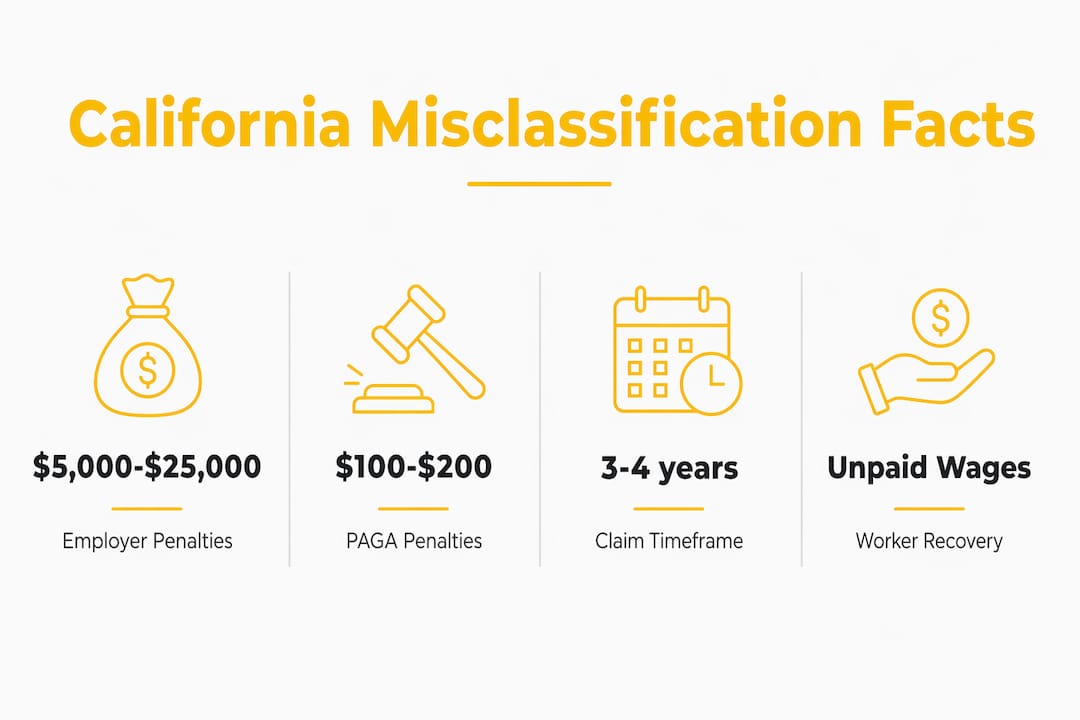
Beyond individual damages, PAGA penalties add $100 to $200 per worker per pay period, which compounds rapidly in class or group actions. Employers also face civil penalties under Labor Code § 226.8 ranging from $5,000 to $25,000 per violation for willful misclassification. Critically, legal experts confirm that willful misclassification does not require bad faith. Even misclassification based on incorrect legal advice qualifies, which means employers cannot hide behind ignorance.
Recent enforcement actions in Southern California illustrate the scale of exposure. A home care company faced a $10 million judgment for misclassification, and multiple caregiver agencies in the region have faced multi-million dollar penalties. Optimum Employment Lawyers has itself secured a $2.2 million class action settlement for workers denied proper meal breaks, demonstrating that California courts take these violations seriously. These cases are not outliers. They reflect a pattern of aggressive enforcement that directly protects Lake Forest workers.
Some workers and occupations fall outside the ABC test under California law, but these exemptions are narrow and rarely apply to the average Lake Forest employee. Understanding where the lines fall protects you from accepting a false classification.
| Exemption Type | Who It Covers | Key Limitation |
|---|---|---|
| Licensed professionals | Doctors, lawyers, architects, certain insurance agents | Must meet specific licensing and practice conditions |
| Business-to-Business (B2B) | Contractors operating a genuine independent business | Must satisfy 12 specific conditions under Labor Code § 2776 |
| Referral agencies | Workers placed through certain referral platforms | Narrow industry and service requirements apply |
| Proposition 22 | Uber and Lyft drivers, DoorDash couriers | Does not apply to most gig or freelance workers outside app-based platforms |
The Business-to-Business exemption deserves special attention because employers frequently misuse it. Labor Code § 2776 requires the contractor to have a separate business location, the ability to negotiate contracts independently, and multiple clients. Most workers who perform services for a single company cannot meet these conditions. Most Lake Forest workers remain subject to the strict ABC test because exemptions require stringent proof that typical employment relationships cannot satisfy.
Proposition 22, passed in 2020, created a carve-out for app-based transportation and delivery drivers working for platforms like Uber and Lyft. This exemption is specific to those platforms and those service categories. A Lake Forest graphic designer working through a freelance platform, or a warehouse worker classified as a contractor, receives no protection from Proposition 22 and remains fully covered by the ABC test.
If your employer claims you fall under an exemption, treat that claim with skepticism. Consult an employment attorney before accepting it. The burden of proving an exemption applies rests entirely on the employer, not on you.
Recognizing misclassification is the first step toward recovering what you are owed. Several workplace indicators signal that your employer may be treating you as a contractor when California law classifies you as an employee.
Once you recognize these signs, documentation becomes your most powerful asset. Record your daily work hours, save all communications from your employer about how to perform your work, and keep receipts for any expenses you paid yourself. This evidence maps directly to the ABC test prongs and strengthens your claim considerably.
Timing matters significantly. Wage claims under California Labor Code carry a three-year statute of limitations, extended to four years under the Unfair Competition Law. PAGA penalty claims have a one-year window from the last violation. Waiting too long can eliminate your right to recover past wages entirely, so acting quickly after you identify misclassification is critical.
Filing for unemployment insurance or submitting a wage claim with the California Labor Commissioner often triggers an Employment Development Department audit of your employer’s classification practices. This enforcement mechanism can benefit not just you but all workers at the same company who were misclassified alongside you.
Pro Tip: Before contacting your employer or signing any settlement, speak with a California employment attorney who handles misclassification cases. Employers sometimes offer quick settlements that are far below what workers are legally owed, particularly when PAGA penalties are in play.
You can also review your rights under California’s AB5 law to understand exactly how the ABC test applies to your situation. For workers in Lake Forest specifically, understanding the difference between employee and contractor status under California law is the foundation of any successful claim.
Misclassified workers in Lake Forest are legally employees under California’s ABC test, and they can recover unpaid wages, penalties, and attorney’s fees when employers fail to prove all three classification prongs.
| Point | Details |
|---|---|
| ABC test burden falls on employer | Employers must prove all three prongs; failure on any one makes you a legal employee. |
| Written contracts do not control status | Courts examine actual working conditions, not contract language or 1099 forms. |
| Recovery includes multiple damage types | Back pay, overtime, missed breaks, expenses, and PAGA penalties are all recoverable. |
| Exemptions are narrow and rarely apply | Most Lake Forest workers remain under the strict ABC test regardless of employer claims. |
| Deadlines are strict | Wage claims have a three-year limit; PAGA notices must be filed within one year of the last violation. |
If you believe your employer has misclassified you as an independent contractor, the Lake Forest employment attorneys at Optimum Employment Lawyers are ready to evaluate your case. Optimum Employment Lawyers focuses exclusively on employee-side cases, which means every strategy they build is designed to recover maximum compensation for workers, not protect employers. Their team has deep knowledge of California labor laws, the ABC test, and PAGA enforcement, and they have secured multi-million dollar results for workers across Southern California. Contact Optimum Employment Lawyers today for a free consultation and find out exactly what your misclassification claim may be worth.
Misclassification occurs when an employer treats a worker as an independent contractor despite the worker qualifying as an employee under California’s ABC test. The ABC test under Labor Code § 2775 presumes employee status unless the employer proves all three classification prongs.
No. California courts examine actual working conditions, not contract labels. Workers cannot waive their rights to employee status through a signed agreement, and a 1099 form does not override the ABC test result.
Wage claims carry a three-year statute of limitations under California Labor Code, extended to four years under the Unfair Competition Law. PAGA penalty claims must be filed within one year of the last violation, making prompt action critical.
Employers face civil penalties of $5,000 to $25,000 per violation under Labor Code § 226.8 for willful misclassification, plus PAGA penalties of $100 to $200 per worker per pay period. Recent Southern California enforcement actions have resulted in judgments exceeding $10 million.
Only if you are an app-based driver working for platforms like Uber or Lyft. Proposition 22 does not apply to most freelance or gig workers in Lake Forest, who remain fully subject to the ABC test under AB5.

© 2026 Optimum Employment Lawyers, PC
Legal Disclaimer | Privacy Policy
 Share
Share
