
(949) 954-8181 Free Case Review No recovery, no fee.
(949) 954-8181 Free Case Review No recovery, no fee.
Unpaid overtime is defined as compensation owed to non-exempt employees for hours worked beyond the thresholds set by California Labor Code Section 510, which requires 1.5 times the regular rate for hours over 8 in a single workday or 40 in a workweek, and double time for hours beyond 12 in a single day. For Irvine employees, this matters more than most people realize. California’s overtime rules are significantly stronger than federal law, and many workers in Orange County are losing hundreds or thousands of dollars each year simply because their employers are not following the rules. This article explains exactly what those rules are, why violations happen, how to document your claim, and what legal options you have.
California operates a dual overtime system that no other state matches in scope. Under California Labor Code Section 510, overtime triggers at two separate points: after 8 hours in a single workday and after 40 hours in a single workweek. Federal law only recognizes the 40-hour weekly threshold. That difference is enormous for Irvine workers who regularly put in 9 or 10-hour days without seeing a penny of overtime on their pay stubs.
The structure works like this. Hours 9 through 12 in a single day are paid at 1.5 times your regular rate. Any hour beyond 12 in that same day is paid at double time after 12 hours. The weekly trigger works independently. If you work five 8-hour days, you hit 40 hours with no daily overtime triggered, but any hour on day six or seven is paid at 1.5 times your regular rate regardless of daily hours.

When both daily and weekly overtime apply to the same hours, California law requires your employer to pay whichever calculation results in the higher amount. This protects you from employers who try to offset daily overtime against weekly totals to reduce your check.
One detail most employees miss: your regular rate includes bonuses and shift differentials, not just your base hourly wage. Non-discretionary bonuses and commissions must be folded into the regular rate before overtime is calculated. If your employer is computing overtime only on your base wage while ignoring a production bonus, your overtime check is almost certainly short.
| Overtime type | Hours threshold | Pay rate | Example at $20/hr |
|---|---|---|---|
| Daily overtime | Over 8 hours in one day | 1.5× regular rate | $30/hr for hours 9-12 |
| Double time | Over 12 hours in one day | 2× regular rate | $40/hr for hour 13+ |
| Weekly overtime | Over 40 hours in one week | 1.5× regular rate | $30/hr for hours 41+ |
| 7th consecutive day | First 8 hours | 1.5× regular rate | $30/hr |
| 7th consecutive day | Over 8 hours | 2× regular rate | $40/hr |
Pro Tip: Review your pay stubs line by line each pay period. Employers frequently make payroll errors ignoring California’s daily overtime threshold. A free California overtime calculator can confirm whether your hours and pay rate match what you were actually paid.
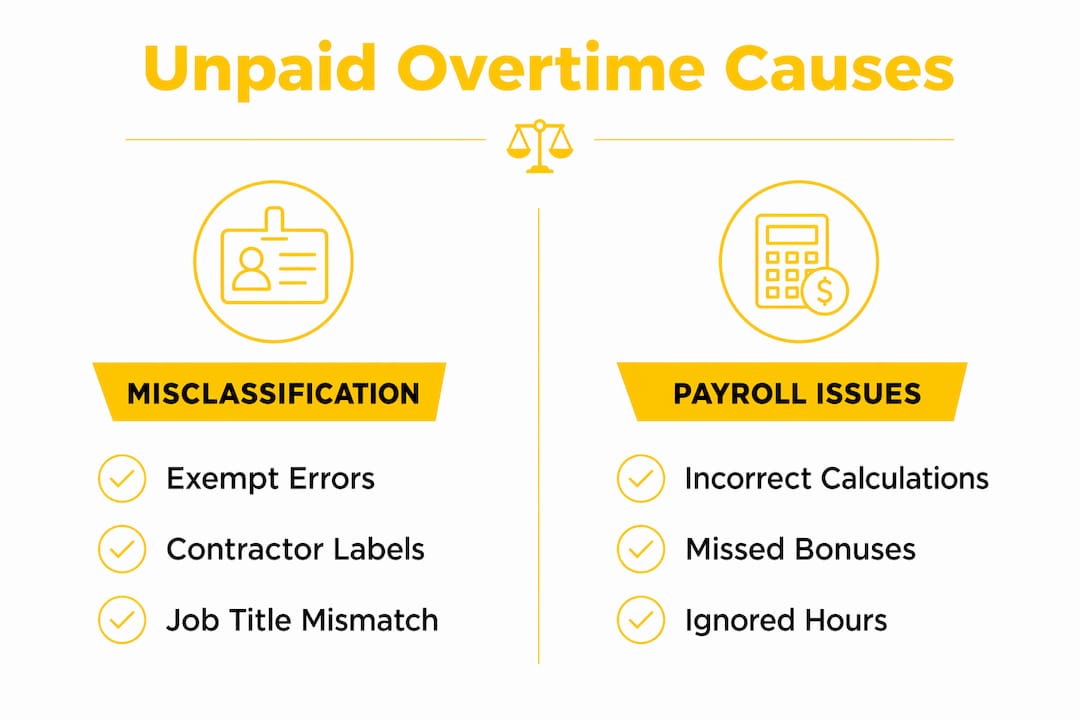
The single biggest cause of unpaid overtime in Irvine workplaces is employee misclassification. California requires employers to prove that a worker qualifies for an overtime exemption. The burden does not fall on you. Under California’s exemption duties test, more than half the work time must involve genuinely exempt duties for the classification to hold. A job title like “manager” or “coordinator” means nothing if you spend most of your shift doing the same tasks as hourly workers.
California also applies the ABC test to independent contractor classifications. Workers labeled as 1099 contractors who actually work set schedules, use company equipment, and perform the core work of the business are likely misclassified. Misclassification affects access to overtime pay, workers’ compensation, and unemployment benefits simultaneously. The financial harm compounds quickly.
Orange County has seen significant misclassification enforcement activity. Technology firms, healthcare staffing companies, and retail chains operating in Irvine have all faced wage and hour claims where workers labeled as exempt salaried employees or independent contractors were found to be non-exempt and owed back overtime. The California Labor Commissioner’s office actively investigates these cases.
Beyond misclassification, other common violations include:
Pro Tip: If your job title changed but your actual daily tasks did not, that is a warning sign. Review the exempt vs. non-exempt criteria under California law to see whether your classification holds up against your real duties.
The strength of your unpaid overtime claim depends almost entirely on the quality of your records. Wage and hour claims hinge on reconciling employer time records with independent employee evidence. Your employer controls the official timekeeping system. You need to build a parallel record they cannot delete.
Start keeping a personal time log immediately. Record your actual start time, end time, and any breaks each day in a notebook, a personal calendar app, or a secure cloud document. Timestamps from work emails, Slack messages, or text exchanges with supervisors are powerful because they are independently verifiable and difficult to dispute. Badge access logs from your Irvine office building are another source your employer may not think to scrub.
The distinction between your job title and your actual duties matters enormously when exemption status is in dispute. Write down a detailed description of what you actually do each day, not what your job description says. Courts and the California Labor Commissioner look at functional reality, not paperwork labels.
| Evidence type | Benefit | Challenge |
|---|---|---|
| Personal time log | Direct record of actual hours | Must be kept consistently from the start |
| Work emails and messages | Timestamped and independently verifiable | Requires access to personal copies before leaving job |
| Badge access records | Objective entry and exit data | Must be requested from employer or building management |
| Coworker statements | Corroborates patterns of off-the-clock work | Coworkers may fear retaliation |
| Pay stubs and W-2s | Shows pay rate and hours reported by employer | Only reflects what employer chose to record |
Preserve copies of all evidence outside of company systems. Email documents to a personal account or store them on a personal device before you leave the job. California law prohibits retaliation against employees who assert their wage rights, but having your evidence secured before any dispute escalates protects you regardless.
Pro Tip: If you suspect your employer is about to terminate you for raising overtime concerns, document every communication about your wages in writing. Proving future lost wages in a retaliation claim requires a clear paper trail connecting your protected activity to the adverse employment action.
Irvine employees have several direct legal paths to recover unpaid overtime, and none of them require you to pay legal fees upfront. The California Labor Commissioner’s office, also called the Division of Labor Standards Enforcement (DLSE), accepts wage claims at no cost to the employee. Filing a claim triggers an investigation and a hearing where your employer must justify their pay practices.
Labor Code Section 203 adds a powerful financial incentive for employers to settle quickly. If an employer willfully withholds overtime through the final paycheck, they owe waiting time penalties equal to one day of wages for every day the wages remain unpaid, up to 30 days. On a $25-per-hour salary, that adds up to $6,000 in penalties alone on top of the unpaid overtime itself.
Anti-retaliation statutes protect you from termination, demotion, or reduced hours after you file a claim. Employers who retaliate face civil penalties up to $10,000 per violation, plus reinstatement and back pay. Filing a claim does not put your job at greater risk. It puts your employer at legal risk.
The statute of limitations for unpaid overtime claims in California is three years for claims under the Labor Code and four years for claims under California’s Unfair Competition Law. That means you can recover back overtime going back several years, not just recent pay periods.
Here is how to start the process:
Many employment attorneys handling overtime claims in California work on a contingency basis, meaning they collect fees only if you win. This removes the financial barrier that stops most workers from pursuing legitimate claims.
California’s dual daily and weekly overtime triggers give Irvine employees stronger legal protections than federal law, and misclassification is the leading reason those protections go unenforced.
| Point | Details |
|---|---|
| California’s dual overtime triggers | Overtime starts after 8 hours daily or 40 hours weekly, whichever benefits you more. |
| Regular rate includes bonuses | Non-discretionary bonuses and commissions must be included when calculating overtime pay. |
| Misclassification is the top cause | Employers must prove exemption through actual job duties, not just job titles. |
| Document everything independently | Personal time logs, emails, and badge records are your strongest evidence in a dispute. |
| Multiple recovery paths exist | Wage claims, lawsuits, and waiting time penalties under Labor Code Section 203 all apply. |
If you are an Irvine employee who suspects your employer has shorted your overtime pay, Optimum Employment Lawyers offers free consultations and works on a contingency fee basis, so you pay nothing unless they win your case. Their team focuses exclusively on employee-side cases, including wage and hour violations, misclassification disputes, and retaliation claims. They have secured significant results for California workers, including a $2.2 million class action settlement for missed meal breaks. Learn more about your Irvine employee rights or explore your options directly at Optimum Employment Lawyers. The sooner you act, the more back pay you can recover within the statute of limitations.
California Labor Code Section 510 triggers overtime at 1.5 times the regular rate after 8 hours in a single workday or 40 hours in a workweek, and double time after 12 hours in a single day. Both daily and weekly thresholds apply independently, giving Irvine employees stronger protections than federal law provides.
When employers label workers as exempt managers or independent contractors without meeting California’s duties test or ABC test, those workers lose their right to overtime pay. California places the burden of proving exemption on the employer, not the employee.
California employees can file wage claims going back three years under the Labor Code, or four years under California’s Unfair Competition Law. This means you may be entitled to recover several years of unpaid overtime, not just recent pay periods.
No. Anti-retaliation laws protect employees who assert their wage rights, and employers who retaliate face civil penalties up to $10,000 per violation plus reinstatement and back pay. Document any adverse action immediately after filing a claim.
You can file directly with the California Labor Commissioner at no cost. However, an employment attorney working on contingency can maximize your recovery by calculating the full amount owed, including waiting time penalties and interest, at no upfront cost to you.

© 2026 Optimum Employment Lawyers, PC
Legal Disclaimer | Privacy Policy
 Share
Share
