
(949) 954-8181 Free Case Review No recovery, no fee.
(949) 954-8181 Free Case Review No recovery, no fee.
Wrongful termination in Lake Forest, CA is defined as any firing that violates California state law, federal law, or an employment contract. If your employer let you go because of your race, age, disability, gender, religion, or national origin, that termination is illegal under the California Fair Employment and Housing Act (FEHA) and federal statutes including Title VII of the Civil Rights Act and the Americans with Disabilities Act (ADA). Lake Forest is an incorporated city in Orange County with a population of 85,858 as of the 2020 census, and every private and public employer operating within its limits is bound by these protections. Understanding your rights is not just reassuring. It is the first step toward doing something about it.

California employees in Lake Forest benefit from some of the strongest workplace protections in the country. FEHA, administered by the California Civil Rights Department (CRD), covers employers with five or more employees and prohibits discrimination based on a broader set of protected characteristics than federal law alone. Federal law through Title VII, the ADA, and the Age Discrimination in Employment Act (ADEA) covers employers with 15 or more employees for most claims and 20 or more for age discrimination.
Here is what those protections cover in practice:
California law also protects whistleblowers who report wage theft, safety violations, or other illegal employer conduct. A Lake Forest warehouse worker fired after reporting unsafe conditions to Cal/OSHA, for example, has a strong retaliation claim under Labor Code Section 1102.5. The key distinction between FEHA and federal law is that California’s statute reaches more employers, covers more protected classes, and generally provides more generous remedies.
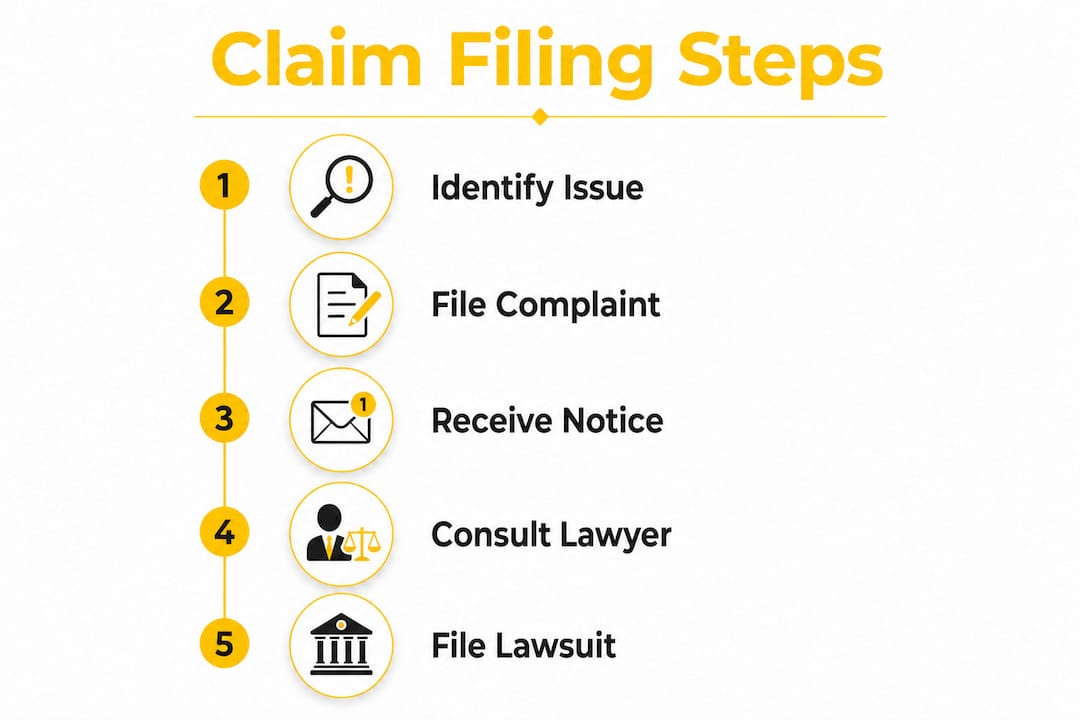
Filing a complaint correctly and on time is the single most important step after a wrongful termination. Here is the process for Lake Forest employees:
Pro Tip: The CRD calculates your filing deadline from the last discriminatory act, not the first. If your employer harassed you for six months before firing you, the timeline starts from the most recent harmful event. Map your timeline carefully before filing.
A common mistake Lake Forest employees make is waiting too long after receiving a Right-to-Sue notice before consulting a lawyer. The notice arrives and feels like a victory. It is actually the start of a countdown.
Deadlines in employment law are absolute. Missing one does not delay your case. It ends it permanently. The table below maps the critical timelines for Lake Forest employees pursuing claims under both California and federal law.
| Deadline | California FEHA | Federal (EEOC/Title VII) |
|---|---|---|
| File complaint with agency | 3 years from last discriminatory act | 300 days in California (deferral state) |
| File lawsuit after Right-to-Sue | 1 year from CRD notice | 90 days from EEOC notice |
| Consequence of missing deadline | FEHA claim permanently barred | Federal claim permanently barred |
The contrast between the one-year FEHA window and the 90-day federal window is significant. A Lake Forest employee who receives both a CRD Right-to-Sue notice and an EEOC Right-to-Sue notice on the same day has 90 days to file the federal lawsuit and one year to file the state lawsuit. These are two separate lawsuits with two separate clocks running simultaneously.
Pro Tip: The moment you receive your CRD Right-to-Sue notice, add the one-year deadline to your calendar immediately. Docketing this date is one of the most important steps you can take to preserve your claim.
Missing the one-year court filing deadline after a Right-to-Sue notice is one of the most common and fatal procedural mistakes in California employment law. Courts do not grant extensions for this deadline based on ignorance of the law. The only way to protect yourself is to act quickly and work with an attorney who tracks these dates as a matter of routine.
A successful wrongful termination or discrimination claim under FEHA or federal law can produce substantial relief. FEHA damages include compensatory damages, punitive damages, reinstatement, and attorney’s fees. Here is what each category means in practice:
Settlement is the most common outcome. Most wrongful termination cases in California resolve before trial, often through mediation. The strength of your evidence, the size of your employer, and the clarity of the legal violation all affect settlement value. Optimum Employment Lawyers has secured results including a $2.2 million class action settlement for missed meal breaks, which demonstrates what aggressive, employee-focused representation can achieve for Orange County workers.
California employees in Lake Forest, CA have strong legal protections against wrongful termination and discrimination under FEHA, and missing the one-year lawsuit filing deadline after a Right-to-Sue notice permanently bars those claims.
| Point | Details |
|---|---|
| FEHA covers more than federal law | California law reaches more employers and protected classes than Title VII or the ADA alone. |
| Deadlines are absolute | You have 1 year after a CRD Right-to-Sue notice and only 90 days after an EEOC notice to file suit. |
| Immediate Right-to-Sue is strategic | Requesting it at filing generates a notice within 24 hours, letting you skip the agency investigation. |
| Remedies include punitive damages | FEHA allows lost wages, emotional distress, punitive damages, and attorney’s fees for prevailing employees. |
| Document before you file | Emails, performance reviews, and witness names are the foundation of any successful claim. |
After working with employees across Orange County, the pattern I see most often in Lake Forest cases is not a lack of legal merit. It is a lack of urgency. Employees spend weeks or months trying to resolve things internally, through HR, through a manager’s manager, through a company ombudsman. By the time they call an attorney, they have sometimes burned through a significant portion of their filing window.
HR departments work for the employer. That is not cynicism. It is their legal and structural role. When you report discrimination to HR, you are creating a record, which can help your case, but you are not triggering any legal protection that stops the clock. The CRD and EEOC deadlines run from the discriminatory act regardless of what HR does or says afterward.
The other mistake I see consistently is undervaluing the immediate Right-to-Sue option. Many employees assume the CRD investigation will validate their claim and strengthen their position. In reality, the investigation can take months or years, and the outcome does not bind a court. For most employees with a clear factual record, requesting the immediate Right-to-Sue notice and moving directly to litigation is the faster and more effective path.
Lake Forest is a mid-size city with a mix of corporate employers, small businesses, and public-sector jobs. The legal standards are the same regardless of employer size, but the practical dynamics of settlement and litigation differ. A large corporation with in-house counsel will respond differently to a complaint than a 20-person company. Knowing how to calibrate your strategy to your specific employer is where experienced legal representation makes the biggest difference.
If you are a Lake Forest employee facing wrongful termination or workplace discrimination, Optimum Employment Lawyers focuses exclusively on the employee side of California employment law. The firm handles wrongful termination, discrimination, harassment, retaliation, and wage disputes for workers throughout Orange County. Their Lake Forest employment attorneys understand the local employer landscape and the specific procedural requirements under FEHA and federal law. Early consultation protects your deadlines and your options. Visit Optimum Employment Lawyers to schedule a free case evaluation and find out exactly what your claim may be worth.
Wrongful termination means your employer fired you for an illegal reason, such as discrimination based on race, gender, age, disability, or religion, or in retaliation for reporting illegal conduct. California’s at-will employment rule does not protect employers who violate FEHA or federal statutes.
You have three years from the last discriminatory act to file a complaint with the CRD under FEHA. After receiving a Right-to-Sue notice, you have one year to file a lawsuit in California Superior Court.
Yes. California employees can pursue claims under both FEHA and federal law simultaneously. The EEOC filing deadline in California is 300 days from the discriminatory act, and you have 90 days after an EEOC Right-to-Sue notice to file a federal lawsuit.
FEHA allows recovery of lost wages, emotional distress damages, punitive damages when employer conduct was malicious, and attorney’s fees. The full range of remedies also includes reinstatement and injunctive relief in appropriate cases.
You are not legally required to have an attorney, but the procedural complexity of dual-filing, tracking multiple deadlines, and building a damages case makes legal representation strongly advisable. Missing one deadline permanently bars your claim with no exceptions.

© 2026 Optimum Employment Lawyers, PC
Legal Disclaimer | Privacy Policy
 Share
Share
