
(949) 954-8181 Free Case Review No recovery, no fee.
(949) 954-8181 Free Case Review No recovery, no fee.
If you work in Newport Beach, California, and you have been fired without a clear reason, passed over for a promotion because of your background, or short-changed on your paycheck, you likely have more legal options than you think. Too many employees in this city quietly absorb the impact of wrongful termination, workplace discrimination, or unpaid wages because they assume California’s at-will employment rules leave them without recourse. That assumption is wrong, and this guide will show you exactly where those rights live, how to protect them, and when to bring in a lawyer.
| Point | Details |
|---|---|
| At-will has real limits | California’s at-will rule has significant exceptions protecting you from retaliatory or discriminatory firing. |
| Deadlines are unforgiving | Statutes of limitations range from 6 months to 3 years depending on your claim type, so act early. |
| Documentation changes outcomes | Written internal complaints create legal evidence of protected activity that can anchor your entire case. |
| Wage claims have a fast track | Small Claims Court resolves unpaid wage disputes under $12,500 significantly faster than administrative hearings. |
| Free legal help is available | Newport Beach employees can access free consultations with employment attorneys before committing to legal action. |
Many employees believe that because California is an at-will employment state, their employer can fire them for any reason at any time. The full picture is far more complicated. California Labor Code § 2922 establishes the at-will rule, but decades of legislation and court decisions have carved out wide exceptions that protect employees across Newport Beach and all of Orange County.
The most commonly recognized grounds for wrongful termination claims in California include:
Newport Beach employers in sectors like finance, real estate, and hospitality frequently face claims from employees who were pushed out after raising internal concerns. The key question is not just why you were fired, but whether a protected activity played any part in the decision. California courts use a “mixed motive” analysis, meaning even partial motivation based on a protected activity can establish liability.
Pro Tip: If you suspect retaliation, send a written complaint to HR before any termination occurs. This creates a formal record that links your protected activity to your employer’s subsequent actions, which is exactly the kind of evidence that supports a wrongful termination claim.
Newport Beach has a highly diverse workforce, from tourism and food service workers to financial professionals in the corporate corridors near Fashion Island. All of them are covered under California’s FEHA, which is broader than federal civil rights law and offers stronger protections for more people.

FEHA prohibits discrimination based on race, gender, sexual orientation, gender identity, age (40 and over), disability, religion, pregnancy, national origin, genetic information, and several other characteristics. Harassment based on any of these categories is also actionable, and California holds employers strictly liable when supervisors harass subordinates.
When you experience discrimination or harassment, the first step is to document everything carefully. Write down dates, times, what was said, who witnessed it, and how it affected your work. Keep copies of all written communications, including texts and emails, in a personal location outside of your work device. The next step is filing a complaint with the California Civil Rights Department (CRD), which enforces FEHA.
FEHA complaints must be filed within three years of the last act of harassment or discrimination. Once the CRD issues a right-to-sue notice, you have one year to file a lawsuit in civil court. Missing either deadline permanently bars your claim, regardless of how strong the underlying facts are.
Pro Tip: Filing an internal complaint with HR before going to the CRD is not just good practice. An employer’s failure to respond or investigate your complaint can itself serve as evidence of a hostile work environment, which strengthens your case considerably.
Wage theft is far more common in Newport Beach than most people realize. Employers in restaurants along Pacific Coast Highway, retail stores near Balboa Island, and white-collar offices in the Newport Center area have all faced wage and hour violations. Common issues include unpaid overtime, missed meal and rest breaks, failure to pay final wages on time, and unauthorized paycheck deductions.
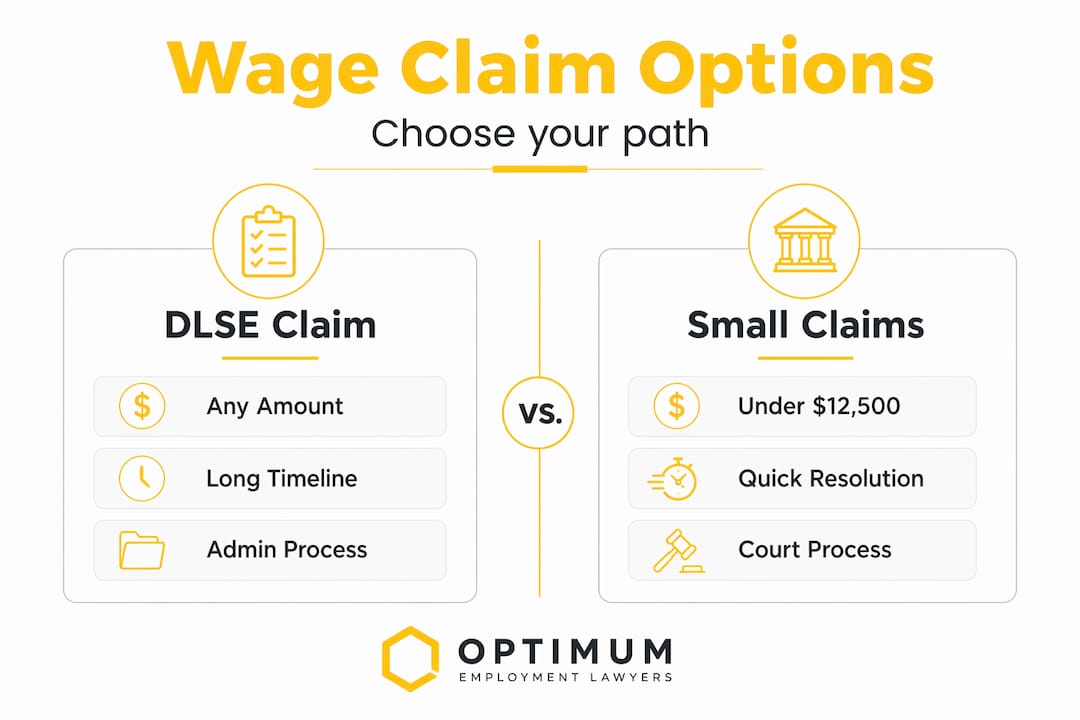
When you have a wage dispute, you generally have two paths: filing a claim with the California Labor Commissioner (the Division of Labor Standards Enforcement, or DLSE) or taking your employer to Small Claims Court.
| Factor | DLSE Administrative Claim | Small Claims Court |
|---|---|---|
| Best for | Claims of any dollar amount | Claims under $12,500 |
| Timeline | 6 to 18 months for a hearing | 20 to 70 days for a hearing |
| Cost | Low filing fees | Low filing fees |
| Enforcement power | Stronger, including license actions | Limited enforcement tools |
| Legal representation | Optional | Optional (attorneys generally not allowed) |
For smaller disputes, Small Claims Court is often faster and more practical than waiting over a year for an administrative hearing. Employees often wait for the DLSE process to run its course when they could have resolved their dispute in weeks through Small Claims.
The stakes in wage cases are real. Under Labor Code §§ 201 and 202, if your employer fails to pay your final wages on time after termination, waiting time penalties accrue at your daily wage rate for up to 30 days. On a $25 per hour salary working 8-hour days, that penalty alone could reach $6,000.
Critical documents to gather before filing any wage claim include:
Timing is one of the most decisive factors in any employment law case. California has different statutes of limitations depending on the type of claim you are pursuing, and missing these deadlines bars your claim permanently. Courts do not typically grant exceptions for employees who acted in good faith but filed too late.
Here is a clear look at the key deadlines Newport Beach employees need to know:
The discovery rule can extend some deadlines. If you did not know and reasonably could not have known about the violation, the clock may start later. The continuing violation doctrine can also extend FEHA timelines if the discriminatory conduct formed part of an ongoing pattern rather than isolated incidents.
Evidence preservation matters just as much as timing. Written complaints to HR or supervisors create documented proof of protected activity. Back up all relevant files, emails, and messages to a personal device or cloud account immediately, since access to work systems typically ends on your last day.
Pro Tip: Keep a personal employment journal on your phone or a private email account. Log incidents with dates, names, and direct quotes. Contemporaneous notes carry significant evidentiary weight and are far more credible than recollections made months later during litigation.
Knowing your rights is step one. Connecting with the right legal help is step two. Newport Beach employees have access to employment attorneys in Orange County who specialize exclusively in employee-side cases. An experienced attorney can assess whether your situation meets the legal threshold for a viable claim before you invest time or money.
Here is what to expect when seeking legal help:
If you are still employed and experiencing ongoing issues, consulting a lawyer before you take any formal action is especially critical. An attorney can help you document properly, communicate strategically, and avoid missteps that could undermine a future claim.
I’ve worked with employees across Orange County for years, and the single biggest mistake I see Newport Beach workers make is waiting. Waiting to see if things improve. Waiting to feel certain. Waiting for someone to tell them they have a “good enough” case. By the time many people reach an attorney, they have already lost evidence, missed deadlines, or responded to their employer in ways that complicate their legal position.
Newport Beach has a particular dynamic worth understanding. The city’s economy skews toward high-income industries where employers are well-resourced and often aggressive about protecting their own interests. A financial services firm or luxury hospitality employer near Fashion Island is not going to respond to a wage complaint with an apology. They will call their lawyers. You should consider doing the same.
What I’ve also found is that employees consistently underestimate the value of the internal paper trail. Filing a written complaint with your HR department, even if you expect it to be ignored, is not a futile act. It is a legal move. It creates the protected activity record that makes retaliation claims viable. Employers who dismiss or retaliate after receiving written internal complaints expose themselves to significantly stronger legal liability.
The uncomfortable truth is that employment law does not reward patience. It rewards preparation and speed. If you believe your employer has wronged you, the best thing you can do is document everything today, consult a qualified Newport Beach employment attorney this week, and make decisions based on real legal advice rather than assumptions.
If you are a Newport Beach employee dealing with wrongful termination, workplace discrimination, or unpaid wages, Optimum Employment Lawyers is ready to hear your story. They focus exclusively on employee-side cases across California, which means they know how to take on well-funded employers and win. Their track record includes a $2.2 million class action settlement for missed meal breaks, demonstrating what focused, employee-centered legal strategy can achieve.
You can explore their Newport Beach legal services or learn more about specific claims through their dedicated wage and hour violations and workplace discrimination pages. A free consultation is your first step toward knowing exactly where you stand.
Wrongful termination in California occurs when an employer fires an employee in violation of state law, public policy, or an implied contract. Common examples include firing someone for reporting harassment, taking protected medical leave, or refusing to commit an illegal act.
You have three years from the last discriminatory act to file a complaint with California’s Civil Rights Department. Once you receive a right-to-sue notice, you have one additional year to file a lawsuit in civil court.
Yes. If your unpaid wage claim is under $12,500, Small Claims Court in California is a legitimate and often faster option, with hearings typically scheduled within 20 to 70 days.
Preserve all evidence right away, including emails, pay stubs, and written communications. Then send a written record to HR if you have not already, and consult a Newport Beach employment attorney as soon as possible to protect your claim deadlines.
Most employee-side employment lawyers offer free initial consultations and take cases on a contingency fee basis, meaning you pay only if you recover compensation.

© 2026 Optimum Employment Lawyers, PC
Legal Disclaimer | Privacy Policy
 Share
Share
