
(949) 954-8181 Free Case Review No recovery, no fee.
(949) 954-8181 Free Case Review No recovery, no fee.
If you work in Santa Ana, California, and your employer has fired you, shorted your paycheck, or treated you unfairly because of your race, gender, age, or disability, you have legal rights worth protecting. The problem is that most employees in Santa Ana don’t act on those rights in time. California has some of the strongest worker protections in the country, but those protections expire if you miss strict deadlines. This guide breaks down exactly what you need to know about wrongful termination, wage theft, and workplace discrimination so you can take the right steps before the clock runs out.
| Point | Details |
|---|---|
| California has multiple deadlines | Seven separate statutes of limitations govern wrongful termination claims, each starting on a different date. |
| FEHA filing is mandatory first | You must file with the CRD within three years before you can sue for discrimination or retaliation in California. |
| Wage theft is recoverable | Unpaid overtime, missed breaks, and off-the-clock work are all legally recoverable through the California Labor Commissioner. |
| Workers’ comp claims are separate | Retaliation for a workplace injury is a different legal track with its own one-year deadline and filing process. |
| Early legal help protects your rights | Consulting a Santa Ana employment attorney early prevents costly procedural mistakes that can kill valid claims. |
California gives workers more legal protection than almost any other state, and those protections apply fully to employees in Santa Ana. Two legal frameworks form the foundation of your rights.
The California Fair Employment and Housing Act, known as FEHA, prohibits employers with five or more employees from discriminating against workers based on race, color, religion, sex, national origin, disability, age, pregnancy, sexual orientation, gender identity, and several other protected characteristics. Federal law adds another layer. Title VII of the Civil Rights Act covers employers with 15 or more employees, and the Americans with Disabilities Act protects workers with qualifying disabilities from companies of the same size.
On the wage side, California law requires employers to pay at least the state minimum wage, pay overtime at 1.5 times the regular rate for hours over eight in a single day or 40 in a week, and provide mandatory meal and rest breaks. Violating any of these rules is wage theft, and it is illegal.
Common forms of wrongful termination in Santa Ana workplaces include:
Pro Tip: Keep copies of your pay stubs, performance reviews, and any written communication with your employer. This documentation becomes critical evidence if you ever need to file a claim.
California is an at-will employment state, which means an employer can generally fire you for any reason or no reason at all. But “at-will” has significant exceptions, and those exceptions are where wrongful termination claims live.

You have a wrongful termination claim when your employer fires you for an illegal reason. The most common scenarios Santa Ana employees face include termination after reporting a workplace injury, firing tied to a discrimination complaint, and retaliation for blowing the whistle on fraud or safety violations. In one well-known California case, a warehouse worker was terminated within weeks of filing a workers’ compensation claim. The timing alone raised enough suspicion to support a retaliation claim under Labor Code §132a.
Here is how the claim process typically works for wrongful termination in California:
The WCAB office in Santa Ana is located at 2 MacArthur Place, Suite 300, Santa Ana, CA 92707. Workers’ compensation retaliation claims under Labor Code §132a have a one-year filing deadline and are entirely separate from civil wrongful termination lawsuits.
Pro Tip: Do not assume your workers’ compensation attorney is also handling your wrongful termination claim. These are two separate legal tracks that require separate filings and often separate attorneys.
| Claim type | Filing body | Deadline |
|---|---|---|
| FEHA discrimination/retaliation | California CRD | 3 years from violation |
| Workers’ comp retaliation (§132a) | WCAB | 1 year from violation |
| Civil wrongful termination lawsuit | Superior Court | 1 year from right-to-sue notice |
| Breach of contract | Superior Court | 2 to 4 years depending on contract type |
Wrongful termination claims in California often involve multiple overlapping legal theories, which means missing one deadline can cost you an entire category of recovery even if other claims survive.
Wage theft is one of the most widespread yet underreported employment violations in Santa Ana. Many workers don’t realize they’re being stolen from because the violations are built into everyday work routines.
The most common forms of wage theft Santa Ana employees experience include:
To recover stolen wages, you can file a wage claim with the California Labor Commissioner’s Office, also known as the Division of Labor Standards Enforcement. The process is free, and you do not need an attorney to file, though having one significantly increases your recovery. You can also file a civil lawsuit to recover unpaid wages, interest, and civil penalties. Class action cases involving wage theft can produce substantial results. Optimum Employment Lawyers secured a $2.2 million settlement in a class action case involving missed meal breaks, which is exactly the kind of violation that many Santa Ana employees experience without realizing it is compensable.
For detailed guidance on wage and hour violations, including how to calculate what you’re owed, speaking with an employment attorney early makes a real difference in your outcome.
Workplace discrimination in Santa Ana is prohibited under both California and federal law, covering a broad range of protected characteristics. If your employer treats you worse than similarly situated coworkers because of who you are, that is discrimination. If a supervisor or coworker creates a hostile work environment based on a protected characteristic, that is harassment.
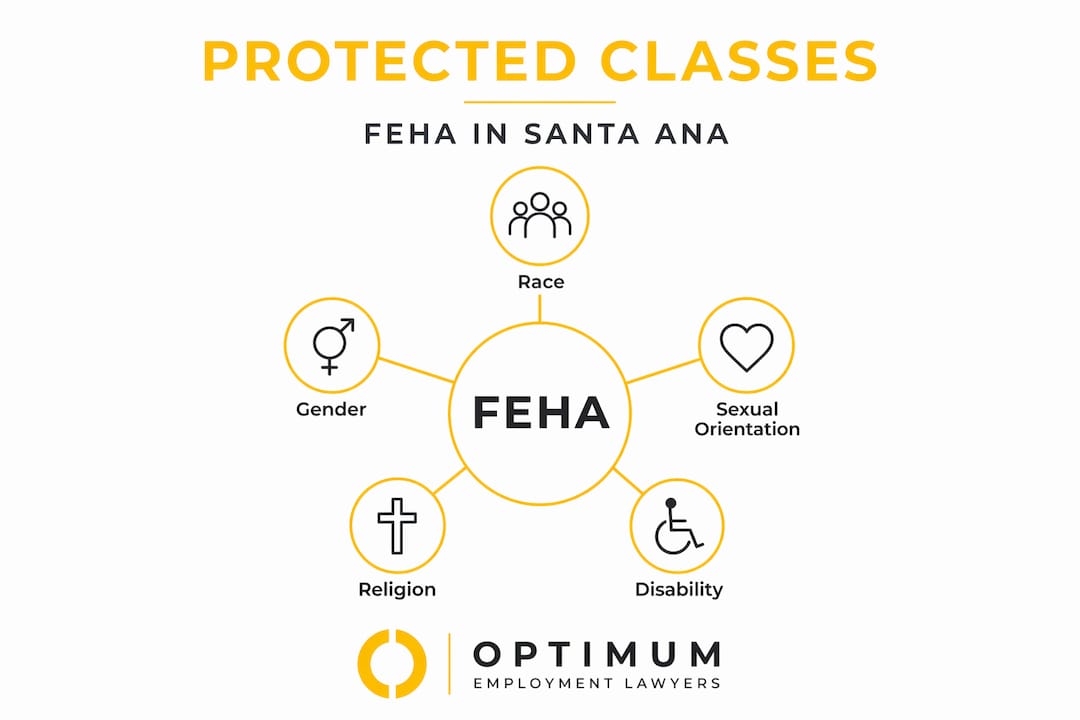
Protected classes under FEHA include race, color, national origin, religion, sex, gender identity, sexual orientation, marital status, disability, age (40 and over), pregnancy, and military status. Federal law under Title VII and the ADA covers overlapping but not identical categories.
Before you can file a federal discrimination lawsuit, filing an EEOC charge is a required prerequisite. In California, which is a deferral state, you have 300 days from the discriminatory act to file with the EEOC. For state claims under FEHA, filing with the CRD within three years is mandatory before you can sue in civil court. This three-year window was expanded from one year by AB 9, which took effect January 1, 2020.
Practical steps to protect your discrimination claim:
Pro Tip: Missing the CRD filing deadline or the subsequent right-to-sue deadline can end a discrimination case even when the underlying conduct is clearly unlawful. Set a calendar reminder the day the discriminatory act occurs.
| Filing body | Deadline | Purpose |
|---|---|---|
| California CRD | 3 years from violation | Required before state civil lawsuit |
| EEOC | 300 days from violation | Required before federal civil lawsuit |
| Civil court (state) | 1 year from right-to-sue notice | Actual lawsuit filing |
| Civil court (federal) | 90 days from EEOC right-to-sue | Federal Title VII lawsuit |
For dedicated discrimination legal representation in Santa Ana and surrounding Orange County, working with attorneys who focus exclusively on the employee side gives you a real advantage.
California has seven separate statute of limitations clocks for wrongful termination claims alone, each starting on a different date and governed by a different code section. This complexity trips up employees and even some attorneys who don’t practice employment law regularly.
Here are the immediate steps to take after wrongful treatment or termination:
Two doctrines can sometimes extend your filing window. Equitable tolling applies when an employee was prevented from filing through no fault of their own. The discovery rule applies when the employee only learned of the discriminatory or retaliatory act after the fact. Neither doctrine is guaranteed, and you should not count on them as a backup plan.
“The biggest mistake employees make is waiting. They think they have time to figure things out, and by the time they call an attorney, a critical deadline has already passed. In Santa Ana, with multiple administrative bodies and overlapping deadlines, the window closes faster than most people expect.”
I’ve seen employees in Santa Ana lose winnable cases for one reason: they didn’t know the clock was running. By the time they called for help, the CRD deadline had passed, or the right-to-sue notice had expired. The law was on their side, but the calendar wasn’t.
What I’ve learned from years of working employment cases is that the workers’ compensation and wrongful termination overlap is the most dangerous blind spot. Employees injured on the job often focus entirely on their workers’ comp claim and don’t realize their employer’s retaliatory firing is a separate civil matter with its own timeline. These are concurrent claims that require separate filings, and missing one means leaving real money and justice on the table.
I’ve also noticed a pattern in how employers in Santa Ana handle these situations. They delay. They request documentation, schedule meetings, and offer vague reassurances while the administrative deadlines tick down. Don’t let that happen to you. The moment you suspect something is wrong, get a legal opinion. You don’t have to file a lawsuit on day one. But you do need to know your deadlines.
If you’re a Santa Ana employee dealing with wrongful termination, unpaid wages, or workplace discrimination, Employees-lawyer is built specifically for situations like yours. Optimum Employment Lawyers represents only employees, never employers, which means every strategy they develop is designed to get you the best possible outcome. Their track record includes a $2.2 million class action settlement for wage violations and significant individual recoveries for wrongful termination and discrimination clients across Orange County.
Whether you need help with a wrongful termination claim or want to understand your options before taking action, the team at Optimum Employment Lawyers offers consultations focused on your specific situation. Don’t wait until a deadline passes. Reach out to Santa Ana’s employee-side legal advocates today.
Wrongful termination occurs when an employer fires you for an illegal reason, such as discrimination, retaliation for filing a workers’ comp claim, or whistleblowing. California’s at-will employment rule does not protect employers who terminate workers for reasons that violate state or federal law.
You have three years to file a complaint with the California Civil Rights Department under FEHA, and 300 days to file with the EEOC for federal claims. Missing either deadline can permanently bar your right to sue, even if the discrimination was clear and well-documented.
You can recover unpaid overtime, missed meal and rest break premiums, off-the-clock work pay, and penalties for misclassification. California law also allows recovery of interest and attorney’s fees in successful wage claims.
No. Workers’ compensation retaliation claims are filed with the WCAB under Labor Code §132a and have a one-year deadline. Civil wrongful termination claims are filed separately in Superior Court. Many Santa Ana employees need to pursue both simultaneously.
Document everything in writing, secure copies of your employment records and communications, and contact a Santa Ana employment attorney within 30 days. The lawsuit deadlines in California vary by claim type, and getting a deadline assessment early is the single most important step you can take.

© 2026 Optimum Employment Lawyers, PC
Legal Disclaimer | Privacy Policy
 Share
Share
