
(949) 954-8181 Free Case Review No recovery, no fee.
(949) 954-8181 Free Case Review No recovery, no fee.


Most employees in Irvine receive a job offer, feel the pressure to sign quickly, and miss the window where they actually hold the most power. Learning to negotiate employment contract terms before you sign is one of the highest-leverage moves you can make for your career and your legal protections. California law gives you more rights than most states, including strong restrictions on non-compete clauses, but those rights only help you if you know how to use them. This guide walks you through exactly what to negotiate, when to do it, and how to protect yourself under California law.
| Point | Details |
|---|---|
| Timing is everything | Your leverage peaks after receiving a written offer and before you sign. |
| Non-competes are largely void | California Business & Professions Code §16600 makes most non-compete clauses unenforceable. |
| Get everything in writing | Integration clauses make verbal promises unenforceable, so insist on a revised written offer. |
| Prioritize 2 to 4 key asks | Focus your negotiation on the terms that matter most to your career and financial security. |
| Legal review pays off | Complex or high-stakes contracts benefit significantly from professional employment contract review. |
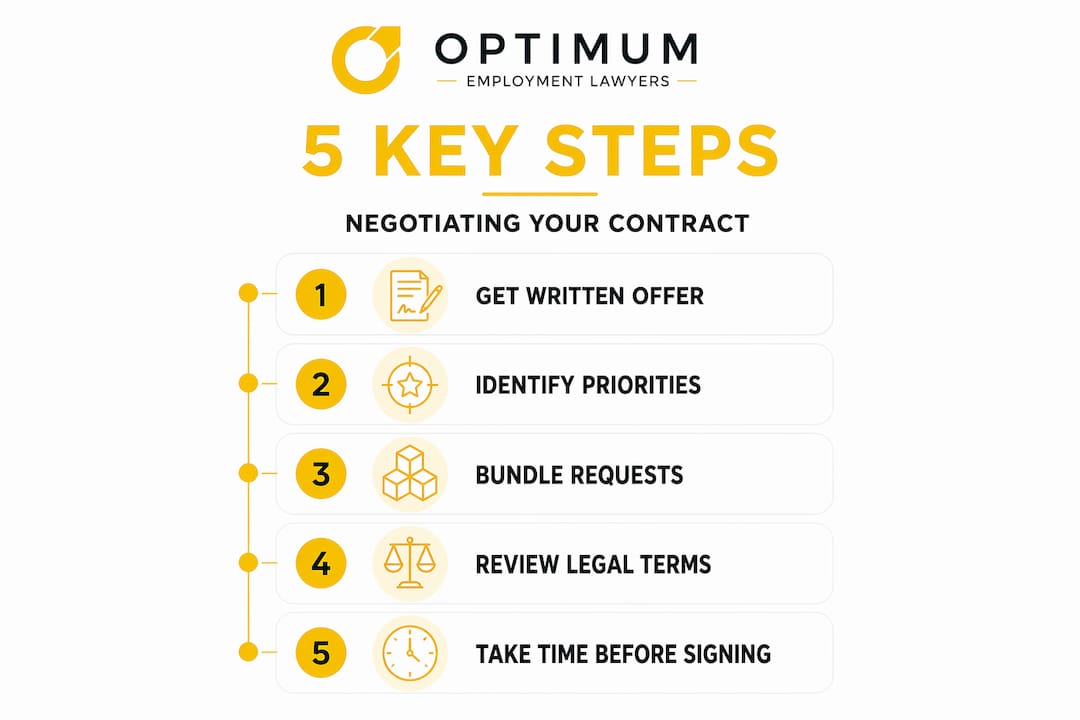
Your leverage peaks after receiving a written offer and before you sign. That window, often just a few days, is when the employer wants you most and has committed the least. Do not negotiate during interviews. Do not wait until after you have signed. Both mistakes cost you real power.
If an employer extends only a verbal offer, ask for it in writing before you respond. You cannot negotiate what you cannot read, and verbal offers give you nothing to push back against in a structured way.
Once you have the written offer, build your prioritized ask list. Focus on 2 to 4 key items. Asking for 10 changes signals inexperience and dilutes your strongest points. Think about what matters most: salary, remote work flexibility, severance protection, equity vesting, or the removal of a problematic restrictive covenant.
Here is how to prepare effectively before your employment terms discussion:
Pro Tip: Bundle all your requests into a single counteroffer email. A single comprehensive counteroffer is more efficient and produces better outcomes than sending scattered requests over multiple messages.
Most employees focus entirely on salary. That is understandable, but it leaves significant value on the table. Here is a breakdown of what is typically negotiable versus what is not for California employees.

| Negotiable Terms | Typically Non-Negotiable |
|---|---|
| Base salary and signing bonus | Standard company benefits structure |
| Equity vesting schedule | Legally required withholding |
| Remote or hybrid work arrangements | At-will employment status (in most cases) |
| Severance terms and notice periods | Core job responsibilities |
| Non-compete and confidentiality scope | Company-wide arbitration policies |
| Job title and reporting structure | Standard background check requirements |
Beyond salary, here are the terms worth your attention during any employment agreement negotiation:
Pro Tip: When negotiating sensitive clauses like arbitration or confidentiality, frame your request around clarity rather than opposition. Say “I’d like to narrow this to specifically defined trade secrets” rather than “I want to remove this clause.”
Understanding contract terms means reading beyond the compensation section. Many employees sign agreements with provisions that create serious legal exposure, and they only discover the problem after a dispute arises.
Watch out for these specific traps:
Pro Tip: Use a contract checklist when reviewing any offer. Reviewing all contract terms including restrictive covenants, arbitration, and termination clauses, not just salary, is what separates employees who protect themselves from those who don’t.
Respond to any offer within 24 to 72 hours. This signals genuine interest and gives the impression of thoughtful review rather than desperation or indifference. Your tone throughout should be collaborative. You are not fighting the employer. You are building a working relationship on clear terms.
Here is the step-by-step process from offer receipt to signing:
Having a credible alternative reduces pressure in negotiation and leads to better outcomes. If you have another offer or are currently employed, use that position. If you don’t, mentally commit to a minimum acceptable package before you begin.
One more thing worth knowing: employers rarely rescind offers because of polite, professional negotiation. If an employer pulls an offer because you asked reasonable questions, that tells you something important about how they treat employees.
Pro Tip: Never sign a contract the same day you receive a revised offer. Give yourself at least one night to review it carefully against your negotiation notes.
California is one of the strongest states in the country for employee mobility, and that matters directly to how you negotiate your contract. California Business & Professions Code §16600 broadly prohibits non-compete clauses in employment agreements, with only narrow exceptions.
Recent legislation has strengthened this even further:
The right approach is to push for narrowly tailored trade-secret protections rather than accepting broad post-employment restrictions. A well-drafted confidentiality clause protects the employer’s legitimate interests without limiting your career. If an employer insists on language that functions like a non-compete, that is a red flag worth taking seriously.
If you are presented with a contract in Irvine or anywhere in Orange County that includes non-compete language, you have legal grounds to push back. You can say directly: “Under California Business & Professions Code §16600, this provision is void. I’d like to replace it with a narrowly scoped trade-secret confidentiality clause.”
I’ve worked with employees across Orange County for years, and the pattern I see most often is this: talented professionals undersell themselves not because they lack leverage, but because they don’t realize they have any.
The written offer is your moment. Once you sign, your options narrow considerably. I’ve seen employees in Irvine accept non-solicitation clauses that effectively locked them out of their industry for two years, only to learn later that those clauses were almost certainly void under California law. They signed because they felt pressure to respond quickly and didn’t want to seem difficult.
What I’ve learned is that employers who pressure you to sign immediately are often the ones whose contracts need the most scrutiny. A legitimate employer gives you time to review. Resistance to reasonable questions about contract language is itself a data point about how that employer will treat disputes down the road.
The other thing I’d push back on is the idea that negotiating benefits or severance is somehow less professional than negotiating salary. In my experience, negotiating termination protections is often more valuable than a few thousand dollars in base pay. Knowing you have wrongful termination protections built into your contract changes your entire relationship with the job.
When the stakes are high, get a lawyer involved before you sign. Not after a dispute arises. Before.
Reviewing a complex employment contract on your own is possible, but high-stakes offers with equity, arbitration clauses, restrictive covenants, or executive compensation deserve professional eyes. The Optimum Employment Lawyers team at Employees-lawyer.com focuses exclusively on employee-side cases throughout California, including Orange County cities like Irvine, Newport Beach, and Santa Ana.
The firm has secured significant results for employees, including a $2.2 million class action settlement for missed meal breaks. That track record reflects a deep understanding of how California employment law works in practice, not just on paper. Whether you need a full employment contract review before signing, guidance on pushing back against unlawful non-compete language, or help negotiating severance terms, the firm offers the kind of focused representation that makes a real difference. Contact Optimum Employment Lawyers early in your negotiation process, before you sign anything, for the best possible outcome.
Your best leverage comes after receiving a written job offer and before signing. Negotiating during interviews or after you have signed significantly reduces your options.
No. California Business & Professions Code §16600 makes most non-compete clauses void, and AB 1076 (effective January 1, 2024) added civil penalties for employers who include them.
Salary, signing bonuses, equity vesting, remote work arrangements, severance terms, notice periods, job titles, and the scope of confidentiality clauses are all commonly negotiable.
Integration clauses in most employment contracts make verbal promises legally unenforceable. Always insist on a revised written offer that reflects every agreed change before signing.
For complex offers involving equity, arbitration clauses, or restrictive covenants, professional legal review before signing is worth the cost and can prevent significant problems later.

© 2026 Optimum Employment Lawyers, PC
Legal Disclaimer | Privacy Policy
 Share
Share
