
(949) 954-8181 Free Case Review No recovery, no fee.
(949) 954-8181 Free Case Review No recovery, no fee.
Most employees assume retaliation means getting fired after filing a complaint. That assumption costs people their cases every day. Discrimination retaliation explained properly covers a far wider range of employer actions, from sudden schedule changes and exclusion from meetings to manufactured performance reviews and hostile supervision. If you work in Irvine, Orange, or anywhere in Orange County and you have reported discrimination or participated in a workplace investigation, what happens next to your job could be retaliation under California law. This article breaks down exactly what qualifies, how to prove it, and what to do about it.
| Point | Details |
|---|---|
| Retaliation goes beyond firing | Demotions, schedule shifts, exclusion, and hostile treatment all qualify as adverse actions under California law. |
| Protected activity triggers protection | Filing complaints, participating in investigations, or requesting accommodations all count as protected activities. |
| FEHA has strict deadlines | You must file a CRD complaint within three years and then file suit within one year of receiving your right-to-sue notice. |
| Documentation is your foundation | Recording dates, witnesses, and incident details early creates the evidence chain that wins retaliation cases. |
| Retaliation claims stand alone | You can win a retaliation claim even if the underlying discrimination claim is not proven successful. |
Understanding retaliation laws starts with two concepts: protected activity and adverse action. If you engaged in a protected activity and your employer responded with a materially adverse action, and there is a causal connection between the two, you have the foundation of a retaliation claim under California’s Fair Employment and Housing Act (FEHA) or federal law.
Protected activities are broader than most employees realize. Under multiple federal statutes, protected activities include:
Federal law draws a sharp distinction between opposition and participation. Participation protection is absolute, meaning you are protected regardless of whether the underlying complaint had merit. Opposition protection requires that you had a good-faith, reasonable belief the conduct you opposed was actually unlawful.
Adverse actions under California law are intentionally broad. Courts apply a standard asking whether the employer’s action would dissuade a reasonable employee from making or supporting a discrimination complaint. Material adversity includes termination, demotion, pay cuts, schedule manipulation, hostile supervision, exclusion from projects, and negative performance reviews that appear only after a complaint. Minor criticisms or isolated personality conflicts do not meet this bar.
“The question is not whether the action hurt your feelings. The question is whether it would stop a reasonable person from ever complaining again.” This is the standard California courts apply when evaluating what is discrimination retaliation.
Pro Tip: Keep a running log of every workplace change that follows your complaint. Even a shift reassignment or a sudden exclusion from a team email thread can matter if it fits a pattern.
A common myth worth addressing: many employees believe that if their employer gives a neutral-sounding reason for the adverse action, the retaliation claim disappears. It does not. The employer’s stated reason becomes the starting point for a pretext analysis, not the ending point.

California gives employees two primary procedural paths, and choosing the right one matters enormously. The path depends on which statute your claim falls under.
For FEHA retaliation claims, the process follows a specific sequence:
For Labor Code § 1102.5 whistleblower claims, the path is different. These claims can be filed directly in Superior Court without going through the CRD at all, and the statute of limitations is three years under Code of Civil Procedure § 338. This path is often faster and avoids the administrative bottleneck entirely.
| Claim Type | Filing Body | Statute of Limitations | Court Filing |
|---|---|---|---|
| FEHA Retaliation | CRD (then Superior Court) | 3 years for CRD complaint, 1 year after right-to-sue | After right-to-sue notice |
| Labor Code § 1102.5 | Superior Court directly | 3 years | No CRD exhaustion required |
Choosing between these paths is not just a procedural question. It affects the burden of proof, available remedies, and litigation strategy. The right procedural path can mean the difference between a strong case and one that gets dismissed on technicalities.
Pro Tip: California employees often benefit from requesting a right-to-sue notice early rather than waiting for the CRD to complete its investigation. This preserves your one-year window to file in court without losing time.
If you are in Irvine or Orange and you are unsure which path applies to your situation, that is precisely the kind of question an employment attorney should answer before you take any formal steps. You can review California lawsuit deadlines to get a clearer picture of the timelines involved.
Winning a retaliation claim comes down to causation. You need to show that your protected activity caused the adverse action, not just that one followed the other. Courts look at several types of evidence to establish this link.
Timing is powerful but not enough on its own. Courts have found that temporal proximity as short as three weeks between a complaint and an adverse action can create an inference of retaliation. But employers know this. They often wait longer or manufacture a paper trail to create distance.
What actually wins cases is a combination of timing plus corroborating evidence. This includes:
Employer defenses and how they fall apart:
| Employer Defense | How It Gets Challenged |
|---|---|
| “We had a legitimate business reason” | Show the reason was not applied consistently or was invented after the complaint |
| “Performance was already declining” | Produce prior positive reviews and show the timing of the change |
| “The decision was made before the complaint” | Discovery often reveals documentation created or amended after the fact |
| “The decision-maker did not know about the complaint” | Depositions frequently reveal HR communications that contradict this |
Employers may create or amend documentation after complaints are filed. Discovery phases are where these inconsistencies surface. Depositions of HR personnel and direct supervisors regularly expose shifting explanations that undermine the employer’s defense entirely.
Pro Tip: Treat your documentation like an attorney would treat evidence. Every entry should include the date, the specific words used, who was present, and how the incident connects to your earlier complaint. This is what lawyers call evidence architecture.
One more point that trips up many employees: your retaliation claim does not require you to prove that the underlying discrimination actually occurred. Retaliation claims stand independently and can succeed even if the discrimination claim fails. This distinction matters enormously when building your legal strategy.
If you suspect retaliation is happening to you right now, the steps you take in the next few weeks can determine whether you have a winnable case. Employees in Irvine, Orange, Costa Mesa, and surrounding cities have access to strong California protections, but those protections only work if you activate them correctly.
Start with these steps:
Potential remedies in a successful California retaliation case include reinstatement to your position, back pay and front pay, compensatory damages for emotional distress, punitive damages in egregious cases, and attorney’s fees.
Pro Tip: Do not post about your situation on social media. Employers routinely monitor employee accounts during litigation, and a single post can be used to undermine your credibility or your damages claim.
Several misunderstandings stop employees from pursuing valid retaliation claims. Clearing them up can change how you see your situation.
Misconception 1: Retaliation only counts if you were fired. Courts recognize a broad range of materially adverse actions. Being reassigned to a less desirable shift, excluded from a key project, or given a negative review for the first time after years of positive evaluations all qualify. The legal standard is whether the action would deter a reasonable employee from complaining, not whether it ended your employment.
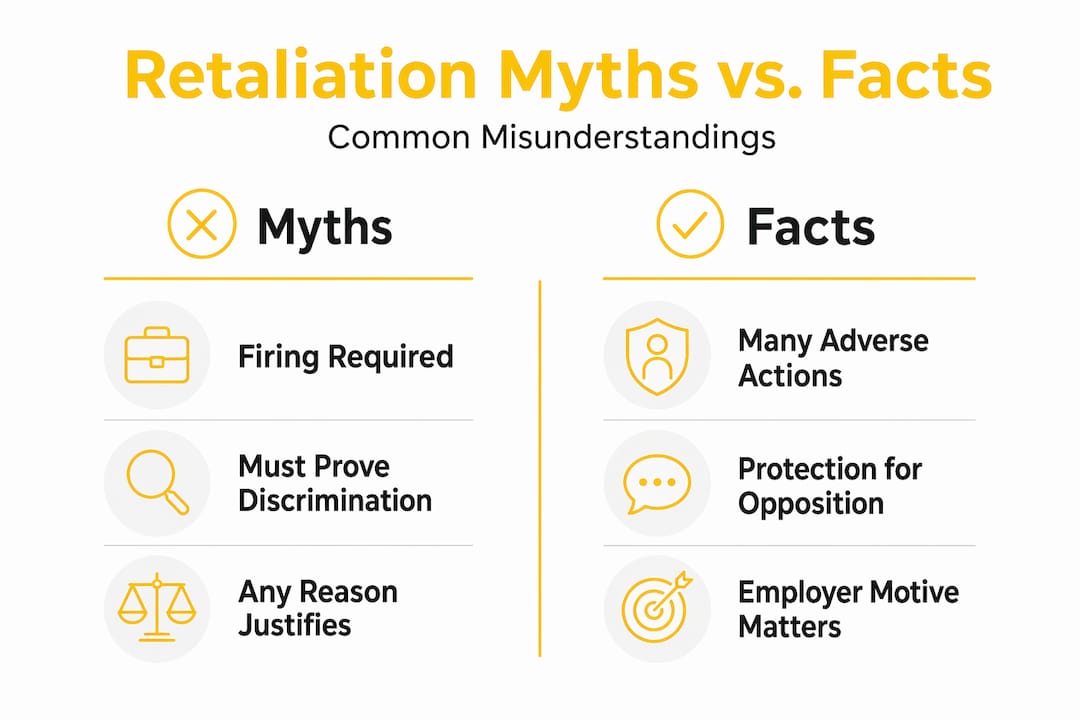
Misconception 2: You had to be right about the discrimination to be protected. Opposition protection covers you as long as you had a good-faith, reasonable belief the conduct was unlawful. You do not have to be proven correct.
Misconception 3: Only the person who complained is protected. California law also covers third-party retaliation. If your employer retaliates against your spouse, close colleague, or someone associated with your complaint, that can also be actionable. This is sometimes called associational retaliation.
Misconception 4: Public employees have the same process as private employees. Public employees often face additional procedural requirements, including specific administrative appeals before filing in court. If you work for a city, county, or state agency in Orange County, your path may look different.
Retaliation law in California is deliberately broad because the legislature recognized that narrow protections would simply push employers toward subtler forms of punishment. Understanding this breadth is what separates employees who protect themselves from those who unknowingly give up their rights.
You can learn more about how workplace discrimination intersects with retaliation to build a fuller picture of your rights.
I have seen employees walk into consultations with strong retaliation cases and walk out of settlements with nothing because they waited too long or signed the wrong document. The single biggest mistake I see is treating the early weeks after retaliation begins as a time to “see how things play out.” That window is when the most critical evidence is created, preserved, or lost.
Employers are not passive after a complaint is filed. They are often actively building a paper trail. I have watched companies manufacture performance improvement plans, create new attendance policies, and suddenly discover conduct that was ignored for years, all within weeks of a complaint. Discovery exposes this, but only if you have your own documentation to counter it.
The other reality most employees do not expect is the timeline. Fewer than 5% of cases reach a jury verdict. Most resolve at mediation or after discovery closes, often 18 to 30 months in. That is a long road emotionally and financially. Knowing this upfront helps you make smarter decisions about settlement versus litigation.
California is genuinely one of the strongest states in the country for employee retaliation protections. But those protections require you to act. Early legal consultation, disciplined documentation, and understanding the procedural paths available to you are what convert a valid grievance into a real outcome.
If you are facing retaliation in Irvine, Orange, or anywhere in Orange County, Optimum Employment Lawyers represents employees exclusively. The firm does not take employer-side cases. Every strategy is built around your situation, your timeline, and your goals. From the first consultation through filing and litigation, the team at Employees-lawyer has secured significant results for California employees, including a $2.2 million class action settlement. If you believe you are experiencing workplace retaliation or wrongful treatment after a discrimination complaint, contact Optimum Employment Lawyers for a case evaluation. You can also review your rights under California wrongful termination law to understand the full scope of your options.
Discrimination retaliation occurs when an employer takes a materially adverse action against an employee because that employee engaged in a protected activity, such as filing a discrimination complaint or participating in an investigation. California law under FEHA prohibits this conduct broadly.
For FEHA retaliation claims, you must file a complaint with the CRD within three years of the retaliatory act, then file suit within one year of receiving your right-to-sue notice. Labor Code § 1102.5 whistleblower claims allow direct court filing within three years.
Yes. Retaliation claims stand independently from the underlying discrimination claim. You do not need to prove the original discrimination occurred to succeed on a retaliation claim.
Strong evidence includes the timing between your complaint and the adverse action, supervisor statements referencing your complaint, sudden policy enforcement that never existed before, and performance reviews that changed dramatically after you complained. Documentation you create in real time carries significant weight.
No. Courts recognize a wide range of adverse actions beyond termination, including demotions, schedule changes, exclusion from projects, pay cuts, and hostile supervision. The legal standard is whether the action would deter a reasonable employee from making a complaint.

© 2026 Optimum Employment Lawyers, PC
Legal Disclaimer | Privacy Policy
 Share
Share
